
If you are asking what is a visor on a helmet, the answer is simpler than the jargon around it suggests. On a motorcycle helmet, the visor is the clear or tinted panel that covers the eye opening, hinges up and down, and keeps wind, rain, insects and road grit out of your eyes. In North America the same part is usually called a shield or face shield. This guide explains what the visor does, the parts it is made of, the types you will see, and how to find the right one for your own helmet.
Need a visor that fits your helmet?
Aftermarket visors matched to the exact helmet model.
The short answer: a helmet visor is the transparent shield across the front of a full-face, modular or open-face motorcycle helmet. It pivots on a mechanism at each side of the shell, closes against a rubber seal around the eyeport, and is usually made of polycarbonate. Visors come in clear, tinted, mirrored and light-reactive (photochromic) versions, and each one fits a specific helmet model, so you buy a replacement by helmet model or shield code, never by looks.
What is a visor on a helmet, in plain terms
A visor is the movable window of a motorcycle helmet. The shell and liner protect your head, the chin bar protects your jaw, and the visor protects your eyes and face while letting you see the road. It is the one part of the helmet you look through, which makes it the part that matters most to your vision on every ride.
Dictionaries describe a helmet visor as a movable part that can be pulled down to protect the eyes or face, and that is exactly how riders use it. You lift it at a standstill to talk or to let air in, and lower it before you pull away. Most visors also have a part-open position, sometimes called a city position, that lets a little air in at low speed.
The word causes some confusion because it means slightly different things to different riders. To a road rider, the visor is the clear shield. To an off-road rider, or a cyclist, a visor often means the fixed peak above the eyes. We cover that difference further down, because it changes what you should search for when you need a replacement.
What a helmet visor actually does
The visor has a handful of jobs, and a good one does all of them at once. Losing any one of them is usually the first sign that the visor needs attention.
- Keeps debris out of your eyes. At road speed, a stone, a beetle or a spray of grit hits hard enough to hurt or distract you, and the visor takes that hit instead.
- Blocks wind and rain. Without a visor, wind makes your eyes water within seconds, and rain stings. A closed visor keeps your vision steady.
- Cuts noise and draughts. A visor that seals properly against its rubber gasket reduces wind noise and stops cold air from blowing across your face.
- Manages light. A tinted or photochromic visor reduces glare. A clear one has no tint and passes the most light of any type.
- Carries anti-fog protection. Many visors have an anti-fog coating, or two small pins for an anti-fog insert, so your breath does not mist the inside.
In Great Britain, the Highway Code treats the visor as something you check before you ride. Rule 83 of the Highway Code rules for motorcyclists says: “Before each journey check that your helmet visor is clean and in good condition.” Rule 84 adds that “Scratched or poorly fitting eye protectors can limit your view when riding, particularly in bright sunshine and the hours of darkness”.
The parts of a visor and how it mounts
A visor looks like a single curved sheet, but it works as part of a small system. Knowing the names of those parts makes it far easier to describe a fault, follow a fitting guide or order the right replacement.
| Part | Where it is | What it does |
|---|---|---|
| Visor (shield, lens) | Across the eyeport | The clear or tinted sheet you look through |
| Pivot mechanism (base plate, side plate) | Each side of the shell | Holds the visor on and lets it hinge up and down |
| Detents (ratchet) | Inside the pivot mechanism | Let the visor stop at set opening positions |
| Eyeport seal (gasket) | Rubber around the eye opening | Seals against the closed visor to keep out water and wind |
| Lock or lift tab | Lower edge of the visor | Gives you a grip and, on many helmets, latches the visor shut |
| Insert pins | Inner face, near each side | Hold a pin-mounted anti-fog insert against the visor |
The pivot mechanism is the part that varies most between makers and between models. Some use a quick-release ratchet you work by hand, some use a sprung lever, and a few older designs use screws. Our guide to the helmet visor base plate shows how to recognise the mechanism on your own helmet.
Because the mounting points, the curve and the size of the eyeport all differ, a visor is made for one helmet model or one family of models. That is why a visor from one helmet rarely fits another, even from the same brand. Our page asking whether motorcycle visors are interchangeable goes into the detail.
What a visor is made of
Almost every modern motorcycle visor is made of polycarbonate. It is a tough, clear plastic that resists impact well and can be moulded into the curved shape a helmet needs. Its weakness is the surface, which scratches far more easily than glass.
To protect that surface, most visors carry a hard coating on the outside to resist scratches. Many also carry an anti-fog treatment on the inside. Both coatings can be damaged by the wrong cleaner, which is why solvents, household glass sprays and paper towel are a bad idea on any visor.
A visor wears out over time, even with care. Fine scratches build up, coatings break down, and sunlight slowly ages the plastic. Our guide to motorcycle visor UV damage explains how that happens, and our motorcycle visor care routine covers cleaning, storage and when to stop polishing and replace.
The main types of motorcycle visor
Visors differ mainly in how much light they let through and how they handle changing light. The type you choose depends on when and where you ride, and it also depends on the law, which we cover in the next section.
- Clear. The standard visor for everyday riding, with no tint at all. Our range of clear replacement visors is organised by helmet.
- Light tint (light smoke). A gentle tint that takes the edge off glare.
- Dark tint (dark smoke). A strong tint for bright sun, mainly used on track.
- Iridium or mirrored. A reflective coating over a tinted visor, mostly chosen for looks and strong sun on track. Our iridium visors for track use page explains the finishes.
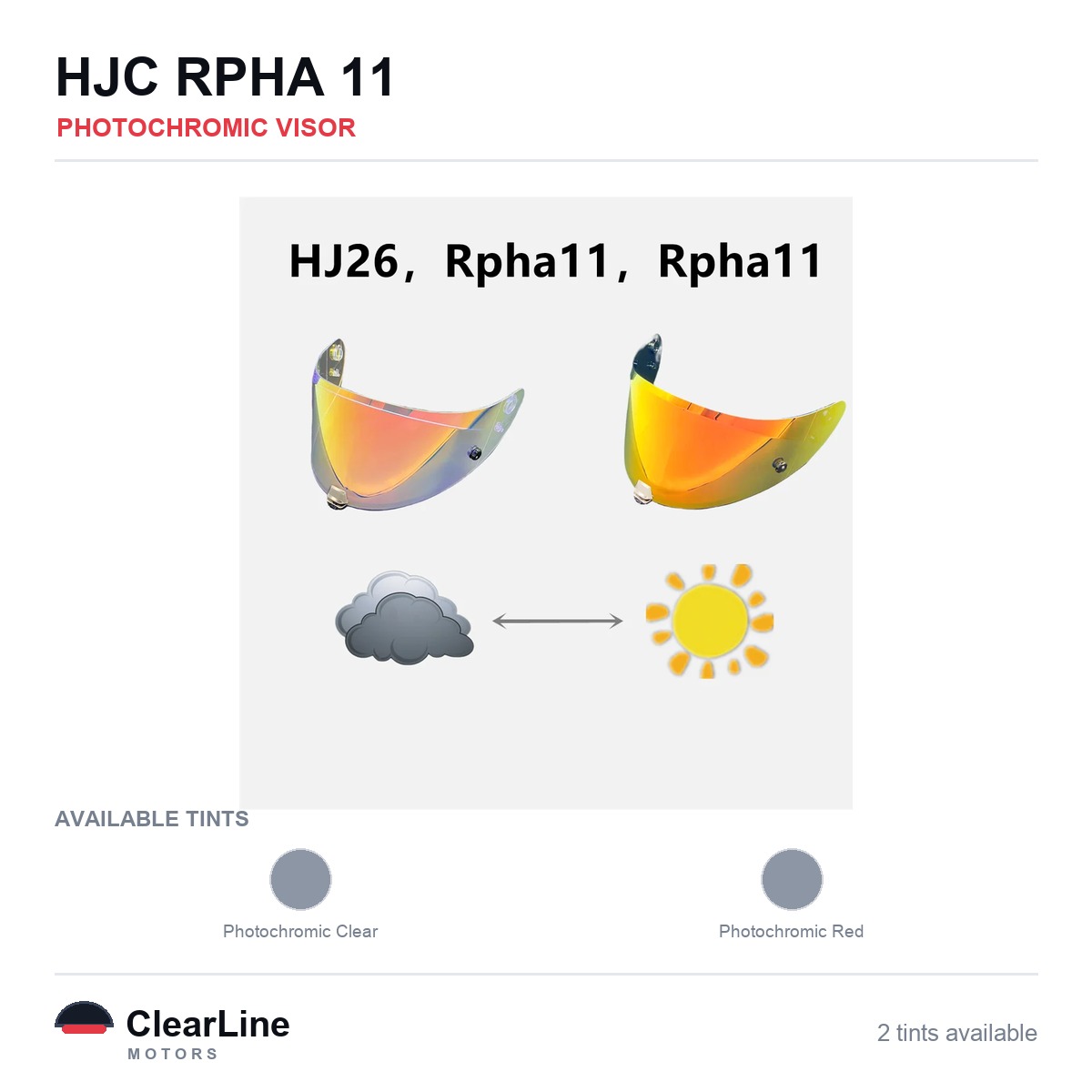
- Photochromic. A visor that darkens in ultraviolet light and clears again as the light drops. See our range of photochromic visors that adjust to the light.
Our full comparison of motorcycle visor types ranks seven finishes side by side. If fogging is your main problem rather than glare, our explainer on what a Pinlock visor is covers visors made ready for an anti-fog insert.
Tinted visors and the law in the US and Great Britain
In the US, visor tint is a matter of state law. FMVSS 218, the federal standard behind the DOT sticker, covers helmets and does not mention visors or tint, so the rules differ from state to state; our guide to tinted visor laws in the US shows what each state says.
In Great Britain, the legal test is the marking on the individual visor, not its colour: under the Motor Cycles (Eye Protectors) Regulations 1999 a visor used on the road must carry a BS 4110 grade with an approved certification mark, or an ECE 22.05 approval. Iridium, mirrored and dark-smoke visors transmit too little light to be legal for road use in Great Britain, and because we do not verify the markings on individual items, ClearLineMoto makes no road-legal claim for any visor it sells (more in our guide to tinted visors in Great Britain).
Anywhere else, check the marking on the visor and the law where you ride.
Visor, peak and internal sun visor: three different parts
Three different parts get called a visor, and mixing them up is a common reason for ordering the wrong item. Here is how to tell them apart.
The main visor (shield)
This is the clear or tinted sheet across the eyeport that this guide is about. It hinges at each side and seals against the eyeport rubber. On a full-face or modular helmet, it is the only thing between your eyes and the wind.
The peak
Off-road and adventure helmets have a fixed or adjustable peak above the eye opening. Riders, and many retailers in the US, often call it a visor too, and a dirt-bike helmet may have a peak and no shield at all. Its job is to shade the eyes and deflect mud and branches, and it does nothing for wind or rain. Our guide to the LS2 Pioneer 2 peak and visor shows both parts on one helmet.
The internal sun visor
Many touring and modular helmets carry a second, smaller tinted visor inside the shell that drops down behind the main visor with a slider. It lets you add shade without changing the main visor. Our comparison of a photochromic visor and an internal sun visor weighs the two approaches.
Visors on different kinds of helmet
Full-face helmets have a visor as standard, and it is the main way the helmet keeps weather out. Modular, or flip-front, helmets also have one, mounted so it can be raised separately from the chin bar. On both, the visor is designed around that specific shell.
Open-face, or jet, helmets vary. Some have a full-length visor that covers the face, some have a short visor, and some have none, in which case riders wear goggles or glasses. Our guide to open-face visor fitment explains how jet helmet visors attach.
Off-road helmets are usually built around goggles. The large chin bar and the peak leave room for a goggle strap, and many have no visor of their own. Adventure helmets often sit between the two, with a peak and a visor that can be removed so goggles can be worn instead.
When a visor needs replacing
A visor is a wear part, and it is cheap compared with the helmet it sits on. Replace it when scratches sit in your line of sight, when the coating has hazed or flaked, when a crack appears near the mounting points, or when it no longer seals or stays where you put it.
Night riding shows the problem first, because scratches catch oncoming headlights and spread the glare across the visor. If you have to look past a mark rather than through it, the visor is ready to go. Our guide on when to replace a motorcycle visor lists eight signs to check.
Taking the old visor off is usually a tool-free job once you know where the release is. Our general guide to removing a motorcycle helmet visor safely covers the habits that apply to any helmet.
How to find the right visor for your helmet
Start with the helmet, not the visor. Find the make and exact model name, which is usually printed on a label under the comfort liner or on the chin strap. Then look for the maker’s shield code, because one code can cover several closely related helmets and the code is what the visor is built to.
Our guide to the motorcycle visor part number shows where to find that code, and our pillar guide on what visor fits my helmet walks through the whole process. The quickest route is the visor finder, which narrows any helmet down to its own parts.
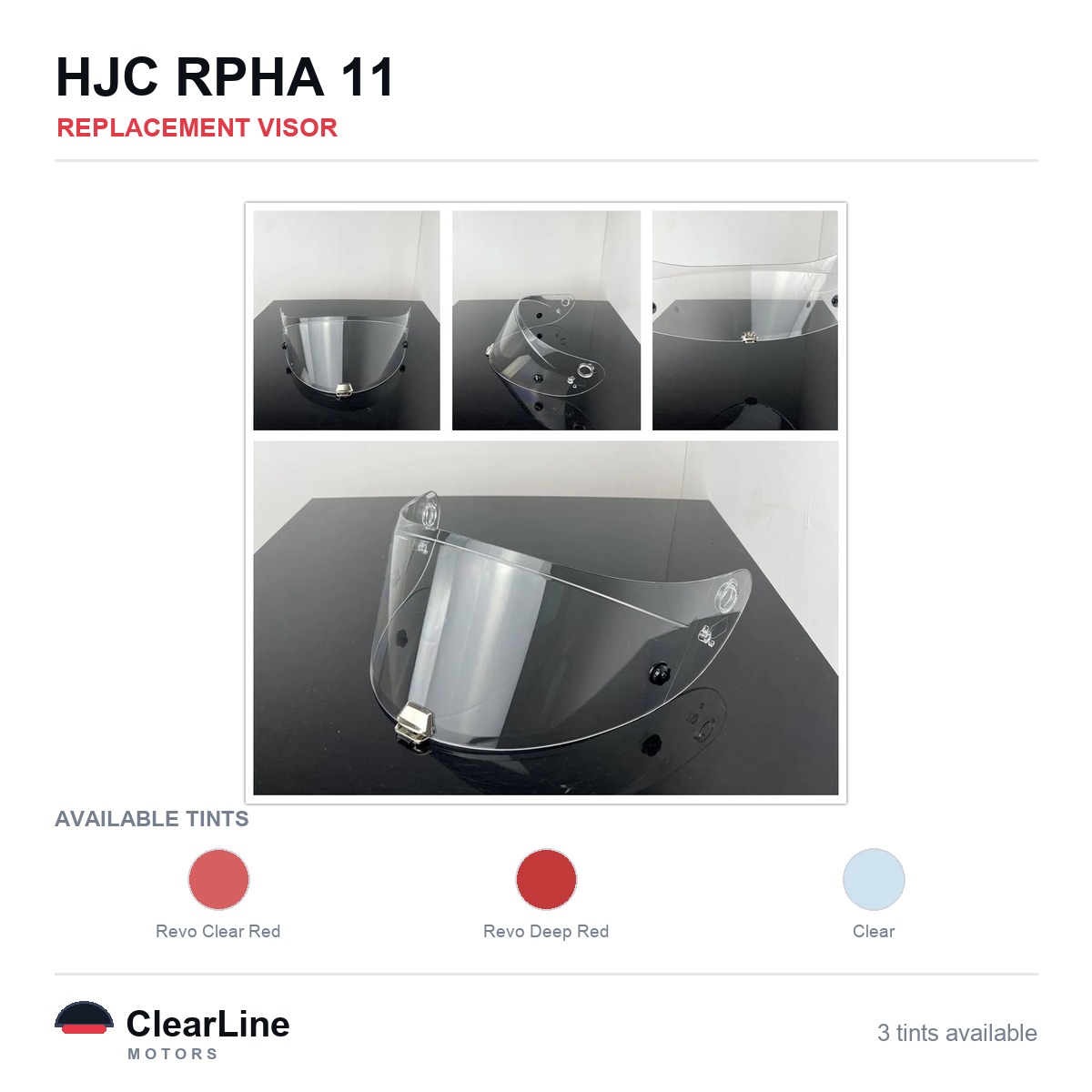
As an example, the HJC RPHA 11 has its own visor category, the HJC RPHA 11 visors, with clear, tinted and photochromic options for that helmet. Every other brand in our visor shop is organised the same way, model by model, and shipping is free to the USA, UK, Canada, Australia and Europe.
Visors and inserts mentioned in this guide
- HJC RPHA-11 Replacement Visor — Iridium, Clear, Red Tints
- the light-reactive replacement visor for the HJC RPHA-11
- See the RPHA 11 visor category
- anti-fog inserts for Pinlock-ready visors
- clear visors for everyday riding
Written by the ClearLineMoto team — who we are and how we source visors.
Frequently asked questions
Is a helmet visor the same as a shield?
Yes, on a motorcycle helmet the two words mean the same part. Riders and makers in North America usually say shield or face shield, while riders in Britain usually say visor. Both describe the clear or tinted panel that covers the eye opening.
What is a photochromic visor?
A photochromic visor darkens when ultraviolet light hits it and clears again as the light fades. It gives one visor for changing light, without swapping parts. It reacts to ultraviolet rather than brightness, so it darkens less behind a car windshield or a tinted screen. Our guide to how photochromic visors work explains why.
Can any visor fit any helmet?
No. Each visor is shaped and drilled for a particular helmet model or family, with its own mounting points, curve and eyeport size. Buy by the helmet model or the maker’s shield code, and treat a product title that lists many helmets with caution.
Do I have to ride with the visor down?
In the US, whether eye protection is required depends on the state; our US guide covers it. In Great Britain there is no rule that you must wear eye protection on a motorcycle, but rule 84 of the Highway Code says it is advisable, and any you do wear must comply with the regulations. In practice a closed visor protects your eyes from wind, rain and debris, so most riders keep it down whenever they are moving.
Why does my visor fog up?
Your warm, damp breath condenses on the cooler inner surface of the visor. Opening the visor slightly, using the helmet’s vents, fitting a breath guard or adding a pin-mounted anti-fog insert all help. Our guide on how to stop helmet visor fogging covers each fix.