
What is a Pinlock visor? It is a helmet visor (shield) built with two small pins on its inner face, so a second, thinner lens can be locked against it to stop fogging. The name comes from the Pinlock® system, a registered trademark of a third party, and the term is now used loosely for any visor made to take that kind of anti-fog insert. This guide from the ClearLine team explains how the system works, how to tell whether your visor has it, and what to check before you buy an insert.
Need a visor that fits your helmet?
Aftermarket visors matched to the exact helmet model.
The short answer:
- A Pinlock visor, often sold as “Pinlock-ready”, has two pins on the inside that hold a separate anti-fog lens.
- The lens has a soft seal around its edge, which traps a thin pocket of air against the visor, like double glazing.
- The lens itself is made from a moisture-absorbing material, so condensation spreads out rather than forming droplets.
- Inserts are shaped for one visor family, so the helmet model matters more than the brand of insert.
- An insert does not change what the law looks at in Great Britain: the marking on the eye protector.
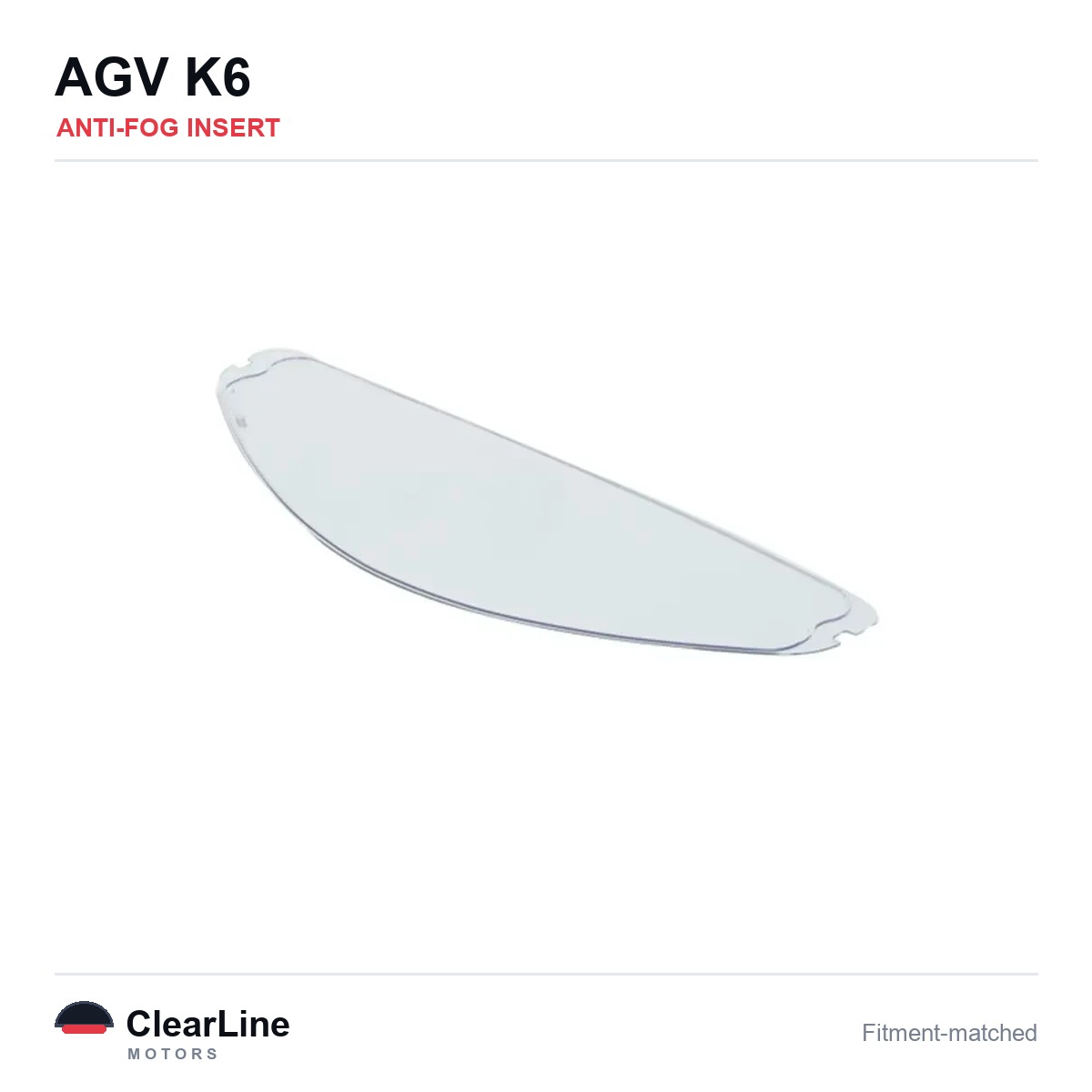
What is a Pinlock visor, in plain terms
A standard visor is a single sheet of polycarbonate. When warm, humid breath meets the cold inner surface, water condenses into thousands of tiny droplets, and those droplets scatter light. That scattering is the grey haze riders call fogging, and it arrives fastest in cold, wet weather at low speed.
A Pinlock-ready visor solves this with a second lens rather than a coating. The visor has two small pins, usually near each end of the eye port, and the insert is flexed slightly so it sits between them under light tension. The tension presses the insert’s sealing bead against the visor and holds it there.
So when someone asks for a “Pinlock visor”, they usually mean one of two things. Either they want a visor that has the pins already moulded in, or they want the insert that goes inside one. The first is a property of the visor; the second is a separate part you can replace on its own.
It is worth separating the trademark from the idea, too. Pinlock® is a third-party brand, and an insert sold by another company can be made to fit a Pinlock-ready visor without being a Pinlock product. ClearLine sells Pinlock-compatible and model-matched anti-fog inserts; none of them is a Pinlock-brand item.
How a pin-mounted anti-fog insert stops fogging
Two things work together. The first is the air gap. The seal around the insert’s edge closes off a thin layer of air between the insert and the visor, and still air is a poor conductor of heat, so the insert’s inner face stays closer to the temperature inside the helmet.
A warmer surface means less condensation in the first place. It is the same reason a double-glazed window mists up far less than a single pane on a cold morning.
The second is the material. Anti-fog lenses are generally made from, or coated with, a hydrophilic (water-loving) layer. A paper in Advanced Science on hydrophilic anti-fogging coatings describes how, on such a surface, condensed water spreads into a thin continuous film almost straight away instead of beading up. A film lets light through cleanly, which is why the view stays clear even when moisture is present.
That paper is a materials study, not a test of any helmet insert, so read it as an explanation of the mechanism rather than a performance claim. What it does make clear is why an anti-fog surface has limits: once it is saturated, or once the seal stops sealing, the droplets come back.
How to tell if your visor is Pinlock-ready
Take the visor off the helmet, or simply flip it up, and look at the inside face near the two outer edges of the eye port. A Pinlock-ready visor has a small pin or post on each side. Some visors are also printed with “Pinlock ready” or a similar line near the edge.
Deciding which anti-fog insert to fit? See how the options compare, ours and the helmet makers’ own, in our guide to the best anti-fog inserts for motorcycle visors.
No pins usually means no pin-mounted insert. You cannot add pins to a visor that was not made for them, and drilling one is a bad idea because it can crack the polycarbonate and weaken the eye protector.
If your visor has no pins, you still have options. You can replace the visor with a Pinlock-ready version for the same helmet, use a stick-on anti-fog film, or rely on ventilation and the habits covered in our guide on how to stop helmet visor fogging.
The fastest way to match a visor to your helmet is the ClearLine visor finder. Pick the brand and model and it lists only parts listed for that helmet.
Pin-mounted inserts versus stick-on anti-fog film
Not every anti-fog insert uses pins. Some other makers’ anti-fog products are a thin film that sticks onto the inside of the visor; most of ours are separate lenses that fit between two pins. The table below sets out the practical differences, so you can tell what a listing is offering before you order.
| Feature | Pin-mounted insert | Stick-on anti-fog film |
|---|---|---|
| Needs a Pinlock-ready visor | Yes, with two pins | No |
| How it is held | Tension between two pins | Pressed onto the visor surface |
| Air gap behind it | Yes, closed by an edge seal | Depends on the design |
| Removable for cleaning | Yes, flex it out of the pins | Usually a one-time fit |
| Fit depends on | Visor shape and pin spacing | Visor shape and eye-port size |
Neither type is universal. Visor curvature and eye-port shape differ between helmet models, so an insert that is a few millimetres off will either leave a gap in the seal or press into your field of view.
That is why our inserts are listed by helmet model. Each product page names the helmets it is matched to and says how it fits, and that page is the thing to read before you add it to the basket.
Insert ratings and what the numbers mean
Inserts in the Pinlock system are sold in grades with a number in the name, such as 30, 70 or 120. The number is the maker’s own anti-fog rating tier, and a higher tier is designed to absorb more moisture before it fogs.
For most riders the choice comes down to the two common grades. Our guide to Pinlock 70 vs 120 compares them on what each one is designed for, and it is the place to start if you ride through winter.
A rating only helps if the insert matches the visor. A high-grade insert that does not seal properly will fog at the edges, while a correctly fitted lower grade can stay clear on an ordinary commute.
Fitting and looking after an insert
A pin-mounted insert goes in with the visor off the helmet. You bow the insert gently, slot one edge under one pin, then ease the other edge under the opposite pin, and the step-by-step version is in how to fit a Pinlock insert.
Once it is in, check that the seal touches the visor all the way round. If you can see a gap, or if moisture appears between the two lenses, the tension is wrong or the insert is the wrong shape for that visor.
Cleaning is where most inserts get damaged. The hydrophilic surface is softer than the visor, so rubbing it hard or using solvents can scratch it or strip its anti-fog behaviour. Our guide on how to clean a Pinlock insert covers the safe method in detail.
Keep the visor itself in good order too. The Highway Code is direct about it: Rule 83 says “Before each journey check that your helmet visor is clean and in good condition.” Rule 84 adds that scratched or poorly fitting eye protectors can limit your view, which applies to a worn insert as much as to the visor in front of it.
Pinlock visors, tint and the law in Great Britain
An anti-fog insert sits behind the visor, so it is part of what you look through. In Great Britain the legal test for motorcycle eye protection is the marking on it, not its colour or how clear it looks.
The Motor Cycles (Eye Protectors) Regulations 1999 prescribe eye protectors meeting BS 4110 grades (or listed equivalents) and require them to be marked with an approved certification mark. BS 4110 is the visor standard; BS 6658 is a helmet standard, and the two are easy to mix up.
Dark smoke, iridium and mirrored visors transmit too little light to be legal for road use in Great Britain, day or night. A clear insert does not change that, and a tinted insert adds another layer of tint in front of your eyes.
ClearLine does not verify the markings on individual items, so we make no claim that any visor or insert we sell is approved or certified. Our guide to tinted motorcycle visors and the law covers the rules in detail.
When an insert is not the whole answer
An insert reduces fogging; it does not make a helmet immune to it. Breath directed straight at the visor, a chin curtain that is missing, or a seal that has dried out can all overwhelm it.
If yours mists at the edges or between the lenses, the fix is usually the fit rather than a new insert, and why a Pinlock insert fogs up works through the common causes in order. If your helmet cannot take one at all, see our options for a Pinlock alternative.
Riders who want one visor for changing light often ask whether an insert can go behind a photochromic visor. It depends on the visor, and photochromic visors with a Pinlock-style insert explains what to check. You can browse the full range of photochromic visors by helmet model.
Choosing a Pinlock-compatible insert for your helmet
Start with the exact helmet model, because inserts follow visor shapes and visor shapes follow models. The model name is usually printed inside the chin bar, under the comfort lining or on the strap label.
Next, check whether your visor has pins, and read the product page for the insert you are considering to see how it mounts. If you ride an AGV K6, for example, the K6 insert’s page describes its fit; a Shoei Glamster rider would look at the Glamster anti-fog insert instead.
If you also need a new visor, our clear replacement visors are listed by helmet model, and the anti-fog insert range brings every insert together in one place. Shipping is free.
Visors and inserts mentioned in this guide
- AGV K6 Anti-Fog Insert — Stops Visor Fogging
- Anti-fog insert for the Shoei Glamster
- Visors and inserts for the AGV K6
- Shoei Glamster visors and inserts
- Pinlock-compatible anti-fog inserts
- Clear replacement visors by helmet
Frequently asked questions
What is a Pinlock visor used for?
It is used to stop fogging. The two pins hold a separate anti-fog lens against the inside of the visor, and the sealed air gap plus the lens material keep condensation from forming a haze.
Can you fit an anti-fog insert to any visor?
A pin-mounted insert needs a visor with pins, and the insert must match that visor’s shape. Visors without pins can take some stick-on films instead; check how each product mounts before you order.
How do you clean a Pinlock visor insert?
Take the insert out, rinse it with lukewarm water and let it dry on its own or blot it gently with a clean microfibre cloth. Avoid solvents and hard rubbing, because the anti-fog surface is softer than the visor.
Is a ClearLine insert a Pinlock product?
No. Pinlock® is a third-party registered trademark. ClearLine sells Pinlock-compatible and model-matched anti-fog inserts, and none of them is a Pinlock-brand item.
Why does my insert fog between the two lenses?
Moisture between the lenses usually means the seal is not touching the visor all the way round. The insert may be under too little tension, fitted the wrong way round, or shaped for a different visor.