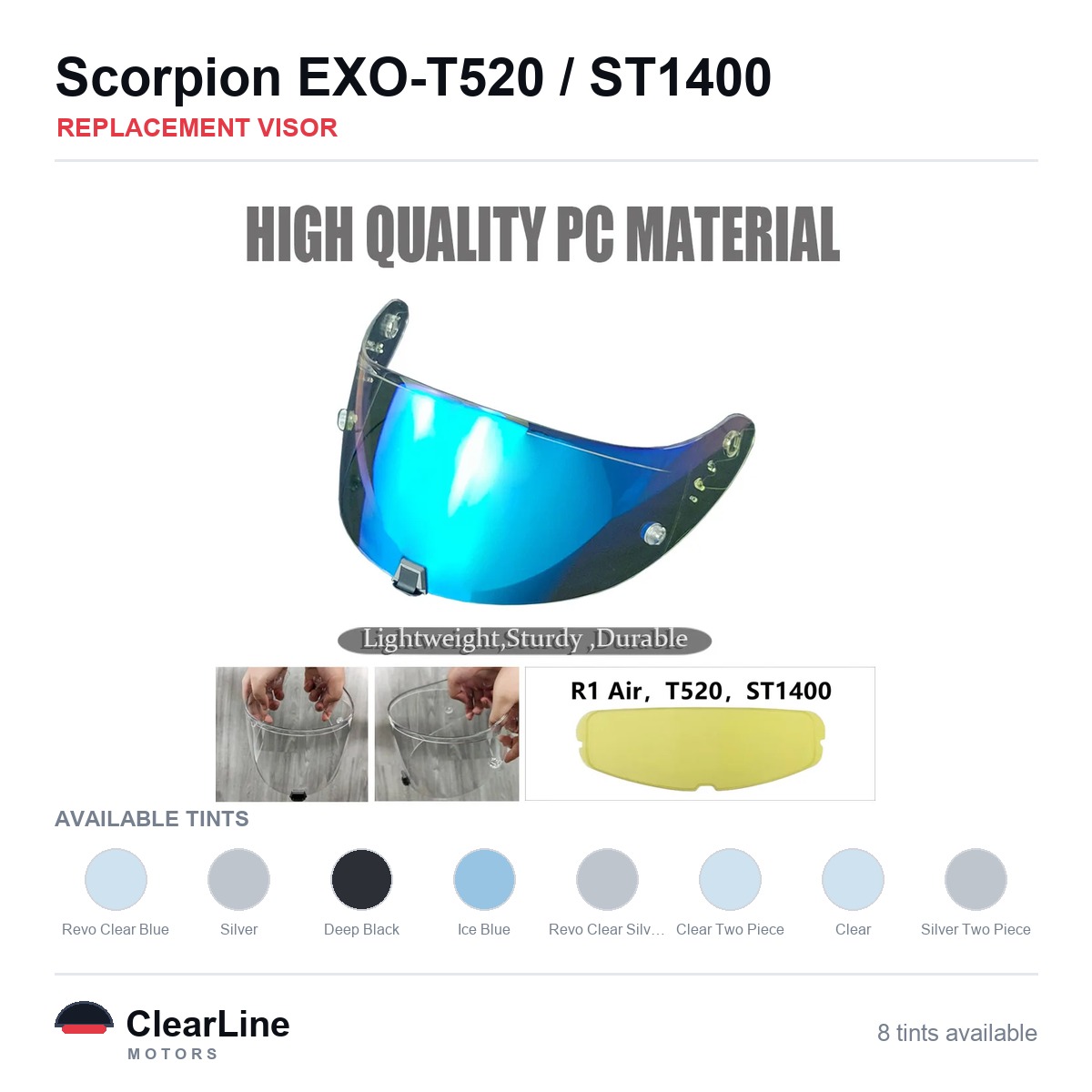
Almost every discussion of tinted motorcycle visors starts in the wrong place, with the colour of the visor. The colour is not the legal test. What decides whether a visor may be used on the road in Great Britain is the approval marking on that individual visor, and a visor with no marking is not a prescribed type even when it is perfectly clear.
This page sets out what each marking means, what the two routes to being a prescribed type actually are, which standard applies to a visor and which does not, and where the widely quoted transmission figure comes from. It is written for riders trying to read the marking on a visor in their hand, and it states plainly where the answer is not knowable from a retail listing.
Scope: Great Britain — England, Scotland and Wales. Compiled 2026-07-30.
The one test that decides it
In Great Britain a visor may be used on the road only if it is a prescribed type under the Motor Cycles (Eye Protectors) Regulations 1999. Two routes make a visor a prescribed type, and both are physical properties of the visor rather than facts about the shop that sold it:
- A BS 4110 grade marked on the visor, together with an approved certification mark — a BSI Kitemark, or an approved EEA equivalent.
- A UNECE Regulation 22 approval marking. The 1999 Regulations as published name the 22.05 series.
A visor carrying neither is not a prescribed type. This is the point that retail listings routinely obscure: the test is the marking on the individual visor, not the tint name, not the helmet brand, and not the description in a product listing.
What each marking or claim actually tells you
| Marking or claim on the visor | What it is | What it establishes about road use in Great Britain |
|---|---|---|
| BS 4110 grade with an approved certification mark | The British Standard for eye protectors for motorcyclists, alongside a BSI Kitemark or an approved EEA equivalent | One of the two routes to being a prescribed type. The grade and the certification mark are needed together |
| UNECE Regulation 22 approval marking | An international approval marking applied to the visor. The 1999 Regulations as published name the 22.05 series | The other route to being a prescribed type |
| A bare E in a circle, with nothing else read | The presence of an approval mark, without the category that accompanies it | Not a statement of road legality on its own, because approval markings also cover daytime-only categories. Read the full marking, not just the E |
| A daytime-use-only marking category | A marking category applied to the visor and defined by how much light the visor transmits, not by its finish | The visor is marked for daytime use and should not be used at night. It is not a general permission to wear a dark visor in daylight |
| BS 6658 | BS 6658 is a helmet standard, not a visor standard | Nothing about the visor. A listing that cites BS 6658 for a visor has cited a helmet standard and told you nothing |
| No marking at all | An unmarked visor | Not a prescribed type, even if the visor is completely clear. An unmarked clear visor is no more prescribed than a mirrored one |
| A tint name — clear, light smoke, dark smoke, iridium, mirrored | A description of appearance, applied by whoever wrote the listing | Nothing. Tint names are not a legal category and no regulation prescribes a visor by colour name |
Where the transmission figure comes from
The standard behind those regulations sets a 50 per cent light-transmission floor. That figure derives from UNECE Regulation 22 rather than from the Act, and it is not a statute in its own right. Mirrored, iridium and dark-smoke finishes transmit too little light to be legal for road use in Great Britain, day or night, which is a consequence of the transmission floor rather than of any rule that names a finish.
Regulation 22.06 is a later series. The sources we could reach conflict on how its transmittance requirement maps to the 1999 Regulations, and we could not check the primary text, so this reference publishes no transmittance figure for that series. A reference that guesses at a number is worse than one that says it does not have it.
The two offences under section 18
Section 18 of the Road Traffic Act 1988 creates two separate offences, and they fall on different people. Confusing them is common, and the rider-facing one is the subject of a persistent myth.
| Who commits it | The offence | Maximum fine | Endorsable |
|---|---|---|---|
| The rider | Using an eye protector that is not a prescribed type | Level 2, a maximum of £500 at the time of writing | Non-endorsable. A conviction under this section does not put an endorsement on the rider’s licence, contrary to a figure widely repeated in rider forums and in retail copy |
| The seller | Offering an eye protector as authorised for use when it is not a prescribed type | Level 3, a maximum of £1,000 at the time of writing | Not applicable |
The second row is the reason for the wording on this site. A retailer that cannot inspect the marking on the item it ships has nothing honest to say about whether that item is authorised for road use, and saying it anyway is the seller offence rather than a marketing choice.
Where ClearLine stands, in the words used on the product pages
This is the wording carried on the visor product pages across this catalogue, reproduced here unchanged so that this reference and the catalogue cannot drift apart:
Whether a visor may be used on the road depends on the approval marking it carries — a BS 4110 grade with an approved certification mark, or an ECE 22.05 approval — not on its tint. We cannot confirm the marking on an individual item, so we do not offer these as authorised for road use; check the marking on the visor you receive and your local law. Mirrored, iridium and dark-smoke finishes transmit too little light to be legal for road use in Great Britain and are intended for off-road, track and closed-course daytime use.
What this reference deliberately does not state
- No approval claim for any item we sell. These are unbranded aftermarket visors and the marking on an individual item is not something we can confirm, so no visor on this site is offered as authorised, approved, certified or marked.
- No measured transmission figures. We do not hold light-transmission measurements for these visors and will not estimate one. Be sceptical of any seller publishing a percentage without saying how it was measured.
- No transmittance figure for the 22.06 series, for the reason given above.
- Great Britain only. This reference covers England, Scotland and Wales. Other jurisdictions legislate separately and are outside its scope.
- Not legal advice. The sources that settle a specific case are the marking on the visor itself and a statement from the manufacturer for that exact part, not a retailer’s summary, including this one.
How this relates to the catalogue this reference was compiled from
The marking test above applies to every item in the ClearLine catalogue without exception, which at the time of compiling was 620 product listings covering 429 helmet models across 27 brands. Those listings break down into 304 replacement visors, 160 photochromic visors and 156 anti-fog inserts.
Photochromic visors are worth a separate note, because they are frequently recommended as the way to have a tint without a legality problem. Approval and road use are not the same question, and a photochromic visor’s dark state can fall below the transmission floor even where its clear state is comfortably above it. The marking on the specific visor and the stated range for it, particularly at the dark end, are what answer the question.
Shipping is free to the UK, the United States, Canada, Australia and Europe, and the delivery estimate for your address is confirmed at checkout.
Sources and method
The legal positions on this page are reproduced from wording already deployed across this catalogue and from an internal reference that was audited before publication; the catalogue figures are counted from the product ledger at the time of compiling rather than stated from memory. The governing instruments named are the Motor Cycles (Eye Protectors) Regulations 1999 and section 18 of the Road Traffic Act 1988, linked here to their primary text so that any statement on this page can be checked against the instrument itself rather than taken on trust. The Government’s public-facing guidance on motorcycle helmet law is published separately at GOV.UK. Where sources conflicted, as with the 22.06 series, the conflict is recorded rather than resolved by guesswork.
Helmet and visor model names are the marks of their respective manufacturers and are used only to identify what a visor fits. ClearLine is an aftermarket retailer and is not affiliated with, endorsed by or supplied by any helmet manufacturer.
How to cite this page
ClearLine, Visor markings and UK road use: a reference for Great Britain, clearlinemoto.com/uk-visor-tint-reference/, compiled 2026-07-30. Corrections are welcome; if any statement here is wrong we would rather fix it than defend it.