
If you have searched “Arai VAS-V vs VAS-Z”, you have probably found a replacement visor (shield) with one of those labels in its title and want to know whether it suits your helmet. The labels look like rival versions of one part. They are not: they name different visor systems that Arai uses on different kinds of helmet.
Aftermarket visors for Arai helmets
The short answer: VAS-V is the system on Arai’s current road and touring full-face helmets, and VAS-Z is the system on its open-face helmets. Arai’s own parts lists keep them apart, so a VAS-V visor and a VAS-Z visor are not alternatives for one helmet. Arai also uses VAS-A on its current adventure helmet and SAI on older full-face models.
- VAS-V: full-face helmets, for example the Corsair-X, RX-7V, RX-7X and Contour-X.
- VAS-Z: open-face helmets, for example the RAM-X, VZ-Ram and SZ-R.
- VAS-A: the current adventure helmet, sold as the XD-5 in North America.
- SAI: an older full-face system, listed for helmets such as the Corsair-V.
- The rule that matters: a shared system name is a family label, not proof of fit. Match the helmet model, not the letters.
This guide explains what each name covers, how Arai’s own parts lists separate them, and how to use that knowledge without buying the wrong part. It also covers anti-fog inserts, tinted visors and the UK marking rule.
Arai VAS-V vs VAS-Z: two systems, two kinds of helmet
Arai names its visor systems rather than just its visors. The system is the combination of the visor’s shape, its side pivots and the base plates that hold it to the shell. A visor made for one system is shaped to that system’s pivots and to that family’s eye port.
The clearest evidence of the split comes from Arai itself. Arai Japan publishes its parts fitment lists by helmet type, and the full-face shield list carries the VAS-V and SAI shields. The VAS-Z shields appear on the separate open-face shield list, next to the VZ-Ram.
Arai’s North American parts lookup tells the same story from the other side. Choose a helmet model and a shield category, and it shows the shields made for that model. On the pages we checked, the Contour-X brought up only VAS-V shields, the RAM-X only VAS-Z shields and the older Corsair-V only SAI shields.
VAS-V vs VAS-Z vs VAS-A vs SAI at a glance
The table below sets out the four system names you are most likely to meet on a listing. The example helmets come from Arai’s own parts pages, linked in the sections that follow.
| System name | Helmet type | Example helmets on Arai’s parts pages | What it means for you |
|---|---|---|---|
| VAS-V | Full-face (road and touring) | Contour-X; RX-7X in Japan | Buy a visor listed for your exact full-face model |
| VAS-Z | Open-face | RAM-X; VZ-Ram in Japan | Buy a visor listed for your open-face model |
| VAS-A | Adventure, with a peak | XD5 (XD-5) in North America | See our Tour-X5 and XD-5 guide |
| SAI | Older full-face | Corsair-V | Not interchangeable with VAS-V by name alone |
Read the right-hand column as the practical point. In every row, the helmet model decides the part, and the system name only tells you which family you are in.
Where VAS-V appears
VAS-V is the name you will see most often, because it covers Arai’s current road and sport-touring full-face helmets. On Arai’s North American parts lookup, the Contour-X shield page lists VAS-V shields, a VAS-V dual-pane shield and a VAS-V MaxVision insert.
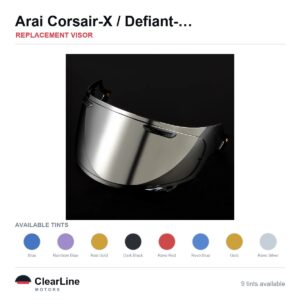
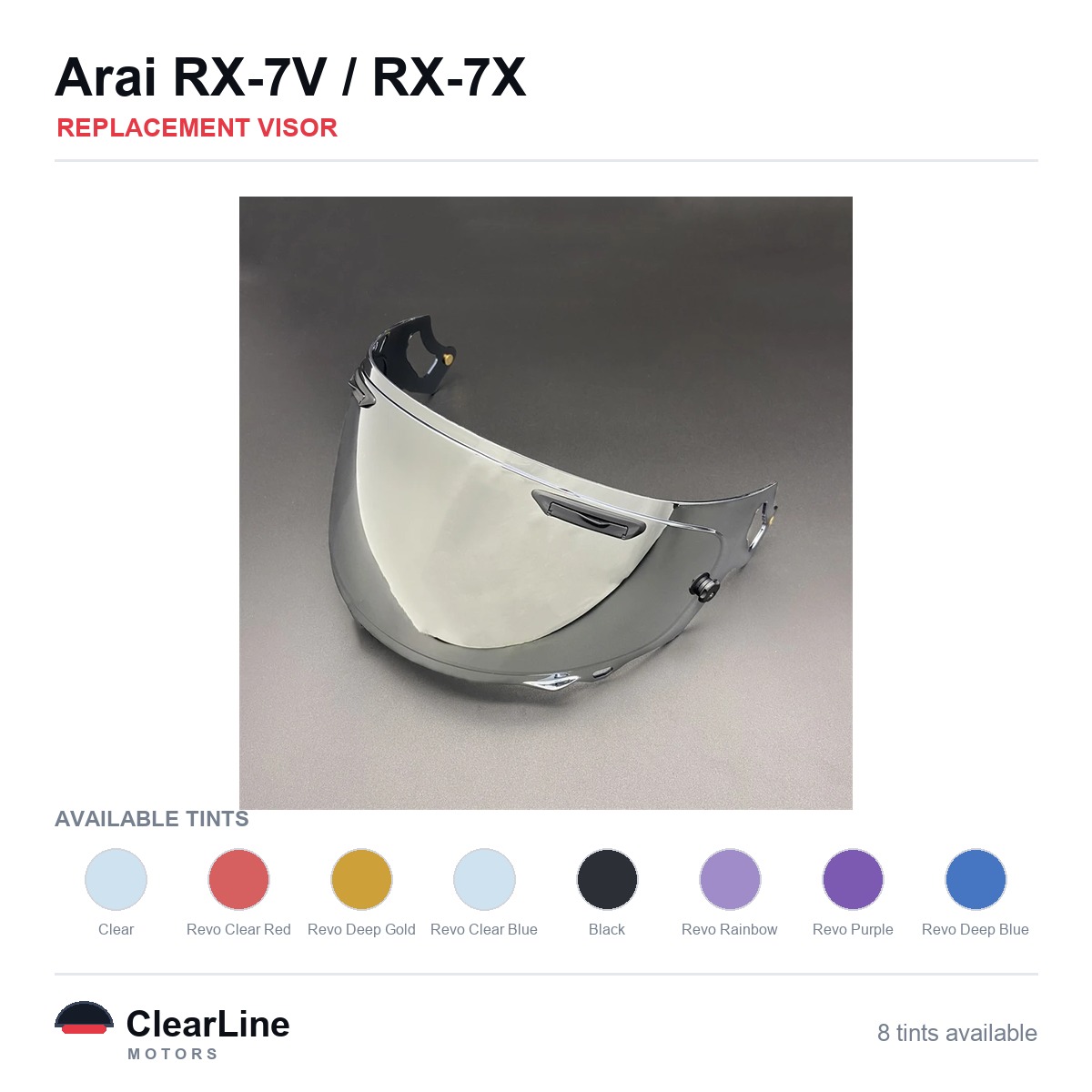
The flagship sport helmet is the best known VAS-V model, and it carries a different name in each market. Our fitment records verify that the RX-7V, RX-7V EVO, Corsair-X and RX-7X are one helmet that takes one visor. Our guide to the RX-7V vs Corsair-X visor covers those names in detail.
We list a replacement visor for the RX-7V and RX-7X, and the full range sits under visors listed for the Arai Corsair-X and visors listed for the Arai RX-7V.
Where VAS-Z appears
VAS-Z belongs to Arai’s open-face helmets. On the North American parts lookup, the RAM-X shield page lists VAS-Z shields in clear and tinted versions, a VAS-Z pivot base set and a VAS-Z insert.
Like the full-face flagship, the open-face helmet changes its name by market. Our fitment records verify that the VZ-Ram, RAM-X and SZ-R share the VAS-Z visor. Our guide to the SZ-R vs VZ-Ram visor explains how those three names line up.
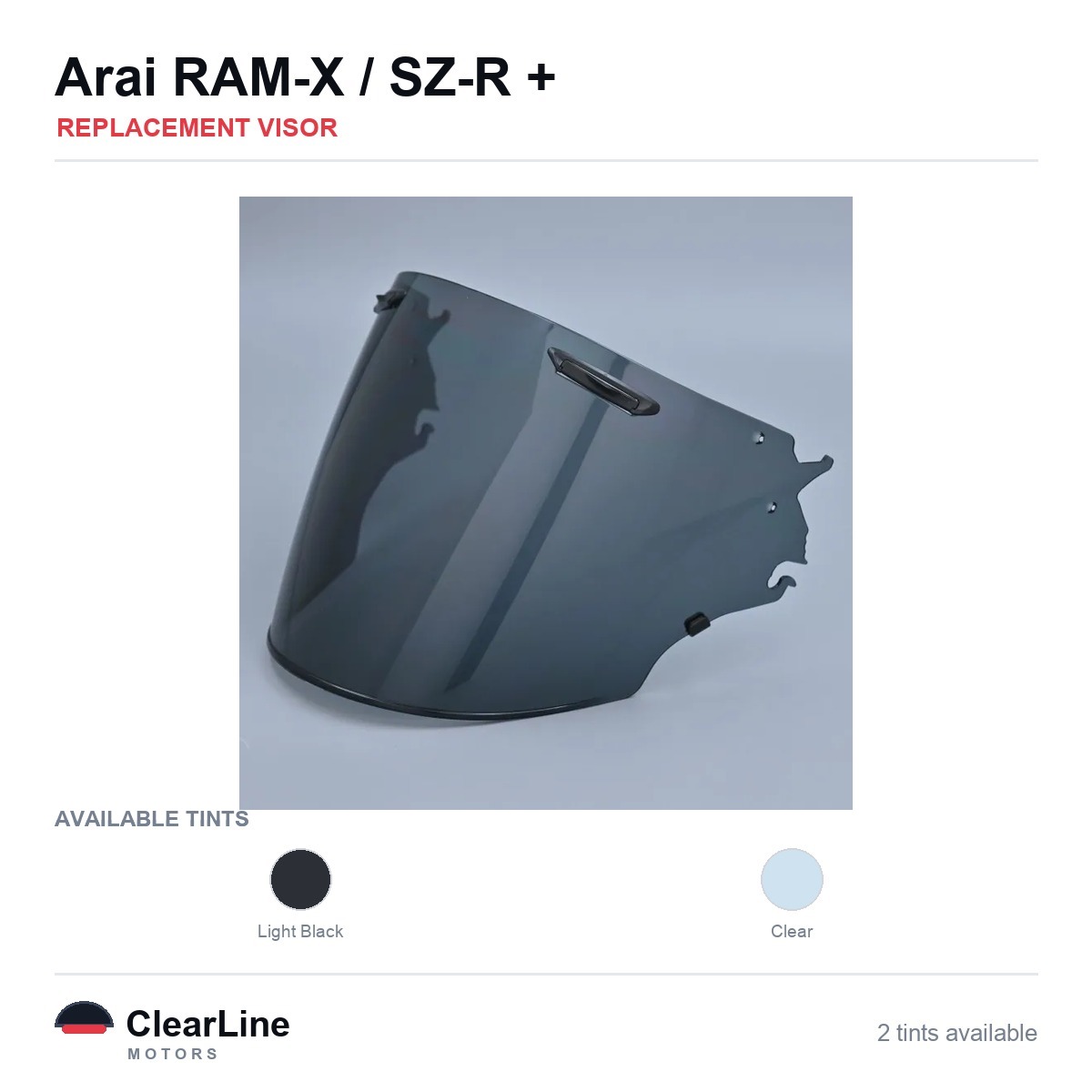
Browse visors listed for the Arai RAM-X or visors listed for the Arai VZ-Ram. The Arai RAM-X / SZ-R Evo / SZ-R / VZ-Ram Replacement Visor is the clear and smoke option in that range.
VAS-A and the older SAI system
Two more names turn up often enough to cause confusion. VAS-A is the system on Arai’s current adventure helmet. Arai’s XD5 shield page lists VAS-A MAX-V shields and a VAS-A insert, and nothing labelled VAS-V.
That helmet is sold as the XD-5 in North America and the Tour-X5 in Europe and the UK. Our Tour-X5 vs XD-5 visor guide covers its names and the visors listed for it.
SAI is an older full-face system. Arai’s Corsair-V shield page lists SAI shields and SAI dual-pane shields for that earlier helmet. If your helmet predates the X-generation names, check for an SAI listing before you assume VAS-V.
Why a shared system name does not prove fit
This is the mistake the system names invite. It is tempting to read “VAS-V” as a universal part number and buy any VAS-V visor for any VAS-V helmet.
Do not do that. Within one system Arai still makes more than one shield, such as standard, top and dual-pane versions, and the helmets that share a system name are different products. A visor listing earns your trust only when it names your exact helmet model.
We apply the same rule to our own fitment records. We only state that two helmet names share a visor when we have verified that both are one helmet, or when the maker lists both against the same part. A similar-sounding system label on a listing is never enough on its own.
How to find your helmet model and system
The system name is useful only once you know the helmet. Work through these in order:
- The label inside the shell. Lift the comfort lining at the back and read the model name and size.
- The manual or box. Both carry the model name used in the market where it was sold.
- The order record. A receipt or confirmation email names the model.
- The old visor. Some visors carry a part code near the pivot, which our guide to finding a motorcycle visor part number explains.
Once you have the model, search for it by name. If the label is unclear, our guide to working out which visor fits your helmet and the visor finder both start from the helmet rather than the part.
Anti-fog inserts are system-specific too
Arai’s parts pages list a separate insert for each system: a VAS-V MaxVision insert for the Contour-X, a VAS-Z insert for the RAM-X and a VAS-A insert for the XD5. The insert has to match the visor’s shape and pin spacing, so it follows the visor, not the helmet brand.
A Pinlock-compatible insert only fits a visor with two locating pins on its inner face. Check your visor for those pins before ordering. We list an anti-fog insert for the RAM-X and VZ-Ram, and our page on Pinlock-compatible anti-fog inserts explains how the pin system works.
Photochromic and tinted visors: the UK marking rule
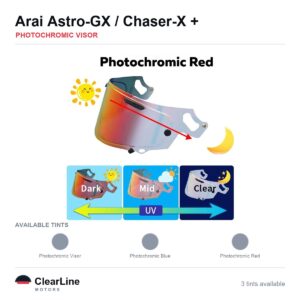
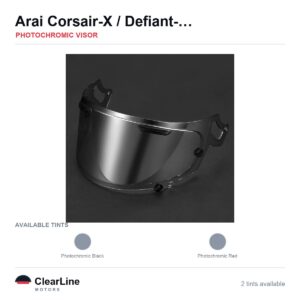
Photochromic visors are the most searched upgrade for Arai helmets. They darken in UV light and clear again as the light falls, and our photochromic visors page covers the range. For the full-face flagship we list a photochromic visor for the Corsair-X and RX-7V, and for the open-face helmet a photochromic visor for the VZ-Ram and SZ-R.
In Great Britain, the legal test for any visor is its marking, not its colour or its tint name. The Motor Cycles (Eye Protectors) Regulations 1999 prescribe standards such as BS 4110 and require the protector to be “marked with an approved certification mark of an approved body”.
Iridium, mirrored and dark smoke visors transmit too little light to be legal for road use in Great Britain, at any time of day. We do not check the marking on individual items, so check it yourself before riding on the road. Our guide to tinted motorcycle visor law in the UK and the iridium visors page go into more detail.
Choosing a clear replacement visor
A clear visor is the everyday choice and the sensible spare for any of these systems. Our clear replacement visors hub lists clear options for every brand we cover.
The UK Highway Code, rule 83 asks riders to check before each journey “that your helmet visor is clean and in good condition.” Rule 84 adds that “Scratched or poorly fitting eye protectors can limit your view when riding, particularly in bright sunshine and the hours of darkness.”
Before you fit a new visor, hold it against the old one on the bench. The pivot openings, the latch tab and the overall curve should line up, and if they do not, stop before fitting it. Our guide on how to clean a motorcycle helmet visor covers looking after it once it is on.
Visors and inserts mentioned in this guide
- Arai RX-7V / RX-7X Replacement Visor — Iridium, Smoke, Clear Tints
- Replacement visor for the RAM-X and VZ-Ram
- Arai Corsair-X / RX-7V / RX-7X Photochromic Visor
- See the VZ-Ram photochromic visor
- Arai RAM-X Anti-Fog Insert
- Visors listed for the Arai SZ-R
- Replacement visors for the Arai RX-7X
- Every visor we list for Arai helmets
ClearLine is not affiliated with Arai. Our visors are aftermarket parts described by the helmets they fit. This guide was written by the ClearLine team.
Frequently asked questions
Is VAS-Z a newer version of VAS-V?
No. They are parallel systems for different kinds of helmet. Arai lists VAS-V shields with its full-face helmets and VAS-Z shields with its open-face helmets.
Will a VAS-V visor fit a VAS-Z helmet?
Do not assume it will. Arai keeps the two on separate parts lists, and its RAM-X parts page lists no VAS-V shield. Buy a visor listed for your exact open-face model.
Does every VAS-V visor fit every VAS-V helmet?
Not by name alone. The system name tells you the family, but Arai makes several shields within it and helmet families differ. Match the model name on the listing to the label inside your helmet.
Which system does my Arai adventure helmet use?
Arai’s North American parts page for the XD5 lists VAS-A shields. That helmet is sold as the Tour-X5 in Europe and the UK, and our Tour-X5 vs XD-5 guide covers its visor.
Do I need a different anti-fog insert for each system?
Yes. Arai lists a separate insert for VAS-V, VAS-Z and VAS-A, because the insert follows the visor’s shape and pin spacing. A Pinlock-compatible insert also needs a visor with two locating pins.