
Arai’s flagship full-face is sold under different badges depending on where it is sold, and that confuses anyone shopping for a new shield. This guide settles the Arai RX-7V vs Corsair-X visor question: why the names differ, which shield the family wears, and how to tell from your own helmet which products to look at. It also covers the RX-7X and RX-7V EVO, the older RX-7 names that are not part of this family, tints, and anti-fog inserts.
Aftermarket visors for the Arai RX-7V
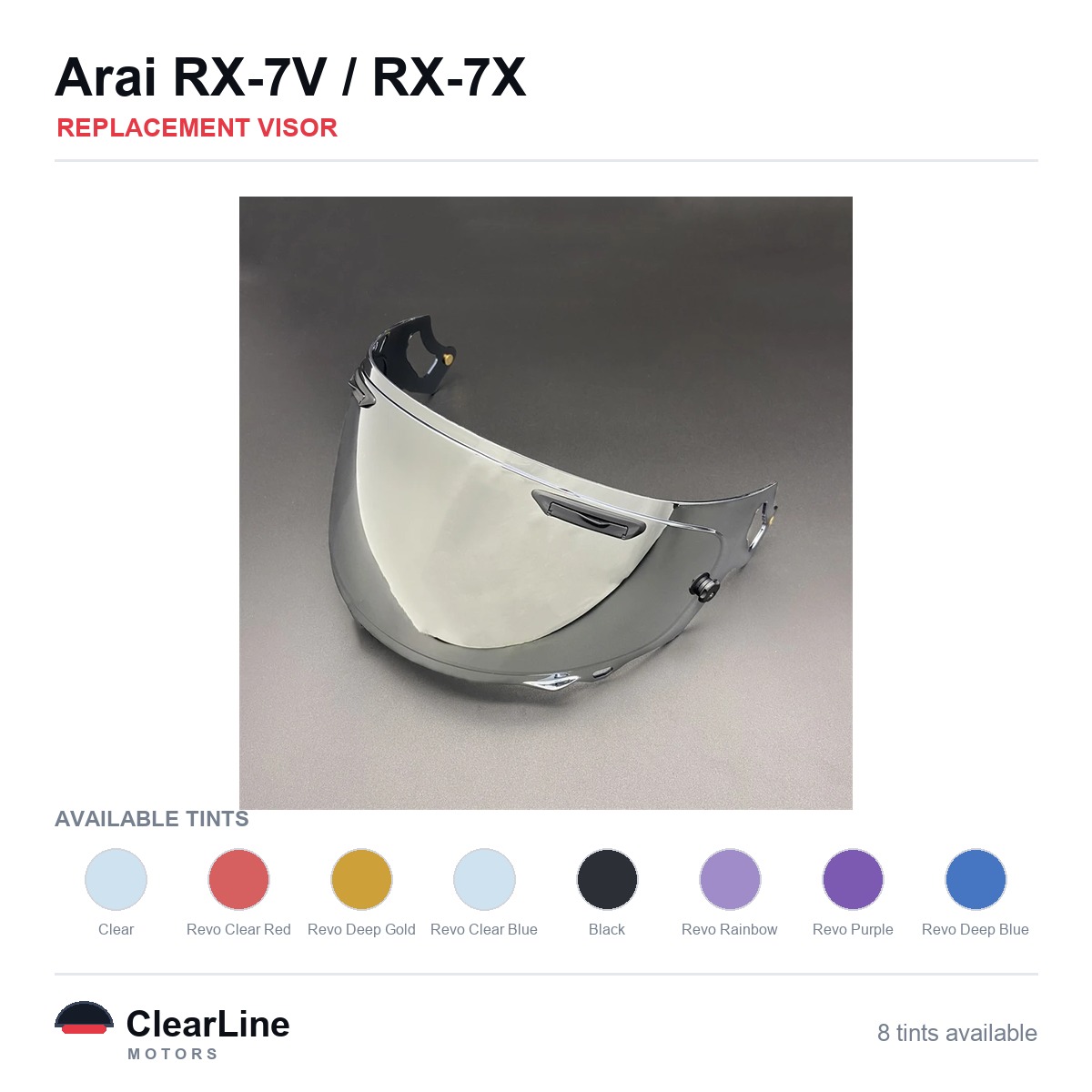
 ReplacementArai Corsair-X / Defiant-X / Quantum-X / RX-7V & more Replacement Visor — Iridium, Smoke, Clear Tints
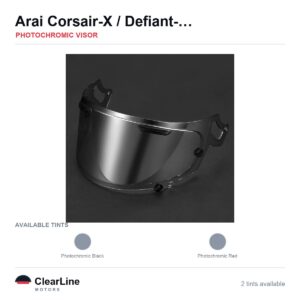 PhotochromicArai Corsair-X / Defiant-X / Quantum-X / Rapide-Neo & more Photochromic Visor
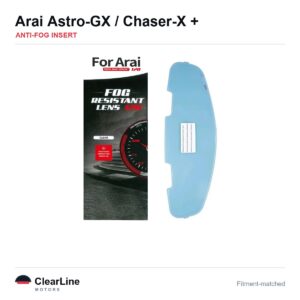 Anti-fogArai Astro-GX / Chaser-X / Concept-X / Contour-X & more Anti-Fog Insert — Stops Visor Fogging
The short answer:
- The RX-7V, RX-7V EVO, Corsair-X and RX-7X sit together in one verified group in our fitment data, on one shared shield.
- That shield is the VAS-V Max Vision, the wide, insert-ready version of the VAS-V design.
- A visor listed for the Corsair-X is listed for the RX-7V too, so a US rider and a UK rider are shopping for the same part.
- Older names such as the RX-7 GP and the Corsair V use an earlier shield design and are not part of this group.
Arai RX-7V vs Corsair-X visor: one flagship, several badges
Arai builds one top-of-the-range racing full-face and sells it under a regional name. In Europe and the UK it is the RX-7V. In the United States it is the Corsair-X, and in Japan it is the RX-7X.
The RX-7V EVO is the later European version of the same platform, updated for the newer helmet approval. To a visor buyer it behaves exactly like the RX-7V, because it keeps the same shield.
So the comparison most riders search for is really a naming question. The shells, paint schemes and approval labels follow the market, but the shield that bolts to the side of the helmet is the same part across all four names in our verified data.
How the four names line up
The table sets out what changes between the names and what stays the same. Read it as a guide to labels, not as four different helmets with four different parts.
| Name on the label | Where it is sold | Shield in our verified data | Store category |
|---|---|---|---|
| RX-7V | Europe and the UK | VAS-V Max Vision | RX-7V visors |
| RX-7V EVO | Europe and the UK, later version | VAS-V Max Vision | RX-7V EVO visors |
| Corsair-X | United States and North America | VAS-V Max Vision | Corsair-X visors |
| RX-7X | Japan | VAS-V Max Vision | RX-7X visors |
Our data does note one real difference. Regional versions can be built on different head shapes, so a Japanese-market RX-7X may fit a head differently from a European RX-7V. That changes how the helmet feels, not which shield it takes.
Arai Corsair-X visor: what US riders are actually buying
Most US riders search for a Corsair-X visor, and most UK riders search for an RX-7V visor. Both searches lead to the same shield. That is why the Corsair-X visor category and the RX-7V visor category list the same core products.
The same goes for the RX-7V EVO visor category and the RX-7X visor category. Pick the one that matches your label, and you will see the products listed for your helmet.
If you bought your helmet abroad or second-hand, do not worry about which badge it wears. What matters is that the label reads one of the four names in this group, not which of the four it is.
The shield the family shares
VAS stands for Variable Axis System. Instead of pivoting from one fixed point high on the shell, a VAS shield moves on a lower, variable pivot, which lets the side of the shell stay smoother and closer to the head.
VAS-V is the version of that design built for Arai’s road and racing full-faces. Max Vision is its wide form, cut for a broad field of view and drilled with two small pins on the inside face so it can carry an anti-fog insert.
Two other shield names come up when you shop, and neither belongs on this helmet. SAI is an older, separate design used on earlier generations, and VAS-A is the peaked adventure version used on Arai’s touring and adventure helmets.
Older RX-7 names that are not part of this group
Arai has used the RX-7 name for several generations, so a helmet that simply says “RX-7” is not automatically an RX-7V. Our fitment data marks the earlier generations as separate.
- RX-7 GP and the older RX-7 models. These predate the VAS-V generation and use the older shield design. They have their own RX-7 GP visor category.
- Corsair V. The previous US flagship, not the Corsair-X. The single letter matters, because the two take different shields.
- Carbon and race editions. The RX-7V RC, Corsair-X RC, RX-7X SRC and RX-7V Racing form their own group in our data and have their own categories. Shop from the category that matches your label.
We only say that two models share a visor when they sit in one verified fitment group. The RX-7V group covers the RX-7V EVO, Corsair-X and RX-7X, so treat any other name as a separate question.
How to confirm your helmet before you order
A wrong-generation shield is the most common mistake with this family. A few checks remove the guesswork.
- Read the label inside the shell. Lift the comfort liner at the back and look for the model name. It should read RX-7V, RX-7V EVO, Corsair-X or RX-7X.
- Look at the side pods. A VAS-V helmet has a low pivot hidden under a cover plate on each side. Compare yours with the photos on the product page.
- Check the inside of your current shield. Two small pins near the edges mean an insert-ready Max Vision shield.
- Read the fitment notes. Every product page lists the helmets it is listed for. Read them rather than relying on the title.
If the label is gone, the visor finder walks you from brand to model. Our round-up of visors that fit Arai helmets covers the rest of the range.
Choosing a tint for the RX-7V or Corsair-X
With fitment settled, the next choice is tint. This is a racing helmet, so many owners want something darker for track days, and that brings the law into play.
Clear
A clear shield is the everyday option, from dawn commutes to night rides. The RX-7V / RX-7X replacement visor is listed for all four names, and our wider clear visor range covers other helmets.
Photochromic
A photochromic shield darkens in UV light and clears as the light fades, which suits rides that cross from sun into shade. The photochromic visor for the Corsair-X, RX-7V and RX-7X is listed in every category in this group. Our explainer on how photochromic visors work covers the trade-offs, and the photochromic visor range shows the rest.
Iridium, mirrored and dark smoke
These finishes look right on a race helmet, but iridium, mirrored and dark-smoke visors are never road legal in Great Britain, day or night. They transmit too little light to be legal for road use, so they belong on track days and private land. Our guide to iridium and mirrored visor legality explains why, and the iridium visor range is listed for track and off-road use.
What the law in Great Britain actually tests
For riders in Great Britain, eye protection is governed by the Motor Cycles (Eye Protectors) Regulations 1999. They point to BS 4110, the British Standard for visors, and require the protector to be marked with an approved certification mark.
So a visor is only road legal in GB if it carries that marking. The badge on the helmet and the colour of the shield do not settle it. We do not check the markings on individual items, so we make no road-legal claim for any visor we sell, including those named in this guide.
Corsair-X owners in the United States should check the rules where they ride. Requirements vary between countries and, in some places, from one state to the next.
Anti-fog inserts for the RX-7V family
A racing helmet is built for airflow at speed, so fogging tends to show up in traffic, at junctions and in cold, damp weather. A Pinlock-compatible insert solves that by holding a sealed second layer against the inside of the shield, keeping warm breath away from the cold outer lens.
The Max Vision shield carries the pins an insert needs. The anti-fog insert listed for the Corsair-X and RX-7V sits in this group’s categories. Our guide to Pinlock-compatible anti-fog inserts explains how they work, and the Pinlock 70 vs 120 comparison covers insert grades.
Fit the insert with the shield off the helmet, lying on a soft cloth. Flex it gently, seat one end against a pin, then the other, and check the seal sits evenly all round.
Changing the shield on a VAS-V helmet
The low pivot is hidden under a side cover on each side of the shell. The covers are not fragile, but forcing them is the usual way owners crack a plate or mark a brand-new shield.
- Work on a towel with the helmet resting on its back and the chin bar facing you.
- Raise the shield fully before you release either side.
- Release one side at a time and lay the old shield face up so the outer surface never touches the bench.
- Fit the new shield, then open and close it a few times to check it seals evenly against the gasket.
The owner’s manual that came with your helmet shows the release for your exact version. Our walkthrough on how to remove a motorcycle helmet visor covers the general method and the mistakes to avoid.
Keeping the new shield in good condition
Rule 83 of the Highway Code rules for motorcyclists says: “Before each journey check that your helmet visor is clean and in good condition.” Rule 84 adds that “Scratched or poorly fitting eye protectors can limit your view when riding, particularly in bright sunshine and the hours of darkness.”
Wash the shield with lukewarm water and a soft microfibre cloth, and keep solvent cleaners away from any coating. When fine scratches cross your line of sight, replacing the shield is usually a better fix than polishing it. Our visor care guide covers cleaning, drying and storage in more depth.
If you also own a Quantic or Contour-X, that pairing has its own guide: Quantic vs Contour-X visor.
Visors and inserts mentioned in this guide
- Arai RX-7V / RX-7X Replacement Visor — Iridium, Smoke, Clear Tints
- Photochromic visor for the Corsair-X, RX-7V and RX-7X
- See the Corsair-X anti-fog insert
- All Corsair-X visors
- All RX-7V visors
- Every Arai helmet we list visors for
Written by the ClearLine team.
Frequently asked questions
Will a Corsair-X visor fit an RX-7V?
Yes. Our verified fitment data places the Corsair-X and the RX-7V in one group on one shared shield, so a visor listed for one is listed for the other. Read the fitment notes on the product page before ordering all the same.
Does the RX-7V EVO take the same visor as the RX-7V?
Yes. The RX-7V EVO is in the same verified group as the RX-7V, Corsair-X and RX-7X, and it keeps the VAS-V Max Vision shield.
Will an RX-7V visor fit an older RX-7 GP or Corsair V?
No. Those earlier generations use an older shield design and are not part of this group. Shop from the category that matches your label.
Can I fit an anti-fog insert to a Corsair-X?
Yes, if it wears the Max Vision shield with two small pins on the inside face. A Pinlock-compatible insert sized for that shield sits between them.
Are tinted visors for the RX-7V road legal?
In Great Britain the test is the certification marking on the individual visor, not its colour. Iridium, mirrored and dark-smoke visors are never road legal in Great Britain, day or night, and we make no road-legal claim for any visor we sell.