Shoei Neotec 3 visor removal takes no tools, and done in the right order it leaves the internal sun visor and the chin bar alone. The outer face shield (the visor, which Shoei calls the CNS-3C) clips onto a base on each side of the shell, and a small trigger on that base releases it. Most riders who struggle are working with the shield half open, and the hooks only release at the top of its travel.
Aftermarket visors for the Shoei Neotec 3
The short answer:
- Close and latch the chin bar, and slide the internal sun visor fully up into the shell.
- Raise the CNS-3C shield to its fully open position.
- On one side, pull the trigger down, lift and turn the shield upward by its bottom edge to free hooks A and B, then ease it down to take hook C off the rail.
- Repeat on the other side. To refit, seat hook B in the gear first, press hooks A and C onto the rail, then open and close the shield to check both sides.
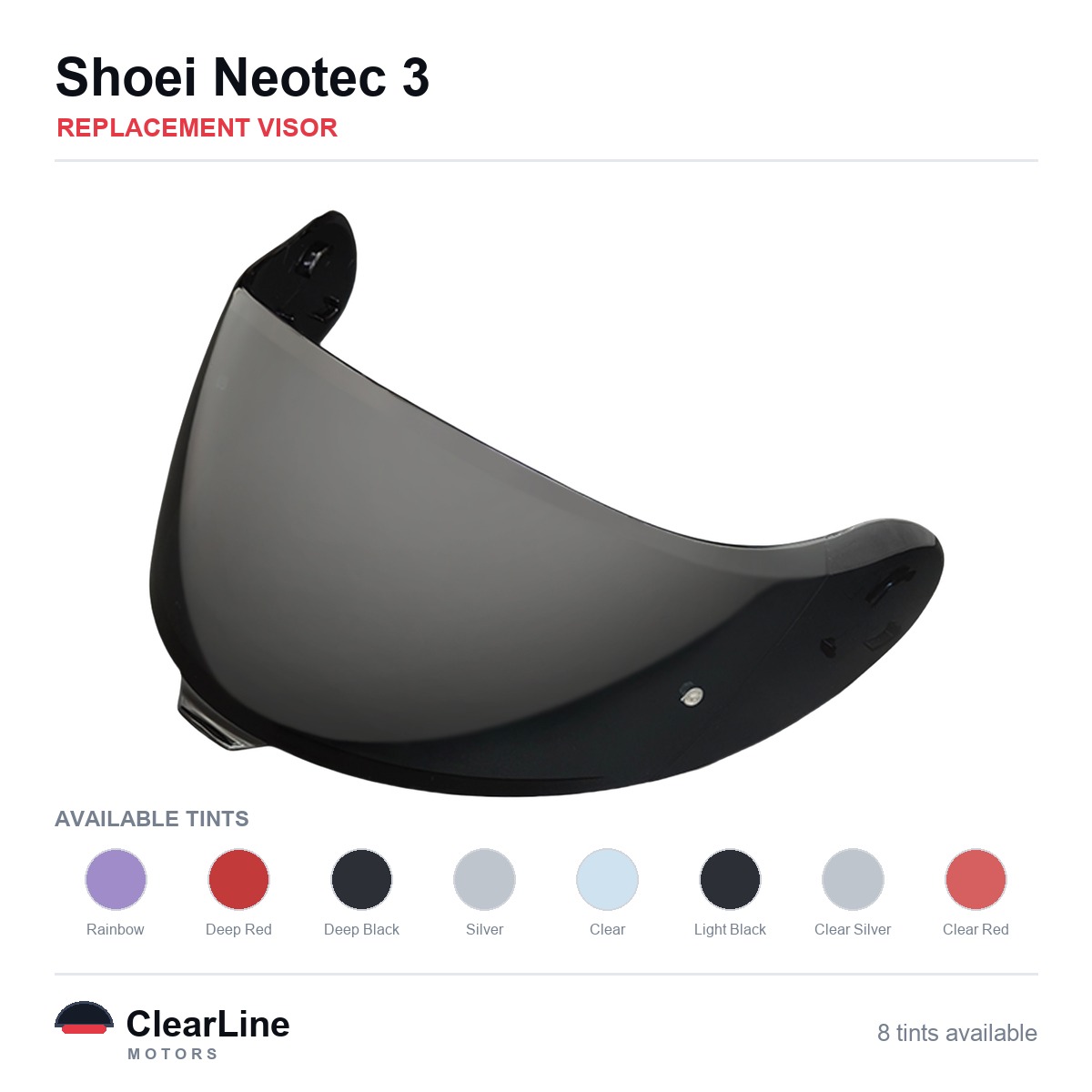
Shoei Neotec 3 visor removal: what you are actually taking off
The Neotec 3 is Shoei’s flip-up (modular) touring helmet, so it has more moving parts around the eye port than a full-face helmet. There is the clear outer shield, the tinted sun visor that drops down inside the shell, and the chin bar that lifts up and over. This guide is about the first of those three only.
The clear outer part is the CNS-3C shield. Shoei’s own CNS-3C visor manual page lists the Neotec 3 as the compatible helmet and links Shoei’s instruction manual and a video on how to remove and attach the CNS-3C visor. In this guide, “visor” (or “shield”, the usual US term) means that clear CNS-3C.
The shield does not hinge on a single screw. Each side locks onto a shield base fixed to the shell, which carries the trigger, a gear and a hook rail. The gear gives the shield its open positions, and the base pulls the shield back against the rubber seal around the eye port when you close it.
Before you start: chin bar closed, sun visor up
Put a folded towel on a table and rest the helmet on it, chin bar towards you. The outer face of the shield scratches easily, and a single grain of grit under it while you work can leave a mark right in your line of sight.
Close the chin bar and make sure it is latched before you touch the shield. A flip-up chin bar that swings while you are working on one side of the shield pulls the helmet off balance and puts load on the side you have not released yet. Working on a closed, latched helmet keeps it steady.
Then slide the internal sun visor all the way up into the shell. This is how you change the outer shield without disturbing the sun visor. With it retracted, it sits out of reach of your fingers and the shield edge, so it cannot pick up a scratch or a fingerprint while you work. Leave it where it is: you do not need to take the sun visor out to change the shield, and Shoei gives that a separate procedure and video of its own.
The Highway Code rules for motorcyclists put the reason for all this care plainly: “Before each journey check that your helmet visor is clean and in good condition.” Have a soft microfibre cloth and a bowl of lukewarm water with a little mild soap ready, because the shield-off moment is the best time to clean.
Step one: removing the CNS-3C shield
Raise the shield all the way up until it stops. This is the step people skip. At any lower position the hooks stay held in the base, however hard you pull, and forcing them is how hooks get bent.
Look at the base on one side and find the trigger. Pull the trigger down and hold it there. Then, holding the bottom edge of the shield, lift and turn the shield upward. Shoei’s manual describes this as releasing hook A, and hook B lets go at the same moment.
Now pull the shield down lightly so that hook C comes off the hook rail. That side is free. Do the same on the other side, and the whole shield comes away in your hands without touching the sun visor behind it.
If one side lets go and the other will not, check that the stuck side is still at the very top of its travel. A shield that has dropped a notch on one side will lock that side again. For a broader look at how other makes handle this, see our guide on how to remove a motorcycle helmet visor.
Cleaning the shield and seals while it is off
With the shield on the towel, wash both faces with lukewarm water and a little mild soap, using your fingertips or a soft cloth. Rinse with clean water and pat it dry with a fresh microfibre cloth rather than rubbing.
Leave out anything aggressive. Solvents, petrol, household glass cleaner and abrasive pads can craze or haze a polycarbonate shield and strip any coating on it. Paper towels are rougher than they look and leave fine scratches over time.
Now wipe the rubber seal around the eye port and both bases. Grit trapped in a base is a common reason a shield feels stiff or will not seal after it goes back on. With the sun visor still retracted, a gentle wipe along the edge of the eye port is all it needs. Our visor cleaning guide and the wider visor care guide go through cloths, drying and storage in more detail.
Step two: refitting the CNS-3C shield
Refitting also happens with the shield in the fully open position. Hold the shield up against the helmet so its hooks line up with the base on one side.
Insert hook B into the gear first. Then press hooks A and C so that they fix onto the hook rail, following the drawings in Shoei’s manual. Shoei’s video on attaching the CNS-3C, linked from its manual page, shows the motion if you want to see it once before you try. Then repeat on the other side.
Now test it, every time. Shoei’s instructions are to confirm that the shield’s hooks and gear fit properly into the base after installation. Open and close the shield several times on its full travel, because a shield that is not properly seated can come loose while you are riding.
Finally, close the shield and look at the seal all the way around. It should touch the rubber with no visible gap. Lower and raise the sun visor once to confirm it still moves freely behind the refitted shield, then lift and close the chin bar once. If all three move as they did before, you are done.
Which shield the Neotec 3 uses
The Neotec 3 takes the CNS-3C. Shoei’s CNS-3C manual page lists the Neotec 3 and no other helmet, and Shoei USA’s Neotec 3 CNS-3C shield page gives its fitment as the Neotec 3. So when you shop, buy for the Neotec 3 by name rather than by family.
The older Neotec II uses the CNS-3, which Shoei sells as a separate part. The names are one letter apart, so check the code before you order. Our post on Neotec 2 vs Neotec 3 visor compatibility covers the generations side by side, and our Neotec 3 visors category lists only parts for the Neotec 3.
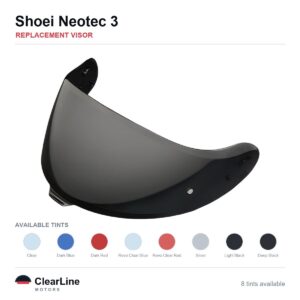
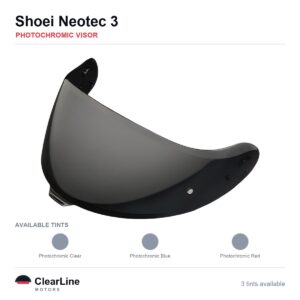
If you are changing the shield because it is scratched, the replacement visor for the Neotec 3 comes in clear and tinted options. A photochromic (transition) visor for the Neotec 3 darkens in sunlight and clears again in shade; our photochromic visors guide explains how that works. For other models, our visors that fit Shoei helmets are grouped by helmet, and the visor finder narrows it down by model.
Anti-fog inserts on the Neotec 3 shield
Shoei describes the CNS-3C as a Pinlock®-ready shield, which means it is made to carry a pin-mounted anti-fog lens on its inside face. If you use a Pinlock®-brand lens, follow the instructions packed with it.
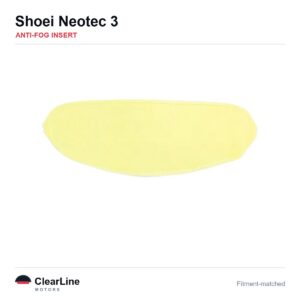
Our Shoei Neotec 3 Anti-Fog Insert is our own aftermarket lens for this shield. Its product page says most of our inserts fit between two small pins on the inside of the visor, and the CNS-3C is made to carry them, so check that yours has them, then take the visor off, clean the inside with a dry cloth and follow the fitting guide in the pack.
Anti-fog layers work because the surface spreads condensation into a thin, even film rather than tiny droplets. A 2022 materials study describes how, on a hydrophilic coating, “condensed water spreads into a pseudo‐film shape immediately to avoid fogging” (Advanced Science, via PubMed Central). For the wider picture, see our anti-fog inserts hub and how to stop a helmet visor fogging.
Tints, markings and the law
A shield change is also when some riders switch tint, so the rules in Great Britain are worth knowing. Under The Motor Cycles (Eye Protectors) Regulations 1999, a visor for road use in Great Britain must meet a prescribed standard, such as BS 4110 or an approved equivalent, and be marked with an approved certification mark. The legal test is that marking on the individual visor, not its colour or the name of the tint.
Iridium, mirrored and dark-smoke visors are never road legal in Great Britain, day or night, because they transmit too little light to be legal for road use. They are for track days and off-road use. Selling eye protection as authorised for road use when it is not is a separate seller offence under section 18 of the Road Traffic Act 1988.
The Neotec 3’s built-in sun visor is a separate part from the outer shield, and swapping the shield does not change it. ClearLine does not check the markings on individual items, so check the marking on any visor yourself before riding on the road. Our clear visors guide and iridium visors guide cover road and track tints in more depth, and rules outside Great Britain differ, so check your local rules.
Troubleshooting a Neotec 3 shield after refitting
Most problems after a shield change come from a hook that did not fully seat or grit left in a base. Work through these before ordering parts.
Why will my Neotec 3 visor not come off on one side?
The shield is probably not fully open on that side. Raise it to the top stop, hold the trigger down fully, lift and turn the shield upward by its bottom edge, then ease it down to free hook C.
Do I need to remove the sun visor to change the Neotec 3 visor?
No. Slide the internal sun visor fully up into the shell and leave it there. The outer shield comes off and goes back on in front of it, and the sun visor has its own separate procedure from Shoei.
Why does my Neotec 3 visor click but still feel loose?
One of the hooks has probably not seated. Take the shield off that side, insert hook B into the gear first, press hooks A and C onto the rail, and open and close the shield several times to check it.
Will a Neotec II CNS-3 visor fit the Neotec 3?
Do not assume it will. Shoei lists the CNS-3C for the Neotec 3 and sells the CNS-3 for the Neotec II as a separate part, so order the shield listed for your exact helmet.
Visors and inserts mentioned in this guide
- Shoei Neotec 3 Replacement Visor
- Neotec 3 photochromic visor
- See the Neotec 3 anti-fog insert
- All visors for the Shoei Neotec 3
Procedure steps in this guide follow Shoei’s CNS-3C visor instruction manual and videos, paraphrased. Written by the ClearLine team. Aftermarket parts, not OEM: Shoei model names show fitment only, and ClearLine is not affiliated with Shoei.