
If you ride a Shoei and you need a new shield, the question that stalls the order is usually Shoei CWR-1 vs CWR-F: two different visors, or two names for one fitment? They are not rival platforms competing for the same helmet. They sit on the same base plate, so for a CWR-1-era helmet the difference between them is a shield generation rather than a fitment decision.
Aftermarket visors for Shoei helmets

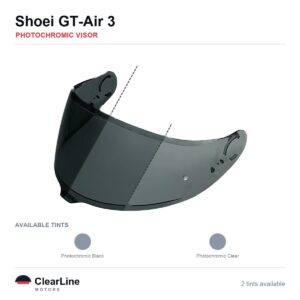
The short answer: the CWR-1 and the CWR-F share the CWR-1 base plate, and our verified fitment data treats the CWR-F as the interchangeable successor shield for that plate rather than a separate fitment. The real dividing line in the Shoei range is not CWR-1 against CWR-F. It is the CWR-1 plate against the later CWR-F2 series, which is a different platform on different helmets.
- Same plate: CWR-1 and CWR-F both address the CWR-1 base plate used by the Shoei NXR, RF-1200, Z-7 and X-Fourteen family.
- Different platform: the CWR-F2 and CWR-F2R belong to newer helmets, including the NXR2, RF-1400, Z-8 and X-SPR Pro.
- Buy by plate, not by badge: the helmet model on the box tells you more than the shield name printed on a listing.
- One thing we will not publish: a model-by-model list of which helmets shipped with a CWR-F as standard, because our own data disagrees with itself on that point.
Shoei CWR-1 vs CWR-F: one base plate, two shield generations
A base plate is the hinge mechanism bolted to each side of the shell. It is the part that decides whether a shield will lock, seal and pivot, and it is why two helmets from different decades can take the same visor while two helmets from the same year cannot.
The CWR-1 is the shield built for that plate on Shoei’s road and race full-face helmets of that generation. The CWR-F arrived later and addresses the same plate. Our verified fitment record for the CWR-1 group states the group is also cross-compatible with the CWR-F base plate, and a second verified group notes that the CWR-F seen in some listings is the interchangeable successor shield for the same CWR-1 base plate, not a different fitment.
For a rider, that collapses a confusing choice into a simple one. If your helmet is on the CWR-1 plate, a shield sold for either designation is addressing your plate. What still varies is the finish, the anti-fog pin arrangement and whether the shield is a current part or a run-out one. If you are not yet sure which plate you have, our guide to identifying a helmet visor base plate mechanism walks through it without removing anything.
Which shield family your helmet is on
Every row below comes from a group our fitment data marks verified, and each group is listed separately on purpose. Two rows name the CWR-1 because our data holds them as two distinct verified groups, and we make no claim that a shield moves between them.
| Shield family | Helmets in the verified group | What the record says |
|---|---|---|
| CWR-1 | Shoei NXR, RF-1200, Z-7, X-14, X-Fourteen, X-Spirit III | Recorded as also cross-compatible with the CWR-F base plate. The six names are three helmet designs under regional badges. |
| CWR-1 (separate group) | Shoei RYD, RF-SR | Held as its own verified group on the CWR-1 plate. We state no interchange between this group and the row above. |
| CWR-F2 | Shoei NXR2, RF-1400, Z-8 | A later platform. Treat a CWR-1 shield as not addressing these helmets. |
| CWR-F2R | Shoei X-SPR Pro, X-15, X-Fifteen | The race-ready variant of the CWR-F2 series, with tear-off posts instead of anti-fog pins. |
| CNS-2 | Shoei Hornet ADV, Hornet X2 | The adventure shield, included so it is not mistaken for a CWR part. |
The full set of groups behind this table, with the reasoning for each merge, is published in our verified shared-shield fitment dataset.
Which Shoei helmets are verified on the CWR-1
Six model names sit in the first verified CWR-1 group, and they resolve to three helmet designs. The NXR and the RF-1200 are the European and North American names for one helmet. The X-Fourteen, X-Spirit III and X-14 are one racing helmet under regional and shorthand names. The Z-7 is the third design in the group.
That matters more than it sounds, because a rider comparing an NXR listing with an RF-1200 listing is often comparing two labels on one shell. We wrote about this pattern across brands in our guide to spotting when the same helmet is sold under different names.
The RYD and the RF-SR form the second verified CWR-1 group. Both are recorded on the CWR-1 plate, and we keep them in their own group rather than folding them into the first. In our catalogue those model names are browsable as the Shoei NXR visor category and the Shoei RYD visor category, which is a direct way to see what is actually stocked for each.
Where the CWR-F claim stops being verifiable
Here is the part most guides skip. It is straightforward to establish that the CWR-F addresses the CWR-1 plate, because two independent verified records in our data say so. It is a different matter to publish a model-by-model list of which helmets left the factory wearing a CWR-F.
We do not hold a verified model-by-model list for the CWR-F, so we do not publish one. One helmet that is easy to misplace here is the Z-8: it is the Japan-market name of the RF-1400, and it takes the CWR-F2 alongside the NXR2 and the RF-1400, not the CWR-F.
So we are labelling it plainly: the standard-fit model list for the CWR-F is UNVERIFIED in our data, and we make no co-fitment claim from it. What survives scrutiny is the plate-level statement, and the plate is what your shield has to mate with. If you want the model-level answer for your specific helmet, the base plate in your hand settles it faster than any table can.
CWR-F2 and CWR-F2R: the later platform bought by mistake
The mistake that actually costs money is not confusing the CWR-1 with the CWR-F. It is confusing either of them with the CWR-F2 series. The NXR2, RF-1400 and Z-8 form one verified group on the CWR-F2, and they are the direct successors to the CWR-1-era helmets, so their model names read as near-identical to the older ones.

One digit separates NXR from NXR2 and one separates Z-7 from Z-8, yet they sit in different verified groups. The X-SPR Pro, X-15 and X-Fifteen form a third group on the CWR-F2R, which is the tear-off variant of the same later series. Stock for those helmets lives in the Shoei NXR2 visor category and the Shoei X-SPR Pro visor category.
Why a listing that names five helmets is not proof of fitment
Search for a replacement shield that fits a Shoei and you will find listings whose titles run to five or six model names. Some of those bundles are accurate. Some of them merge models that our verified groups place on different shields, and a title is not a test result.
We hold ourselves to a narrow rule on this site. A shared-visor claim gets published only when every model named sits inside one verified group. A supplier listing that bundles a RF-1400 with an X-SPR Pro is a listing, not a verification, because those two models live in different groups in our data even though both are in the CWR-F2 series.
The practical version for a buyer is short. Treat any multi-model title as a shortlist to check rather than an answer, and check it against the model name on your own helmet. Reading the marking on the shield you are removing is a reliable step, which is why we wrote up how to find and read a visor part number.
How to check your own base plate before you order
You do not need tools for this, and you do not need to guess from photographs. Work through it in order.
- Find the model name on the helmet, not the shield. It is usually printed inside the neck roll or on the certification label under the lining.
- Match that model to a group using the table above, rather than matching the shield name you can see.
- Open the shield mechanism and look at the plate. Our walkthrough on how to remove a motorcycle helmet visor safely covers the release on this style of plate.
- Read any marking on the old shield and write it down before it goes in a drawer.
- Cross-check the model against a stocked category rather than a general search, so you are comparing what exists for your helmet.
If you would rather work from the helmet than from the part, the ClearLine visor finder starts with your model and narrows from there. For Shoei specifically, our broader guide to what visor fits Shoei helmets covers the CNS families as well, and the flip-front question is handled separately in our Shoei Neotec visor compatibility guide.
Road use in Great Britain: the marking is the test
Fitment and road legality are separate questions, and mixing them up costs riders money. In Great Britain the test is not the colour of a visor, the name of its tint or the helmet it fits. It is the marking on the individual eye protector.
The Motor Cycles (Eye Protectors) Regulations 1999 prescribe eye protectors that meet a grade in British Standard BS 4110 and that are, in the words of the instrument, “marked with an approved certification mark of an approved body”. BS 4110 is the visor standard. Selling an eye protector as authorised for motorcycle use when it is not of a prescribed type is a seller offence under section 18(4) of the Road Traffic Act 1988, so we never describe any product here as approved, certified or authorised for road use.
Iridium and mirrored visors transmit too little light to be legal for road use.
The Highway Code adds the everyday duty on top of the legal one. Rule 83 asks riders to “check that your helmet visor is clean and in good condition” before each journey, and rule 84 warns that scratched or poorly fitting eye protectors can limit your view when riding. A correctly fitted shield on the right plate is part of that, because a shield fighting the wrong plate will not seal.
Choosing a finish once you know the fitment
Fitment first, finish second. Once the plate is settled, the choice is about what you ride in rather than what fits. Clear is the default for all-conditions use, and our clear replacement visors hub is the starting point for that.
Photochromic shields shift with ultraviolet light and suit riders who leave in one light level and arrive in another. A tint that is fixed and dark is a daylight-only accessory, and the marking rule above still governs whether any individual shield may be used on the road. If misting is the real problem rather than light, a pinned insert is the more direct fix, and the Pinlock-compatible anti-fog inserts hub explains which shields are ready for one.
Whatever you settle on, browse it inside the visors and inserts that fit Shoei helmets so the options you see are options that exist for a Shoei plate. Shipping is free on every order.
Visors and inserts mentioned in this guide
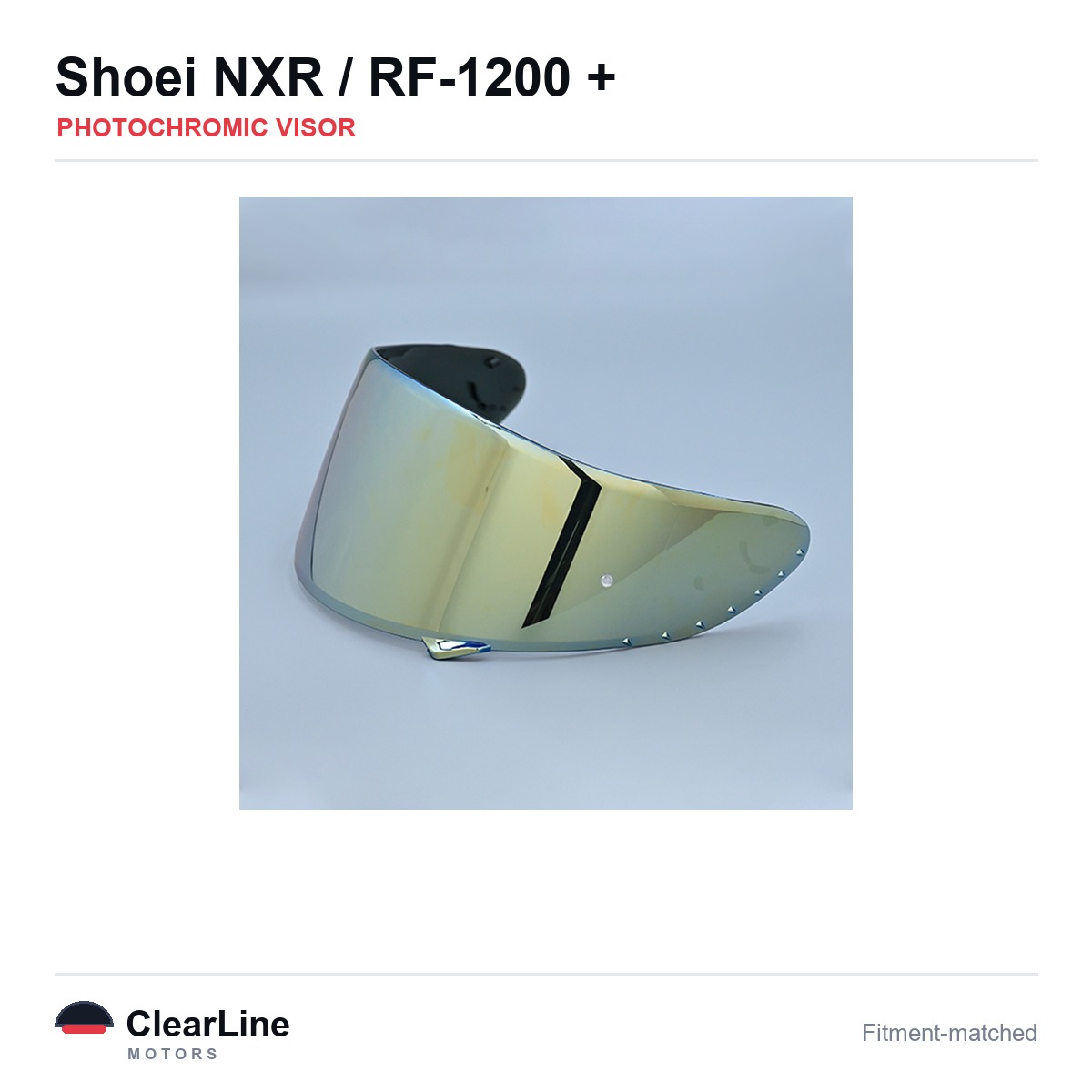
- Shoei NXR / RF-1200 / RYD / X-Fourteen & more Photochromic Visor — the CWR-1-plate photochromic option.
- replacement visor for the Shoei NXR2 and Z-8 — the later CWR-F2 platform.
- See the Shoei X-Fifteen replacement visor for the CWR-F2R group.
- Browse the Shoei X-Fourteen visor category for the racing side of the CWR-1 group.
- Browse the Shoei Z-8 visor category if your helmet is the Japanese-market NXR2.
Frequently asked questions
Is the Shoei CWR-F the same as the CWR-1?
They are not the same part, but they address the same base plate. Our verified fitment data records the CWR-1 group as cross-compatible with the CWR-F base plate, and describes the CWR-F as the interchangeable successor shield for that plate rather than a separate fitment. For a CWR-1-era helmet, both designations point at your plate.
Will a CWR-1 visor fit a Shoei NXR2 or RF-1400?
No. The NXR2 and the RF-1400 sit in a verified group on the CWR-F2, which is a later platform than the CWR-1 plate. The model names are close enough to cause mistaken orders, so check the digit after NXR and the number after RF before you buy.
Which Shoei helmets take the CWR-F as standard?
We do not publish that list. We have no verified record of which individual helmets shipped with a CWR-F, so the model-level answer is unverified here and we will not guess at it. The plate-level answer is solid, and the plate is what the shield has to mate with.
Does the Shoei Z-7 take the same visor as the Z-8?
They are in different verified groups. The Z-7 sits with the NXR, RF-1200 and X-Fourteen family on the CWR-1 plate, and the Z-8 sits with the NXR2 and RF-1400 on the CWR-F2. One digit of difference is a whole platform of difference here.
How do I tell which plate my Shoei has without removing the visor?
Start from the helmet model rather than the shield. The model name inside the neck roll or on the label under the lining maps to a group in the table above, and that is usually enough. If the label is worn away, our base plate identification guide walks through the visual differences.
Written by the ClearLine team. More about who we are and how we source aftermarket visors is on our about page.