The Scorpion EXO-R320 is a budget street full-face helmet, sold mainly in the US. Its visor (shield) sits on Scorpion’s Ellip-Tec ratchet plates and comes off without tools, but only if the visor is fully open and the small release latch is held up first. This guide covers Scorpion EXO-R320 visor removal and refitting step by step, how the visor lock lever works, and what to check before you ride.
Aftermarket visors for Scorpion helmets


The short answer: sit the helmet in front of you with the eye port facing away, ratchet the visor up to its fully open position, then use both hands to push the Y-shaped release latch on each side upwards. Keep the latch held up, press both thumbs squarely on the centre of the Ellip-Tec plate and gently peel the visor away from the helmet. The visor can only come off, or go back on, in the fully open position.
How the EXO-R320 visor system works
Scorpion calls the mechanism on the R320 the Ellip-Tec Ratchet System. In the EXO-R320 tech manual, Scorpion describes it as “tool-less faceshield changes in seconds” and says it “pulls the shield back against the eyeport gasket during closing to ensure a proper seal.”
Each side of the helmet carries a round ratchet plate. The visor clips onto that plate and clicks through a series of positions as you raise it. Behind the visor edge is a small Y-shaped release latch, which holds the visor in its locking mechanism.
Two things follow from that design. First, the visor will only release in its fully open position, so trying to pull it off half-way up only strains the plate. Second, the latch has to be held up while the visor comes away, which is why Scorpion asks you to use both hands.
If you own helmets from other makers too, our step-by-step guide to removing a motorcycle helmet visor covers the other common mechanisms, from side pods to push buttons.
Check the model before you start
Scorpion has sold many EXO helmets with similar names and similar-looking side plates. The steps in this guide come from Scorpion’s own manual for the EXO-R320, so take a minute to confirm the model before you order a visor or start pulling at the plates.
- The model label. Lift the comfort liner and read the label on the shell or the EPS liner. It should read EXO-R320.
- A round ratchet plate on each side of the shell, behind the visor edge, with a small visor lock lever just below it.
- No internal drop-down sun visor. The R320 manual lists none among the helmet’s features. If your helmet has a sun visor slider on the shell, check the label again, because it is likely a different EXO model.
Do not assume that a visor from another EXO helmet fits the R320 just because the side plates look alike. Order the visor listed for your exact model, and use the visor finder if you are unsure which model you own. Our overview of visors that fit Scorpion helmets lists the other models in the range.
What you need before you start
The swap needs no tools at all. A little preparation still protects the paint, the ratchet plates and the new visor.
- A soft surface for the helmet, such as a folded towel or the helmet bag
- A clean microfibre cloth for the plates and the visor
- The replacement visor, with its protective film left on for now
- The owner’s manual for your helmet, if you still have it
- Good light from the side, so you can see the release latch clearly
Scorpion’s manual asks you to place the helmet in front of you with the eye port facing away. That way the visor can rise fully and both ratchet plates are easy to reach with both hands.
Scorpion EXO-R320 visor removal, step by step
This is the sequence Scorpion gives in the R320 manual. Scorpion puts one warning in capitals, and it is worth repeating: the faceshield can only be removed or installed when it is in the fully opened position.
- Set the helmet down. Place it in front of you on the towel with the eye port facing away from you.
- Open the visor all the way. Ratchet it up through every click until it stops at the top of its travel.
- Push the release latch upwards. Using both hands, push the Y-shaped release latch up so the visor can come out of its locking mechanism.
- Keep the latch held up. Scorpion’s manual is explicit that the latch must stay up while the visor comes away.
- Peel the visor away. With both thumbs pushing squarely on the centre of the Ellip-Tec plate, gently pull or peel the visor away from the helmet.
- Repeat on the other side. Release the second side in the same way and lift the visor clear.
Lay the old visor on its outer face so the inside stays clean. If a side will not come away, stop and check two things: that the visor really is fully open, and that the latch is still held up. Never lever the visor off with a screwdriver or a coin, because the tip slips and marks the shell or the visor edge.
Fitting the new visor
Wipe each ratchet plate with a dry microfibre cloth first. Grit around the plate is the usual reason a new visor feels rough or will not seat. The manual’s diagram is the final word, but the method below is the general approach for this type of ratchet plate.
- Peel back only the edges of the protective film. Leave the centre covered until the visor is on, so fingerprints cannot mark it.
- Hold the visor in the fully open position. Scorpion states that the visor can only be installed in that position.
- Line up the first side. Offer the visor’s pivot opening up to the ratchet plate so it sits square, not tilted.
- Press it home. Push squarely in the centre of the plate until the visor seats and the latch engages.
- Repeat on the other side. Keep the first side seated while you fit the second.
- Work the visor down and up. Ratchet it down to the closed position and back up again several times.
A correctly fitted visor clicks evenly on both sides and closes flat against the eye port gasket. If one side lags, or the visor sits proud at one corner, that side is not fully home. Take it off and seat it again.
Peel off the rest of the film and wipe the outer face with a damp microfibre cloth. The Highway Code is clear on this: “Before each journey check that your helmet visor is clean and in good condition.”
Using the visor lock lever
The R320 has a small lever below the ratchet plate that locks the visor shut or opens it a crack for air. Scorpion’s manual gives clock positions for it, and it only works with the visor in its lowest position.
- To lock the visor: close it fully, then turn the lever anticlockwise to about the 2 o’clock position. Check the visor is held securely.
- For air at low speed: turn the lever clockwise to the 5 o’clock position. The visor opens slightly to let air flow in. Test it to check it has released.
- Closed but free: at 3 o’clock the visor is closed but not locked, so it will lift when you raise it.
A visor that will not lift after a swap is usually still locked, not jammed. Turn the lever to 3 o’clock before you blame the new visor. Never try to remove, change or adjust the visor while riding, which Scorpion’s manual also warns against.
Adding an anti-fog insert to an EXO-R320 visor
A new visor fixes scratches and changes the tint, but it does nothing for fogging on a cold morning. Scorpion describes the R320 visor as prepared for a pin-style insert. That is a thin inner lens held between two small pins on the inside of the visor, with a sealed layer of air between the two.
That layer of air keeps the inner lens closer to the temperature of your breath, so condensation has far less chance to form. Most insert lenses also carry a hydrophilic surface. Research on anti-fog coatings in Advanced Science describes how, on a hydrophilic coating, condensed water spreads into a thin film rather than the light-scattering droplets you see as fog.
Check the visor before you order an insert. If you can see two small pins on the inside face, near each side, the visor is ready for a pin-style insert. If there are no pins, an insert cannot be fitted to that visor.
Fit the insert with the visor off the helmet, on a soft surface. Hold the insert by its edges, seat one end against the first pin, flex the visor gently and slip the other end under the second pin. Our guide to fitting a pin-style anti-fog insert shows the method in more depth, and our range of Pinlock-compatible anti-fog inserts explains how inserts compare with coatings.
Choosing a replacement visor for the EXO-R320
The removal is identical whatever the tint, so the choice comes down to when and where you ride. The table below summarises the main options in our Scorpion EXO-R320 visor range.
| Visor type | Best suited to | Road use in Great Britain |
|---|---|---|
| Clear | All-round riding, dusk, night and rain | Depends on the marking on that individual visor |
| Light or dark tint (smoked) | Bright daylight | Depends on the marking; dark smoke tints are not permitted |
| Photochromic | Riders moving between sun and shade | Depends on the marking on that individual visor |
| Silver, iridium or other mirrored finishes | Track days and off-road use | Not permitted at any time of day |
A clear visor is the safest single choice if you only want one, and our guide to clear replacement visors covers the options. The replacement visor listed for the EXO-R320 comes in clear and several tints. Before you peel the film, hold the new visor against the old one and check that the pivot openings and pins line up.
Scorpion’s own manual warns never to use a dark or tinted visor in dark or poor visibility conditions. If you ride through changing light, a photochromic visor darkens in sunlight and clears again in shade. For circuit riding, iridium visors cut glare on a bright track. Our guide to motorcycle visor types compares every finish side by side.
When to replace the visor
Scratches are the obvious reason, but they are not the only one. Scorpion’s manual says its shield coatings lose their effectiveness in about two years, and recommends fitting a new visor at least every two years for that reason.
The manual also tells riders never to wear a visor that has become scratched or worn out, or to ride with one that is fogged by condensation. A scratched visor scatters light from oncoming headlights, which is at its worst at night and in rain. Our guide on when to replace a motorcycle visor goes through the signs in more detail.
The law in Great Britain: the marking on the visor is the test
In Great Britain the legal test for a visor is the marking on that individual visor, not its colour or the name of its tint. The Motor Cycles (Eye Protectors) Regulations 1999 prescribe BS 4110 and require that a protector is marked with an approved certification mark of an approved body. A visor is only road legal in GB if it carries that marking.
Iridium, mirrored and dark smoke visors transmit too little light to be legal for road use in Great Britain, day or night. They are sold for track and off-road use.
Selling eye protection for road use when it is not of a prescribed type is itself an offence under section 18 of the Road Traffic Act 1988. That is why ClearLine never describes any visor as approved or certified: we do not check the marking on individual items. Read our guide to tinted visor law in Great Britain for the detail. Most EXO-R320 owners ride in the US, where the rules differ by state, so start with our guide to visor tint rules in the US.
Common problems after a visor swap
Most problems after fitting a new visor come from a side that is not fully seated, or from dirt on a ratchet plate. Work through these before deciding a part is faulty.
Why will my EXO-R320 visor not come off?
The visor is almost always not fully open, or the Y-shaped latch has dropped back down. Ratchet the visor to the very top, push the latch up with one hand and keep it there while your thumbs press on the centre of the plate. Then peel the visor away gently.
Why does the visor whistle or let air in along the top?
Check that both sides are fully seated and that the visor closes evenly against the eye port gasket. The ratchet is designed to pull the visor back against that gasket, so a side that is not home leaks air along the brow. Also check the lock lever is not set to the 5 o’clock airflow position.
Why will the visor not lift after the swap?
The lock lever is probably in the locked position. Turn it to 3 o’clock, which leaves the visor closed but free to lift. If it still sticks, take the visor off and clean both plates.
Does an anti-fog insert change whether a visor is road legal?
No. The insert sits on the inside and works the same way whatever the outer tint. In Great Britain the legal status of the visor still depends on the marking it carries.
Looking after the visor and ratchet plates
Scorpion’s manual says the visor may be cleaned with plastic polish or mild soap and water, and warns never to use petroleum-based chemicals, solvents, petrol or cleaning agents on the shell, liners or visor. These habits help a visor last:
- Never wipe a dry, dusty visor. Soak it with lukewarm water first so grit floats off instead of being dragged across the surface.
- Use mild soap and a microfibre cloth only. Paper towels and gloves are abrasive enough to dull the surface.
- Clean the ratchet plates every few months. Grit builds up around the latch, especially after wet rides.
- Store the helmet in its bag. That protects the visor, the plates and the paint from knocks between rides.
Our full guide to cleaning a motorcycle helmet visor covers technique in more depth. For every other Scorpion model in the range, browse the Scorpion helmet visors. This guide was written by the ClearLine team.
Visors and inserts mentioned in this guide
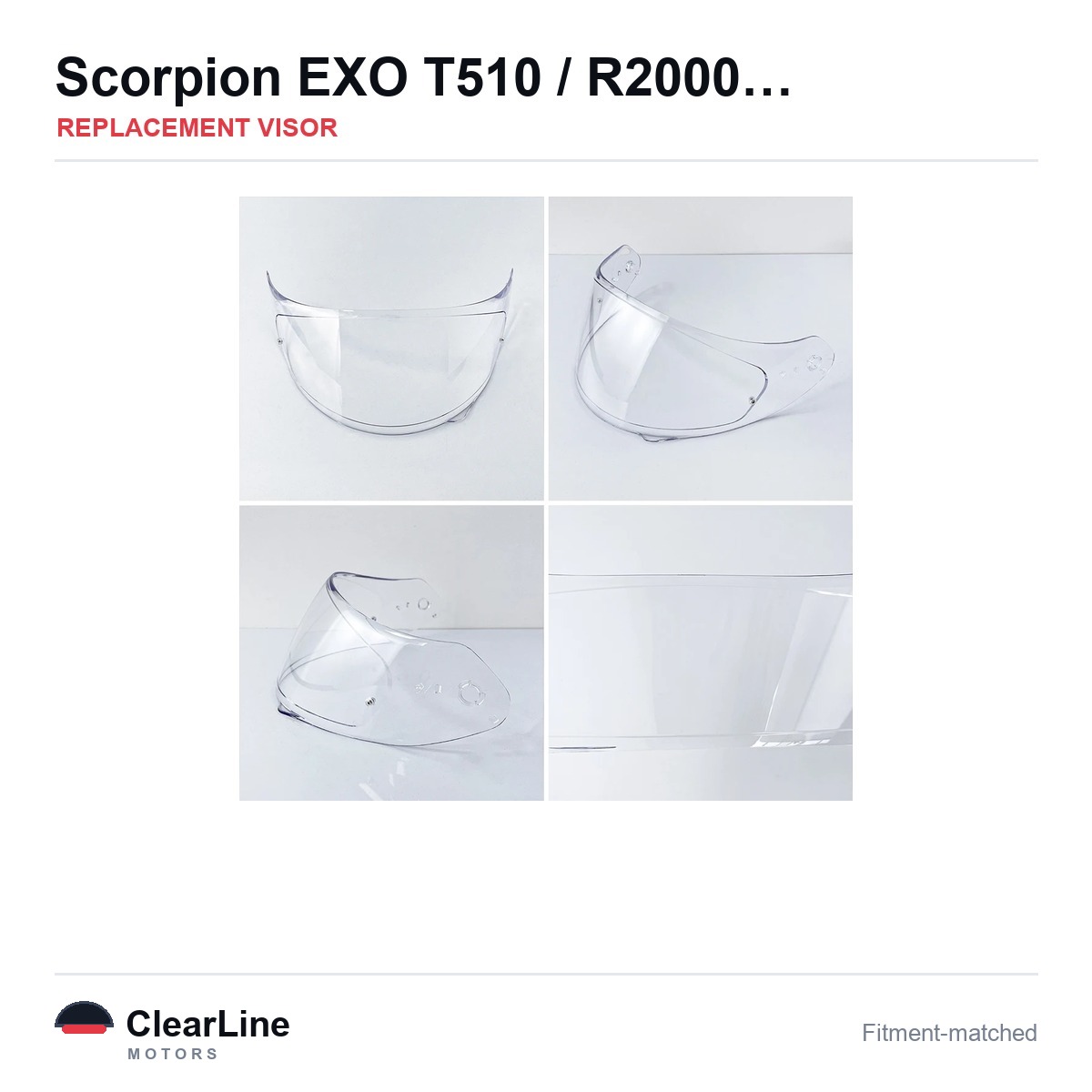
- Scorpion EXO-T510 / R2000 / R320 / R410 & more Replacement Visor — Smoke, Clear, Silver Tints
- Photochromic visor for the Scorpion EXO-R320
- All Scorpion EXO-R320 visors
- Pinlock-compatible anti-fog inserts
Frequently asked questions
Do you need tools to remove the Scorpion EXO-R320 visor?
No. Scorpion designed the Ellip-Tec ratchet system for tool-less visor changes. With the visor fully open, you hold the Y-shaped release latch up and peel the visor away from the plate with your thumbs.
Can the EXO-R320 visor come off when it is half open?
No. Scorpion’s manual states that the visor can only be removed or installed in the fully opened position. Ratchet it all the way up first.
How often should I replace an EXO-R320 visor?
Scorpion recommends a new visor at least every two years, because the coatings lose their effectiveness over time. Replace it sooner if it is scratched, since scratches scatter light at night and in rain.