If you are hunting for a replacement and keep meeting two part codes, the Shoei CNS-1 vs CNS-3 question is the one that decides whether the visor you order will actually mount. Both are face-shield part codes used across full-face and flip-front helmets, and neither is printed anywhere obvious on the outside of the helmet. The codes matter because a visor is a mechanical part with a specific aperture, a specific lock and a specific base-plate interface.
Aftermarket visors for Shoei helmets

The short answer: CNS-1 and CNS-3 are two different face-shield part codes from two different helmet generations, and they should never be assumed interchangeable. ClearLine does not publish cross-model fitment claims, because we do not verify the mounting or the markings on individual items. The reliable check is the code moulded into the visor you are taking off, matched against the fitment list shown on the product page for the visor you are about to buy.
What a CNS code on a helmet visor actually is
CNS is a face-shield part series. The number after it identifies a generation of that shield, not a tint, not a coating and not a size. Two visors can look almost identical on a shelf and still carry different codes, because the difference lives in the mounting geometry rather than in the shape you notice first.
That is why the code is the useful unit of information and the helmet name often is not. Helmet ranges get refreshed, renamed for different markets and carried over for years, while the shield they take may or may not change at the same time. A rider who orders by helmet name alone is trusting that the range and the shield generation moved together, and that is an assumption rather than a check.
If you have never looked for a part code before, our guide to reading the part number moulded into your old visor walks through where the moulding usually sits and what the surrounding characters mean.
Shoei CNS-1 vs CNS-3: what we can tell you and what we cannot
Here is the honest position. We can tell you, exactly and from our own catalogue, which helmet models each visor we stock is listed for, because that is data we hold and can show you. We cannot tell you that any two helmet models share a shield, because verifying that claim means handling and measuring both items, and a retailer who has not done that is repeating someone else’s listing.
UNVERIFIED: any statement that the GT-Air family, the Neotec family and the J-Cruise family share one visor is not something ClearLine has verified, and this guide makes no such claim. Treat every cross-model fitment table you find online, including the ones on large retail sites, as a lead to check rather than an answer.
What the catalogue does show is a clear split in how the two generations are listed:
| Checkable fact | CNS-1 generation listings | CNS-3 generation listings |
|---|---|---|
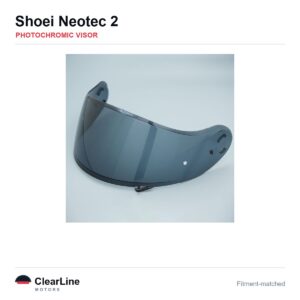
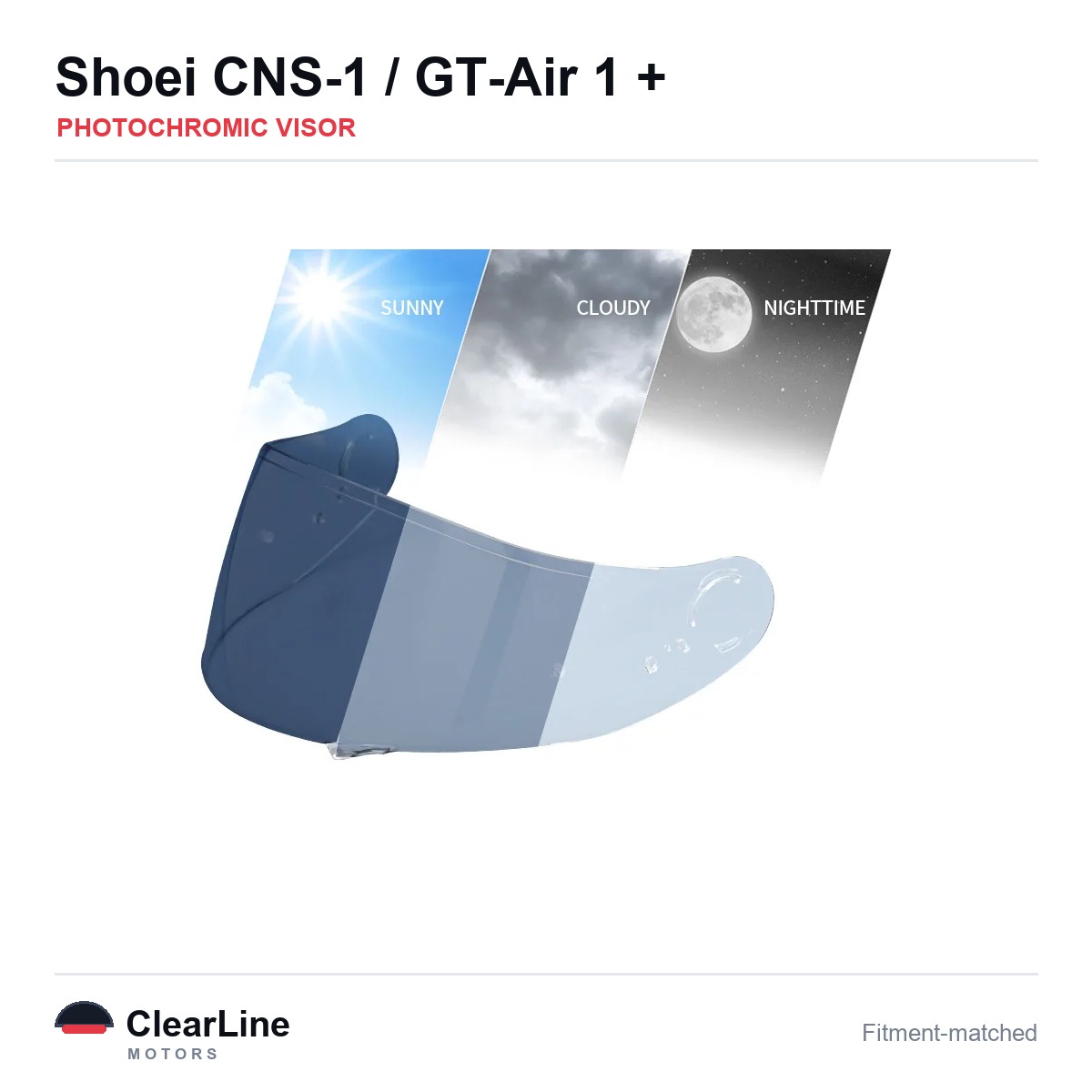
| Example ClearLine listing | Shoei GT-Air 1 / GT-Air II / Neotec Photochromic Visor | Shoei Neotec 3 Photochromic Visor |
| Helmet models named in the listing title | Three (GT-Air 1, GT-Air II, Neotec) | One (Neotec 3) |
| Catalogue categories the listing carries | GT-Air 1 Visors, GT-Air II Visors, Neotec Visors | Neotec 3 Visors only |
| Verified shared-fitment group on record | None | None |
| How to confirm before ordering | Read the code on your old visor, then the fitment list on the page | Read the code on your old visor, then the fitment list on the page |
Read the bottom two rows together, because they are the practical answer. Neither generation has a verified shared-fitment group on our records, so the listing title is a starting point and the moulded code is the evidence.
Read the code moulded into your old visor
Take the old visor off the helmet and hold it so light rakes across the inside face near the lower edge. Moulded characters are the same colour as the visor and almost invisible head-on, which is why most riders never notice them. You are looking for a short alphanumeric string, often near the pivot boss or along the bottom lip.
Write down every character you can read, including any suffix letter, and photograph it in case the light was kinder than your eyes. A suffix can separate a plain shield from an insert-ready one within the same generation, so a partial reading is worth less than it looks. If you are removing the visor for the first time, work through identifying which base plate mechanism your helmet uses before you start prising anything.
When the code is unreadable — scuffed away, or the visor is long gone — the base plate becomes your reference instead, and the helmet’s own documentation or spare-parts listing is the next place to look.
Why a bundled model list on a listing is not proof of fitment
This is worth spelling out, because it is the single most common way riders end up with a visor that does not seat. Supplier listings routinely bundle several helmet names into one product title to catch more searches. The bundle tells you which searches the seller wants to appear for; it does not tell you that the items were compared.
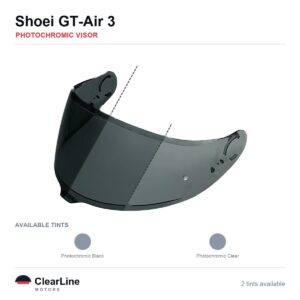
Our own catalogue showed a live example of the problem until October 2026. One replacement-visor listing was filed under GT-Air 3 Visors alongside GT-Air II Visors, GT-Air Visors and Neotec Visors, while the separate Neotec 3 and GT-Air 3 visor listings each sat in a single model category on their own. Two listings in the same shop implied different things about the same helmet generation, and only one of them could be describing the part accurately. We have since corrected that listing: it is now sold for the GT-Air, GT-Air II and Neotec only, because Shoei fits the GT-Air 3 with the CNS-1C shield.
We flag that rather than hide it. It is also why the ClearLine visor finder asks for your helmet model and points you at the listing built for it, instead of offering one shield and inviting you to hope. The wider principle is covered in our guide to whether visors are interchangeable between helmet models.
Check the base plate before you order
The base plate is the ratchet-and-cam assembly bolted to each side of the shell, and it is the part a visor actually mates with. Generations change here more often than riders expect, because the mechanism is where manufacturers add quick-release features and tighten the seal. A shield from a neighbouring generation may hook onto the plate and still refuse to close flush at the top edge.
A visor that sits proud by a millimetre is not a cosmetic problem. It lets air and water track along the brow line, it loads the lock unevenly, and it usually announces itself as wind noise at motorway speed. If the fit feels like it needs force, stop, because forcing a shield onto the wrong plate is how the pivot lugs snap.
Our companion piece on the CWR-1 and CWR-F visor codes covers the same reasoning for the sport-touring and racing side of the range.
Tints, coatings and inserts across both generations
Once the generation is settled, the remaining decisions are about the optical layer rather than the mounting. A clear shield is the default for year-round UK riding, a photochromic shield darkens in response to ultraviolet light, and a fixed tint is a fair-weather or track choice. Browse the clear and replacement visor range if you want the straightforward option, or the photochromic auto-tint visors if you ride into changing light.
Anti-fog inserts are a separate purchase and a separate fitment question. An insert needs a shield with the pins or the pin bosses to accept it, and that is a property of the individual visor rather than of the code on its own. Our guide to matching a Pinlock-compatible insert to a visor goes through what to check.
Whichever optical layer you choose, buy it against the fitment list you have already verified. A tint is easy to change your mind about later; a mounting mismatch is not.
Where a tinted or iridium visor stands under the law in Great Britain
The legal test in Great Britain is the marking on the individual eye protector, not its colour and not the name of its tint. The Motor Cycles (Eye Protectors) Regulations 1999 prescribe, among other things, “Grade X in British Standard BS 4110:1979” and require that a protector be “marked with an approved certification mark of an approved body”. BS 4110 is the visor standard; BS 6658 is a helmet standard, and the two are not interchangeable.
Iridium, mirrored and dark-smoke visors transmit too little light to be legal for road use in Great Britain, whatever the hour. That is not softened by daylight and it is not a daytime-only restriction. Everything in this section describes the position in Great Britain.
ClearLine makes no claim that any item it sells is approved, certified or suitable for road use, because we do not verify the markings on individual items. If you want a heavily tinted shield for closed-circuit or off-road use, the iridium and mirrored visor range is there for exactly that. The Highway Code also asks riders to check, “Before each journey”, that “your helmet visor is clean and in good condition”, and notes that “Scratched or poorly fitting eye protectors can limit your view when riding”.
A five-stage check before you buy
- Remove the old visor and read every character moulded into it, in raking light.
- Note the helmet’s full model name and generation, including any market-specific suffix.
- Open the product page for the visor you want and read its fitment list in full.
- Confirm the listing’s own categories match your helmet model, not merely your helmet range.
- Decide the tint or coating last, once the mounting question is settled.
Work the stages in that order and the CNS code stops being a guessing game. Skip the first one and every later stage inherits the guess. If you would rather have the catalogue do the narrowing, start from the what visor fits my helmet guide or browse the visors listed for Shoei helmets.
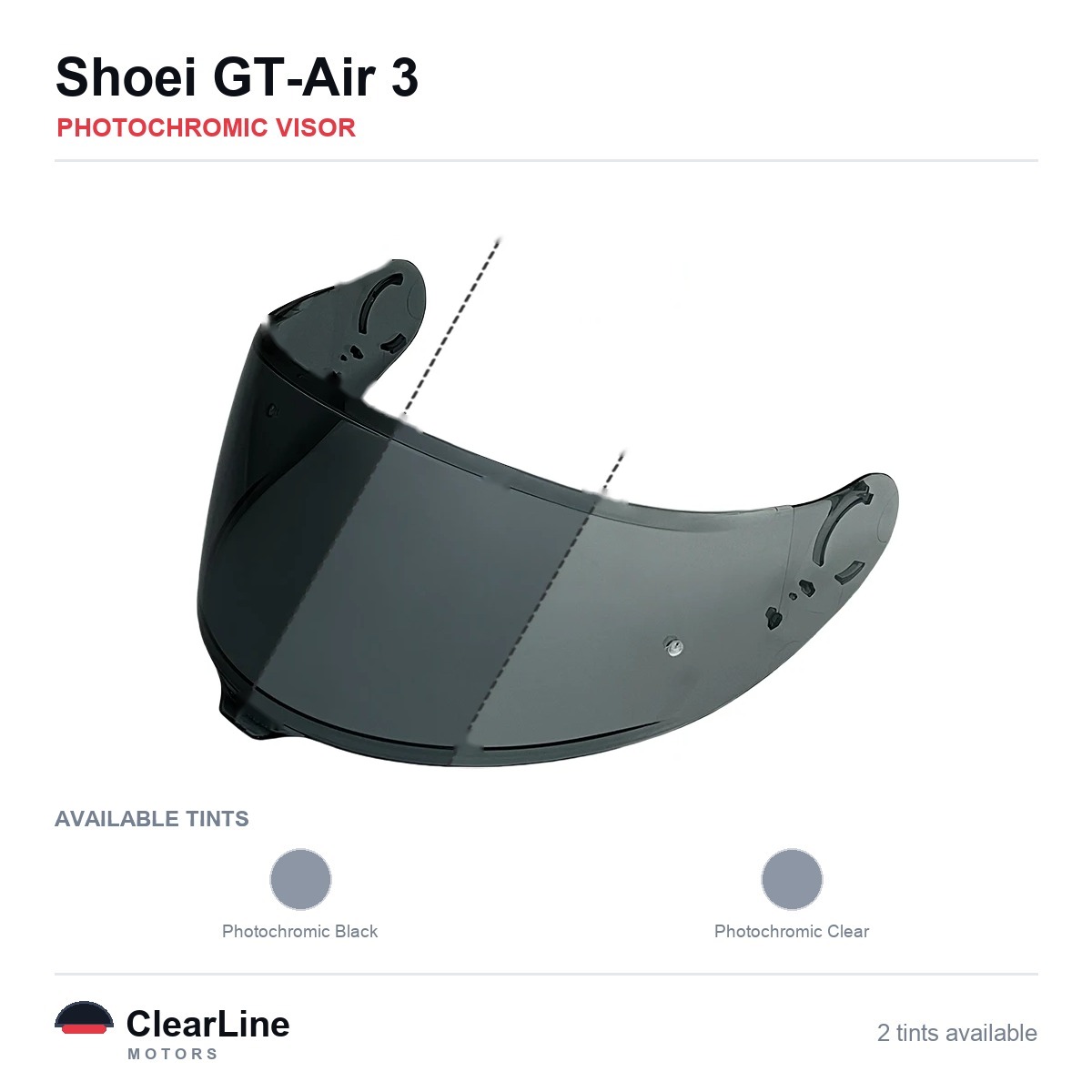
Visors and inserts mentioned in this guide
- Shoei GT-Air 1 / GT-Air II / Neotec Photochromic Visor
- replacement visor for the Shoei Neotec 3
- See the GT-Air 3 photochromic visor
- The multi-model GT-Air II, GT-Air and Neotec replacement visor listing
- Neotec 3 auto-tint visor
- Browse by model: visors for the GT-Air II, visors for the GT-Air 3 and visors for the Neotec 3
Frequently asked questions
Is a CNS-1 visor the same as a CNS-3?
No. They are separate face-shield part codes from separate helmet generations, and they should never be assumed interchangeable. Confirm the code moulded into the visor you are replacing, then check it against the fitment list on the product page.
How do I find the part code on my visor?
Remove the visor and tilt it so light rakes across the inside face near the lower edge. The characters are moulded in the same colour as the shield, so they show up as a shadow rather than as print. Photograph what you find, because a partial reading is worth less than a complete one.
What if my old visor has no readable code?
Fall back on the base plate and the helmet’s own spare-parts documentation. Compare the plate’s shape and the position of its cam against the images on the product page. If nothing matches with confidence, ask rather than order on a hunch.
Can I fit an anti-fog insert to either generation?
Only if the individual shield has the pins or pin bosses to accept one, which varies within a generation rather than tracking the code. Check the insert’s own fitment list against your visor, not against your helmet name alone.
Are iridium and dark-smoke visors allowed on roads in Great Britain?
Iridium, mirrored and dark-smoke visors transmit too little light to be legal for road use in Great Britain, at any hour. The legal test is the marking on the individual eye protector rather than its colour. ClearLine makes no claim that any item it sells is approved or certified.
Does a visor change affect wind noise?
It can, and a new noise after a change is usually a seal that is not sitting flush at the brow. Recheck the seating before assuming the shield is wrong. A visor that needs force to close is telling you something.
Written by the ClearLineMoto team. ClearLine sells aftermarket visors and anti-fog inserts and is not affiliated with or connected to any helmet manufacturer; helmet model names are used to describe compatibility only. More about us on the ClearLine about page.