Shoei GT-Air visor compatibility comes down to one split that catches out a lot of riders. The original GT-Air and the GT-Air II share a shield with the first Neotec, while the GT-Air 3 has its own. Order by the helmet name alone and you can end up with a visor that looks right in the photo and will not clip onto your base plates.
Aftermarket visors for the Shoei GT-Air

The short answer:
- GT-Air and GT-Air II: Shoei lists both, plus the original Neotec, under the CNS-1 shield.
- GT-Air 3: Shoei lists it alone under the CNS-1C shield, which it describes as designed specifically for that model.
- Anti-fog inserts: Shoei says both shields accept the Pinlock CWR-1/CW-1/CNS-1 lens insert, but a shield-and-insert pair is still bought for one helmet generation.
- When in doubt: read the code on your old shield or its box, then match the part to that code rather than to a model list on a listing.
Shoei GT-Air visor compatibility by generation
Shoei names its shields by code rather than by helmet, and the code is what decides fitment. On its own USA product page for the CNS-1, Shoei lists the fitment as GT-Air II, GT-Air and Neotec, and describes it as “Designed for SHOEI Neotec, GT-Air, and GT-Air II helmets”. That is the maker’s own statement, published on the Shoei CNS-1 shield page.
The GT-Air 3 page tells a different story. Shoei’s CNS-1C shield page lists a single helmet under fitment, the GT-Air 3, and its spec list says the shield is “Designed specifically for the SHOEI GT-Air 3 helmet model”. The GT-Air 3 does not appear on the CNS-1 fitment list at all.
| Helmet | Shield code (per Shoei) | Other helmets Shoei lists for the same shield | Insert Shoei names |
|---|---|---|---|
| GT-Air (first generation) | CNS-1 | GT-Air II, Neotec | Pinlock CWR-1/CW-1/CNS-1 |
| GT-Air II | CNS-1 | GT-Air, Neotec | Pinlock CWR-1/CW-1/CNS-1 |
| GT-Air 3 | CNS-1C | None listed | Pinlock CWR-1/CW-1/CNS-1 |
Read the table as two families, not three. If you own a GT-Air or a GT-Air II, you are shopping in the CNS-1 family. If you own a GT-Air 3, you are shopping for a CNS-1C part and nothing else.
Why the GT-Air 3 is the odd one out
The GT-Air 3 is a newer helmet with its own shield design. Shoei’s description of the CNS-1C points to two features: a “Tool-free quick-change mechanism” for fitting and removal, and a “Centrally mounted visor tab” that opens and closes the shield “without twisting”. Neither of those claims appears on the CNS-1 page, which is a hint that the two parts are built differently.
The practical consequence is simple. A visor made to the CNS-1 pattern is shaped for the GT-Air and GT-Air II shell and their base plates, so you should not expect it to seat on a GT-Air 3. The reverse applies too. Shoei does not list any older helmet under the CNS-1C, so a GT-Air 3 shield is not a drop-in upgrade for an older GT-Air.
If you are not sure which generation you have, look at the shield itself. A tab in the middle of the lower edge matches Shoei’s description of the CNS-1C. The model name on the comfort liner label or in the owner’s manual will settle it either way.
Finding a visor for the Shoei GT-Air and GT-Air II
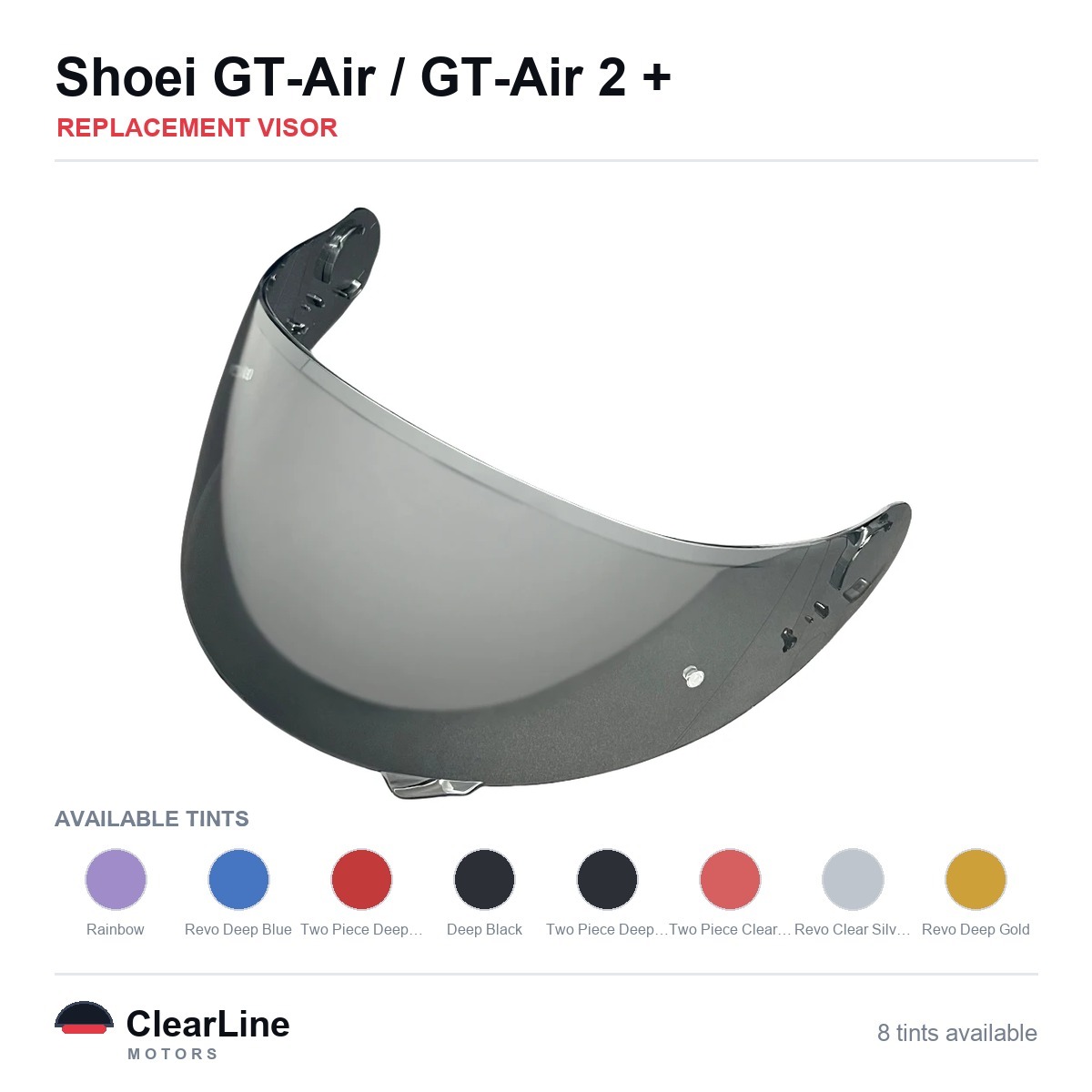
Because Shoei groups the GT-Air, GT-Air II and original Neotec under one shield code, a visor made to that pattern is the part to look for. Our Shoei GT-Air visor category and the GT-Air II visor category collect the replacement visors, photochromic visors and inserts listed for those helmets.
Owners of the first Neotec can use the same part family, and the Neotec visor range carries the same listings. The later Neotec II is not on the CNS-1 fitment list, so do not assume it follows its older sibling. Our guide to the CNS-1 and CNS-3 shield codes covers that split in more detail.
One warning about listings in general. Many aftermarket listings bundle a long list of helmet names into the product title. A bundled list is the seller’s data, not the maker’s fitment, and some bundles mix helmets that Shoei puts on different shields. Trust the shield code first and the title second.
Finding a visor for the Shoei GT-Air 3
The GT-Air 3 needs a part made for the CNS-1C pattern. Keep your search to listings for that helmet alone, and be wary of any title that lumps the GT-Air 3 in with the GT-Air II or the Neotec, because Shoei does not list them on the same shield.
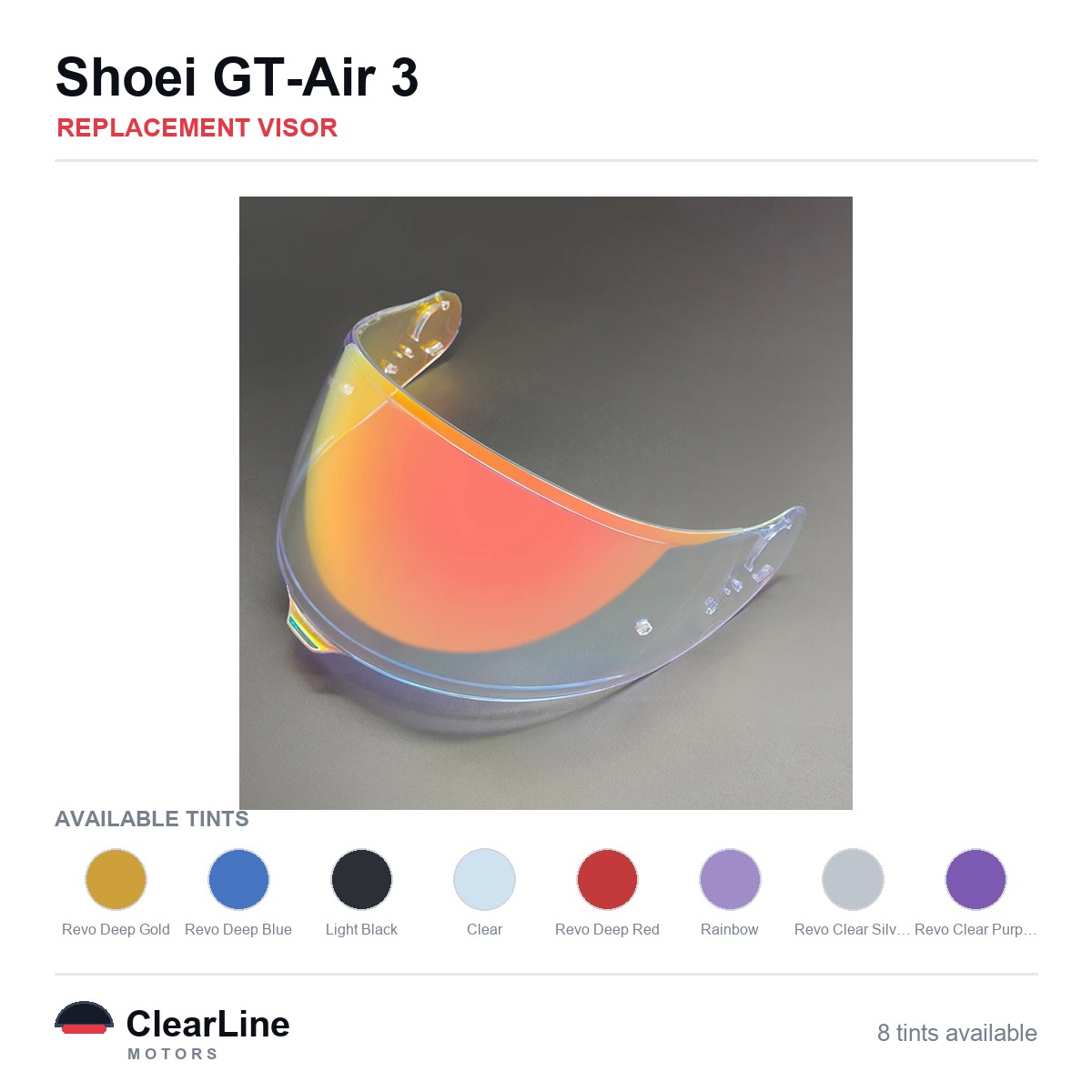
Our Shoei GT-Air 3 visor category holds the parts listed for that model only. They include the Shoei GT-Air 3 Replacement Visor in clear and tinted options, a photochromic version, and an anti-fog insert.
Anti-fog inserts across the GT-Air family
Both of Shoei’s shield pages carry the same line about inserts. The CNS-1 and the CNS-1C are each described as compatible with the Pinlock CWR-1/CW-1/CNS-1 lens insert. That tells you both shields have the pins an insert needs, which is what “Pinlock ready” means on a Shoei part.
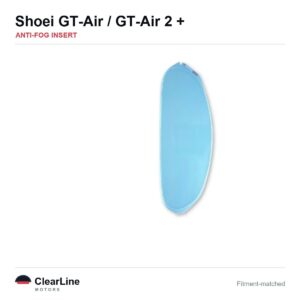
It does not mean any insert will sit correctly on any shield. An insert has to match the curve and the pin spacing of the shield it clips into, so buy it for the helmet you own. We list a Pinlock-compatible insert for the GT-Air II, GT-Air and Neotec and a separate anti-fog insert for the GT-Air 3. Our inserts are Pinlock-compatible, not Pinlock-brand.
Fitting one is quick. Open the shield, flex the insert gently, and seat it between the two pins so the silicone seal sits flat against the shield all the way round. A gap in that seal is the usual reason an insert fogs at the edge. For a fuller look at how inserts work and which to pick, see our guide to Pinlock-compatible anti-fog inserts.
Photochromic options for the GT-Air 2 and GT-Air 3
A photochromic visor darkens in ultraviolet light and turns near-clear again as the light drops. It is one of the most searched upgrades for both the GT-Air II and the GT-Air 3, and the same fitment split applies.
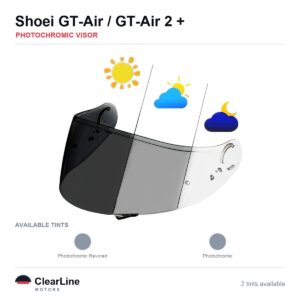
For the CNS-1 family there is the photochromic visor for the GT-Air II, GT-Air and Neotec. For the GT-Air 3 there is a GT-Air 3 photochromic visor made to its own pattern. Our photochromic visor guide and range explains the trade-offs, such as how the change slows in cold weather and why the tint does not react behind a car windscreen.
If you would rather keep a clear shield as your everyday part, the clear replacement visor range is the place to start. Many riders keep a clear visor fitted and carry a tinted one for bright days off the road.
Tinted, smoke and iridium visors: the legal position
Where you ride changes the rules, so check the law that applies to you before fitting a tinted shield. In Great Britain, the Motor Cycles (Eye Protectors) Regulations 1999 set the test, and the test is the marking. The Eye Protectors Regulations refer to BS 4110, the visor standard, and require the protector to be “marked with an approved certification mark of an approved body”.
Colour and tint names are not the test. Iridium, mirrored and dark smoke visors transmit too little light to be legal for road use in Great Britain, by day or by night. We do not check the markings on individual items, so we make no claim that any visor we sell is approved for road use. Treat a tinted shield as a track or off-road part unless the marking on that visor says otherwise.
The Highway Code also asks riders to keep the view ahead clear. Its rules for motorcyclists say “Before each journey check that your helmet visor is clean and in good condition”, and warn that scratched eye protection can limit your view. A worn shield on any GT-Air is a good reason to replace it, whatever the tint. For the full picture, read our guide to iridium and mirrored visor legality, and browse the iridium visor range with that in mind.
A four-step check before you order
- Confirm the helmet generation. Read the model name on the liner label or in the manual. GT-Air, GT-Air II and GT-Air 3 look alike from a distance.
- Find the shield code. Check the old shield or its box for a code. CNS-1 means the GT-Air, GT-Air II and Neotec family, and CNS-1C means the GT-Air 3.
- Match the part to the code. Choose a listing made for that code or for your single model, and ignore long bundled model lists.
- Buy the insert for the same helmet. If you want anti-fog protection, pick the insert listed for your helmet so the pins and curve match.
Still unsure? The visor finder lets you pick your helmet brand and model and shows the parts listed for it. You can also browse every Shoei-compatible visor in one place. Every order ships free.
Visors and inserts mentioned in this guide
- Shoei GT-Air II / GT-Air / Neotec Replacement Visor — Iridium, Smoke, Clear Tints
- GT-Air II / GT-Air / Neotec Photochromic Visor
- anti-fog insert for the GT-Air II and GT-Air
- replacement visor for the GT-Air 3
- See the GT-Air 3 photochromic visor
- GT-Air 3 Anti-Fog Insert
Frequently asked questions
Does a GT-Air II visor fit the original GT-Air?
Yes, according to Shoei. Its CNS-1 shield page lists the GT-Air, the GT-Air II and the original Neotec under the same fitment. A visor made to the CNS-1 pattern is the part for both helmets.
Will a GT-Air II visor fit a GT-Air 3?
You should not expect it to. Shoei lists the GT-Air 3 only under the CNS-1C shield, which it describes as designed specifically for that helmet. The GT-Air 3 is not on the CNS-1 fitment list.
Do the GT-Air II and GT-Air 3 take the same anti-fog insert?
Shoei describes both of its shields as compatible with the Pinlock CWR-1/CW-1/CNS-1 lens insert. Aftermarket inserts are cut to a shield’s curve and pin spacing, so buy the insert listed for your own helmet rather than assuming a swap will seal.
How do I tell which GT-Air I own?
Check the model name on the comfort liner label or in the owner’s manual. On the shield, a centrally mounted opening tab matches Shoei’s description of the GT-Air 3’s CNS-1C. If the old shield or its box carries a code, that settles it.
Is a tinted visor for the GT-Air legal on the road?
In Great Britain the test is the certification marking on the visor, not its colour. Iridium, mirrored and dark smoke visors transmit too little light to be legal for road use there, day or night. We do not verify markings on individual items, so check the visor and the law where you ride.