
If you are weighing up a Ruroc Atlas 3.0 vs 4.0 visor, the question “which one fits?” has two halves that are easy to run together. The first half is which generation of Atlas you actually own. The second is what a seller is genuinely willing to verify about swapping parts between those generations.
Aftermarket visors for the Ruroc Atlas 4.0
This guide separates the two. Everything below comes from our own catalogue records and from the legislation that applies in Great Britain, and where we cannot verify something we say so rather than filling the gap with a guess.
The short answer: ClearLine lists its Atlas visors and inserts under both the Atlas 3.0 and the Atlas 4.0 categories, so a product shown in your generation’s category is listed as fitting that generation. We publish no interchange claim between Atlas generations, because we do not verify shield geometry or markings on individual helmets. Work out your generation first, then buy from that generation’s category.
What a Ruroc Atlas 4.0 visor has to match
A visor is not a flat piece of plastic that any helmet will accept. It has to agree with the helmet on three separate things at once, and a mismatch in any one of them is what turns a promising-looking part into a returned parcel.
The first is the mechanism. The pivot, base plate or quick-release cam on the shell has to accept the matching feature on the visor, and those mechanisms are model-specific rather than brand-wide.
The second is the aperture. The curve of the shield and the line where it meets the shell decide whether the seal closes evenly or leaves a gap at the top edge or the chin bar.
The third is the detent, meaning the set of positions the visor holds open at. A shield that physically clips on but will not hold a cracked-open position is still the wrong part. Our guide to measuring helmet visor fitment walks through checking all three before you order.
Ruroc Atlas 3.0 vs 4.0 visor: how to tell them apart before you order
This is the step most people skip, and it is the one that decides whether the rest of the process works. Ruroc has sold several generations of the Atlas, and the generation name is rarely printed anywhere obvious on the helmet itself.
The most reliable record is your own. The original order confirmation, the retail listing you bought from, or the box the helmet arrived in will normally name the generation explicitly.
Failing that, check the label inside the shell. Helmets sold in the UK carry a certification label with model and approval information, and that label is the manufacturer’s own statement about what the helmet is.
The last resort is a photograph. Take a clear picture of the base plate area with the visor removed, and compare it against the images on the product page before committing. If the two do not obviously match, treat that as a no rather than a maybe.
What ClearLine lists for the Atlas, and what we do not claim
Our catalogue currently carries three Atlas products, and all three are filed under both generation categories. That filing is our supplier’s listing data, and it is the whole basis of what we are able to tell you.
| Product | Filed under | What it is for |
|---|---|---|
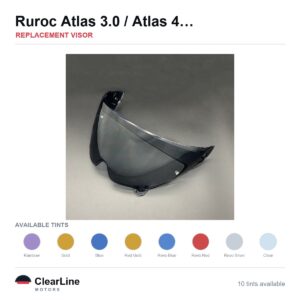
| Replacement Visor | Atlas 3.0 Visors, Atlas 4.0 Visors | The standard shield, listed across the full tint range |
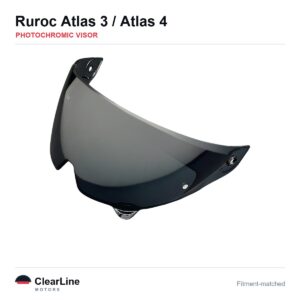
| Photochromic Visor | Atlas 3.0 Visors, Atlas 4.0 Visors | Darkens in daylight and clears again out of it |
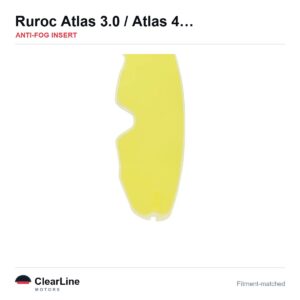
| Anti-Fog Insert | Atlas 3.0 Visors, Atlas 4.0 Visors | An insert fitted inside the shield to stop misting |
Here is the important limit. A product name that lists two model names, and a category page that holds one product, are both listing data from our supplier. Neither is a test, and neither is evidence that a shield taken off one generation will seat correctly on another.
So we make no interchange claim. We will tell you what a product is filed under, and we will not tell you that your old shield will fit your new helmet, because nobody here has measured it. You can browse the full Ruroc visor range and work from the generation categories.
Clear, smoke and mirrored finishes: what the tint changes
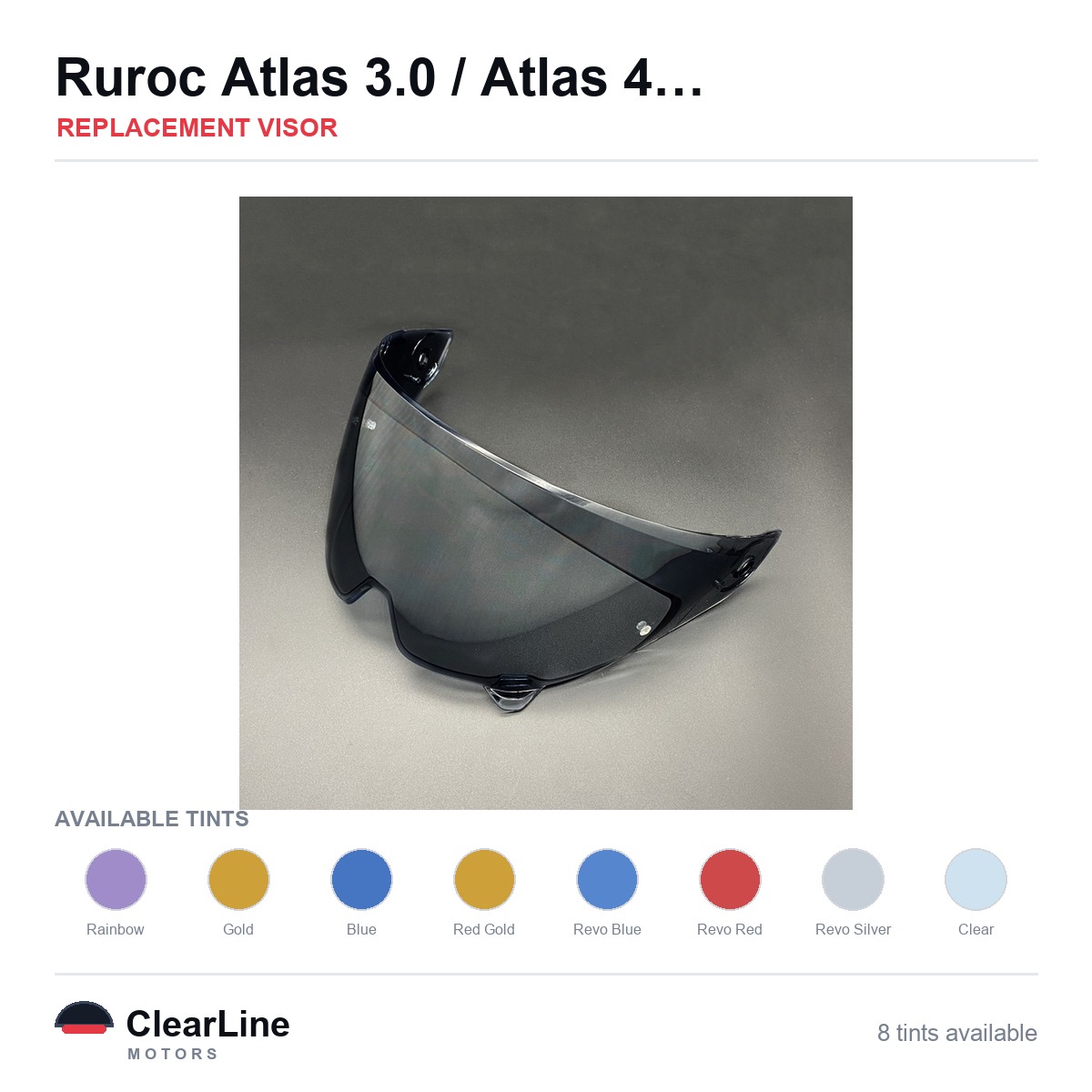
The replacement shield is listed in clear, smoke, silver, gold, blue, rainbow, red gold and the Revo mirrored finishes. Which of those you can actually use comes down to where you ride, and that is worth settling before you pick on looks alone.
Anything mirrored or heavily darkened transmits too little light to be legal for road use in Great Britain. Those finishes are sold for track and closed-circuit riding. Our explainer on iridium and mirrored visor legality covers why that holds at every hour of the day.
For public roads, the practical choice is a clear shield or a light tint, and ClearLine keeps those together in the clear replacement visor range. A clear shield is also the one to own if you ride at night or through a British winter, when light is scarce and a dark tint costs you more than it gives you.
A photochromic shield is the middle path, darkening as ultraviolet light rises and clearing again as it falls. That behaviour is what the photochromic visor range exists for, and it removes the roadside swap on a day that starts grey and turns bright.
The legal test is the marking, not the tint name
This guide describes the position in Great Britain only. Eye protectors for motorcyclists are prescribed by the Motor Cycles (Eye Protectors) Regulations 1999, and the detail sits in regulation 4.
That regulation prescribes protectors conforming to Grade X in British Standard BS 4110:1979, along with the later XA, YA and ZA grades and equivalent European standards. It also requires the protector to be “marked with an approved certification mark of an approved body”. BS 4110 is the British Standard that applies to visors.
Read that last requirement carefully, because it is the whole test. What makes a visor lawful for road use in Great Britain is the marking carried by that individual item, not the name of its colour and not the description on a listing.
That is also why we never describe anything in our catalogue as approved, certified or road legal. We do not inspect markings on individual items, so any such claim from us would be an assertion we cannot stand behind. Check the marking on the part in your hands.
The Highway Code view of a clean, undamaged shield
The everyday version of the same concern appears in the Highway Code. Rule 83 tells riders to check “that your helmet visor is clean and in good condition” before each journey.
Rule 84 goes further on why a tired shield matters, warning that “scratched or poorly fitting eye protectors can limit your view when riding, particularly in bright sunshine and the hours of darkness”. That is a fair description of what a scuffed visor does at dusk.
It is worth reading as a replacement trigger rather than a cleaning instruction. A shield that has gone hazy with fine scratching scatters oncoming headlights, and no amount of polishing puts the surface back.
Fogging on a tight-sealing Atlas shield
A shield that seals well is a shield that traps your breath, which is why a good seal and a fogging problem so often arrive together. Warm, humid air meets cold plastic, and condensation forms as a fine mist of droplets that scatters light.
An insert fixes this by changing the surface the moisture lands on. Instead of beading into droplets, the condensate is held as an even film, and an even film stays transparent. The Atlas anti-fog insert is the version filed under both Atlas generation categories.
Inserts are not interchangeable across shields, because each one is cut to a particular shield shape and relies on pins or an adhesive edge set for it. If you are weighing an insert against a coating or a spray, our anti-fog insert hub compares the approaches.
Fitting a replacement shield without marking it
Work on a towel on a table, never on your knee beside the bike. Most dropped visors are dropped during removal, and a fresh shield only has to hit the ground once.
Open the visor fully to its highest position first, which is where most quick-release mechanisms disengage. Release one side, support the shield with your other hand, then release the second side rather than pulling the whole part free in one movement.
Handle the new shield by its edges only. Fingerprints on the optical area are not merely untidy: the oils attract dust, and the first clean is when scratching usually happens.
Seat both sides before you close it, and check the seal by closing the visor slowly and watching where it meets the shell. An even line all the way round means it is home. A gap at one corner means one side has not engaged, and forcing it closed is how tabs break.
If your Atlas is older than a 3.0
Our catalogue lists Atlas visors under the Atlas 3.0 and Atlas 4.0 categories only. If your helmet predates those, we do not currently hold a listing for it, and we would rather say that than sell you a part on a hopeful assumption.
The honest options are a manufacturer-direct part, a used shield from a reputable source, or a replacement helmet if the shield is no longer made at all. Any of those beats forcing a part that was never cut for your shell.
If you are unsure which generation you are dealing with, or you own something other than an Atlas, the ClearLine visor finder narrows the catalogue down by helmet model. For the wider question of how fitment works across brands, start with our pillar guide on what visor fits my helmet.
ClearLine is an independent aftermarket supplier. We are not affiliated with Ruroc, and our parts are described as fitting a model rather than as manufacturer equipment. You can read more about how we work on the ClearLine team page.
Visors and inserts mentioned in this guide
- Ruroc Atlas 3.0 / Atlas 4.0 Replacement Visor — Iridium, Smoke, Clear Tints — the standard shield, listed across the full tint range.
- photochromic visor for the Ruroc Atlas 3.0 and Atlas 4.0 — darkens in daylight, clears again out of it.
- See the Atlas anti-fog insert — the insert-based answer to misting.
- everything filed under the Atlas 3.0
- everything filed under the Atlas 4.0
- the mirrored and iridium shields we stock, for track use
Frequently asked questions
Does a Ruroc Atlas 3.0 visor fit an Atlas 4.0?
We do not make that claim. Our supplier files the Atlas products under both generation categories, but listing data is not a fitment test, and nobody here has measured a shield from one generation against a shell from the other. Buy from the category that matches the helmet you own.
How do I know which Atlas generation I have?
Start with your purchase record, which normally names the generation outright. If that is gone, read the certification label inside the shell. As a final check, photograph the base plate with the visor off and compare it against the product page images before you order.
Can I use a mirrored Atlas shield on UK roads?
Mirrored and heavily darkened shields transmit too little light to be legal for road use in Great Britain, at any hour. They are sold for track and closed-circuit riding. For the road, choose a clear shield or a light tint, and check the marking on the item itself.
Will an anti-fog insert fit the Atlas photochromic visor?
An insert only fits a shield that has been prepared for one, with the pins or the adhesive seating it needs. Both products are filed under the same Atlas categories, but check the individual product pages for the shield you own rather than assuming the pairing works.
Do you sell a visor for the Ruroc Atlas 2.0?
Not at present. Our Atlas listings sit under the Atlas 3.0 and Atlas 4.0 categories only, so there is nothing in the catalogue we could honestly sell you for an earlier shell. A manufacturer-direct part is the better route.