
A motorcycle helmet chin curtain is one of those small parts that arrives in the box, gets thrown in a drawer, and then gets blamed for something years later. It is a flap of fabric or foam that closes the gap under the chin bar of a full-face helmet. Riders fit one for quiet and warmth, and a fair number take it straight back out again in spring. Both groups are right, because the part solves one problem and quietly creates another.
The short answer: a chin curtain blocks the column of air that rushes up into your helmet from underneath. That makes the helmet quieter, warmer and less draughty, and it is genuinely useful on a cold motorway run. The same blocked airflow also traps the warm, moist air you breathe out, so a helmet with a chin curtain fitted fogs sooner and clears more slowly than the same helmet without one.
If you want the quiet without the fog, the curtain is not the part to change — the visor is. A second pane inside the visor is what keeps the view clear, and our guide to stopping helmet visor fogging covers the whole picture.
What a motorcycle helmet chin curtain actually is
A chin curtain is a shaped strip, usually fabric-covered foam, that pushes into a channel running along the inside edge of the chin bar. On most full-face helmets it seats behind the comfort liner and sits against your throat when the helmet is on. It is not structural, it is not part of the safety shell, and removing it changes nothing about how the helmet protects you.
The shape is specific to the helmet. Manufacturers cut the channel differently and the curtain has to follow the curve of that particular chin bar, so a curtain for one model rarely seats properly in another. That is why they are sold per model rather than as a universal part, and why a generic one from a marketplace listing often sits proud, whistles, or falls out on the first cold morning.
Plenty of touring and sport-touring helmets ship with a curtain already fitted. Track-focused and adventure helmets often do not, because both are designed around moving as much air through the helmet as possible.
What a chin curtain does well
The air that reaches your ears inside a helmet does not mostly come in through the vents. A large share of it comes up from below, around your neck, through the open bottom of the chin bar. That rising column is turbulent and it is loud.
Close it off and three things improve at once. Wind noise at motorway speed drops noticeably, because you have removed one of the larger paths for air to enter and swirl. Cold air stops running up the inside of the helmet and over your chin and cheeks, which on a winter ride is the difference between comfortable and miserable. Buffeting settles down, because there is less turbulence bouncing around inside the shell.
None of that is dramatic on its own. Together, over a two-hour ride in February, it is the reason experienced riders keep one fitted from October onwards.
Why a chin curtain can make your visor fog
Fog on the inside of a visor is condensation. Your breath leaves your body warm and close to fully saturated with water vapour. When that air touches a surface colder than its dew point, the vapour comes out of the air and settles on the surface as a film of tiny droplets, and those droplets scatter light instead of passing it through. That is the grey haze you are looking at.
Two things decide whether it happens. One is how cold the inner face of the visor is, which is set by the weather and by how fast you are going. The other is how humid the air inside the helmet is, which is set by your breathing and by how quickly that breath gets flushed out.
A chin curtain works directly on the second one, in the wrong direction. The updraft it blocks was not only carrying cold air in, it was carrying your exhaled moisture out. Seal the bottom of the helmet and the humid air stays put, sitting against a cold visor. This is why riders often find their visor started fogging the week they fitted the curtain, and why the marketplace listings that advertise a chin curtain as a fogging fix have it backwards.
The part that actually keeps the view clear
If the humidity cannot be reduced without giving back the quiet, the answer is to stop the visor being cold. That is what a second pane does. An anti-fog insert seals to the inside of the visor with a silicone bead and traps a thin layer of still air between the two surfaces. The inner pane is insulated from the wind, stays above the dew point of the air in the helmet, and so nothing condenses on it.
Modern inserts add a second mechanism on top of the air gap. A hydrophilic surface treatment changes what condensate does when it forms at all. Research on antifogging coatings published in Advanced Science in 2022 (PMC9109053) describes the effect plainly: “condensed water spreads into a pseudo‐film shape immediately to avoid fogging”.
A continuous film of water passes light through; a field of separate droplets scatters it. Your eye reads the first as clear and the second as fog.
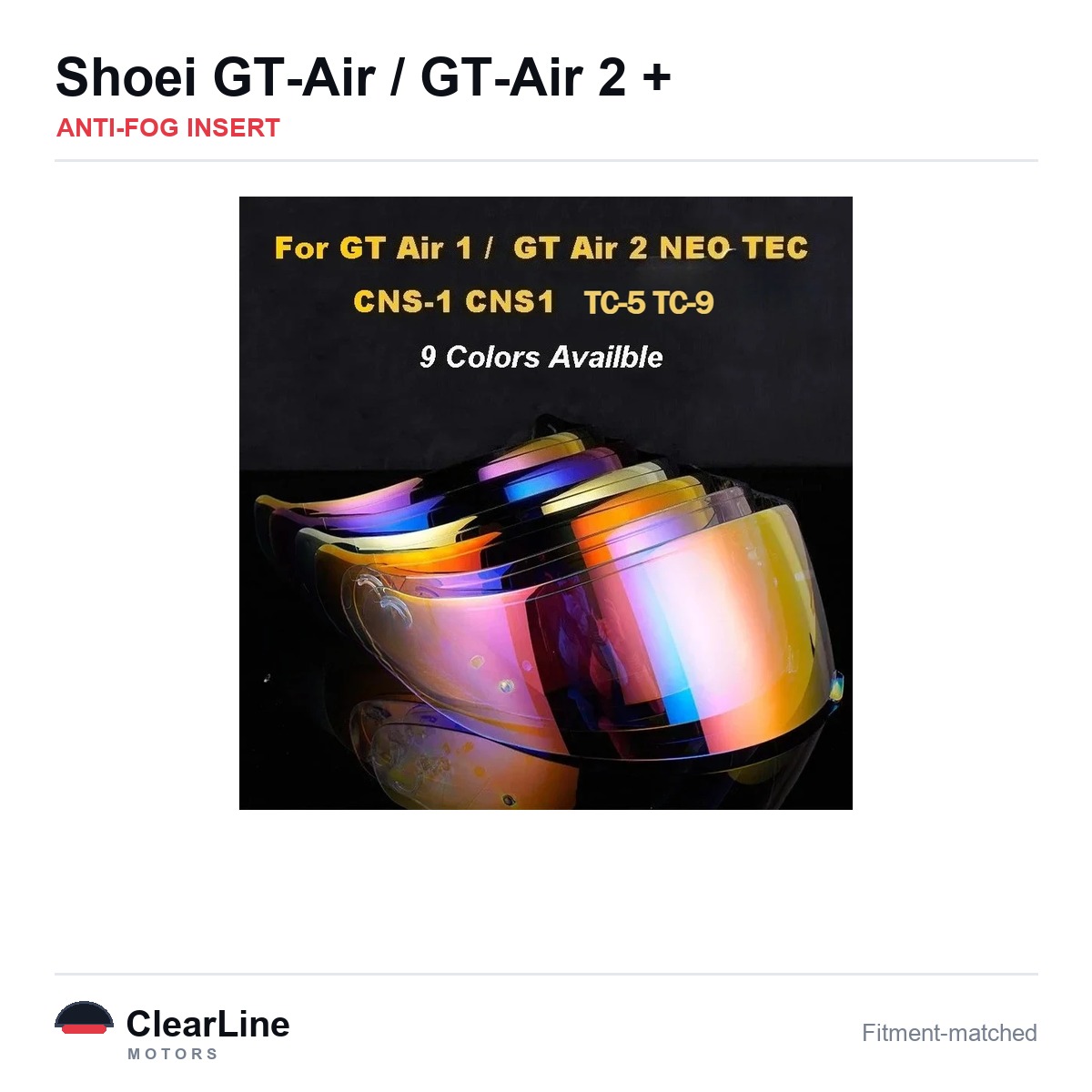
We stock Pinlock-compatible anti-fog inserts cut for specific visors, including the Shoei GT-Air II, GT-Air and Neotec insert shown above and the AGV K6 Anti-Fog Insert. The insert needs a visor with the pins to hold it, so check your visor is the pin-ready version before ordering. If yours is not, a clear replacement visor in the pin-ready specification is the first thing to sort out.
Chin curtain, breath guard, or both
These two parts get confused constantly, and they are not alternatives. A chin curtain closes the gap between the chin bar and your neck. A breath guard sits in front of your nose and mouth and redirects what you exhale downwards, away from the visor. One manages the air coming in from below, the other manages where your breath goes.
| Part | What it blocks | Effect on noise | Effect on fogging |
|---|---|---|---|
| Chin curtain | Air rising into the helmet from under the chin bar | Reduces wind noise | Makes fogging more likely |
| Breath guard | Exhaled air travelling up towards the visor | Little or none | Reduces fogging |
| Anti-fog insert | Nothing — it insulates the visor surface | None | Prevents condensation forming |
Run together, a chin curtain and a breath guard cancel out some of each other’s side effects: the curtain keeps the warmth in, the guard steers your breath away from the cold pane. That combination still relies on the guard sealing well against your face, which depends on your nose shape as much as the part. We go through the trade-off in detail in what a motorcycle helmet breath guard does.
Which helmets take a chin curtain
Almost every modern full-face and flip-front helmet has the channel for one, whether or not a curtain came in the box. Touring models are the most likely to include one, because they are built for long, cold, fast distances. Open-face and half helmets have no chin bar, so the question does not arise.
The curtain is sold by the helmet manufacturer under the model name, and that is where to buy it — we do not stock chin curtains, only visors and inserts. What we can tell you is which visor and insert fit the same helmet, and that is worth checking at the same time, because a curtain and a fogging visor tend to arrive together as a problem. Start from your model in the visor finder, or browse the visors and inserts that fit Shoei helmets and the visors and inserts that fit AGV helmets directly.
How to fit and remove one
This takes about a minute once you know where the channel is, and it needs no tools.
- Take the helmet off and turn it upside down so you are looking into the chin bar from below.
- Find the channel — a narrow slot running along the inside lower edge of the chin bar, usually just behind the front lip of the comfort liner.
- Start the curtain at one end, pushing the stiffened tab into the slot until it seats.
- Work along to the other end with your thumb, feeding the tab in a little at a time rather than trying to press the whole strip in at once.
- Run a finger along the seated edge to check for a section that has popped back out. A curtain that is half in will whistle at speed, which is the opposite of the reason you fitted it.
Removal is the same in reverse, and a curtain will usually pull straight out with steady pressure from one end. Most riders take theirs out around April and put it back in October. There is no harm in leaving it in year-round if you accept the warmer, more humid helmet that comes with it.
Keeping the visor clear once the curtain is in
An insert does most of the work, but a few habits matter more in a sealed helmet than an open one.
Start clean. A visor carrying a greasy film from fingers, road grime or an old polish gives condensation more to cling to, and a surface that was never properly washed will fog before a clean one does. Warm water, a drop of mild detergent and a soft cloth on both faces is the whole routine — no solvents and no polish.
Crack the visor open one notch when you stop at lights, before the fog has formed rather than after. Keep your ventilation open in cold weather even though the instinct is to shut it, because the vents are now the only route the moisture has out.
If your visor fogs on a brand new helmet the cause is often none of these, and why a new visor fogs goes through it. Riders running a headset have their own version of the problem, covered in helmet intercom fogging. If your visor has no pins for an insert, the alternatives to a Pinlock-ready setup sets out what is left.
What the law expects of your view
A chin curtain is not eye protection and no British Standard applies to it. What it can affect is the thing the law does care about, which is whether you can see.
The Highway Code is direct about this. Rule 83 tells riders to “check that your helmet visor is clean and in good condition” before each journey. Rule 84 warns that “Scratched or poorly fitting eye protectors can limit your view when riding, particularly in bright sunshine and the hours of darkness”. A fogged visor is the same failure by a different route, and setting off with one is a choice the Code expects you not to make.
Where the law does bite is the visor itself. In Great Britain a visor is only road legal if it carries the certification marking prescribed in The Motor Cycles (Eye Protectors) Regulations 1999, which name Grade X and Grades XA, YA and ZA in British Standard BS 4110 — the standard written for visors. The test is the marking on that individual visor, not its colour and not what a listing calls it.
Heavily tinted visors transmit too little light to be legal for road use in any conditions, so reaching for a dark visor because a clear one keeps fogging swaps one problem for a worse one. ClearLine does not verify markings on individual items, so we make no claim about the legal status of anything we sell.
The Highway Code text above is published by the Department for Transport at gov.uk, and both rules were read against the live page while writing this.
Visors and inserts mentioned in this guide
- Shoei GT-Air II / GT-Air / Neotec Anti-Fog Insert
- Anti-fog insert for the AGV K6
- See the full anti-fog insert range
- Clear replacement visors
- Everything that fits a Shoei
- Everything that fits an AGV
Not sure which part fits your helmet? Start with the visor finder and work from your model. Free shipping applies to every order.
Frequently asked questions
Does a motorcycle helmet chin curtain cause fogging?
It makes fogging more likely rather than causing it outright. The curtain blocks the airflow that was carrying your exhaled moisture out of the helmet, so the air inside stays more humid and reaches the visor’s dew point sooner. The fog itself is caused by a cold visor meeting that humid air. An anti-fog insert fixes the cold surface, which is why it works with the curtain still fitted.
Does a chin curtain reduce wind noise?
Yes, and this is the main reason to fit one. A significant share of the air reaching your ears comes up through the open bottom of the chin bar rather than through the vents, and that rising column is turbulent and loud. Closing it off reduces noise at motorway speed and cuts down buffeting inside the shell. It will not make a loud helmet quiet, but the difference is audible.
Can I use a chin curtain from a different helmet model?
It is unlikely to seat properly. The curtain pushes into a channel cut into that specific chin bar, and the length, curve and tab thickness all vary between models. A curtain that does not seat fully will whistle, work loose or fall out. Buy the one listed for your helmet by its manufacturer.
Should I take the chin curtain out in summer?
Many riders do, and there is no downside to trying it. In warm weather the airflow the curtain blocks is welcome, and the helmet runs cooler and less humid without it. Removing and refitting it takes about a minute and does nothing to the helmet’s protection, so treat it as a seasonal adjustment rather than a permanent decision.
Is a chin curtain a safety part?
No. It is a comfort part that sits behind the comfort liner and takes no load. Fitting or removing one does not change how the helmet protects you in an impact, and it is not covered by the standard that applies to the helmet shell. The part of your kit the law does test is the visor, which must carry the certification marking to be used on the road in Great Britain.
Written by the ClearLine team.