
Fitting a brand-new visor and then watching it mist up worse than the scratched one you just binned is one of the more demoralising moments in motorcycling. It feels like a faulty part. New visor fogging is almost never a fault, though: it is usually the predictable result of what came off the old visor, how well the new one seals, and what is still sitting on the surface of a part that has spent weeks in a box.
The short answer: a new visor fogs more than the old one for four common reasons — the anti-fog insert or coating stayed behind on the visor you removed, the fresh seal is tighter so less of your breath escapes, packing and handling residue is still on the inside surface, or the visor is sitting cold and slightly proud of its base plate. All four are fixable in about ten minutes, and none of them means the visor is defective.
Why new visor fogging catches riders out
Fog is condensation. Warm, damp air from your breath meets a surface that is colder than the dew point of that air, and the water vapour turns into thousands of tiny droplets that scatter light in every direction. The visor is not dirty and it is not cloudy — it is covered in droplets small enough to act like frosted glass.
Whether those droplets form at all depends on two things you can influence: how cold the inner surface is, and how much moist air is trapped against it. A replacement visor changes both of those variables at once, which is why the difference is so noticeable on the first cold morning after a swap.
The surface chemistry matters too. Research on anti-fog coatings describes the mechanism plainly: hydrophilic coatings “can prevent surface fogging by instantly facilitating pseudo-film water condensation but suffer from short antifogging duration due to water film thickening with further condensation” (Advanced Science, 2022). In other words, the trick is not to stop water condensing. It is to make the water spread into a thin, continuous film you can see through rather than into droplets you cannot.
That paper studies coating materials in a laboratory, not motorcycle visors on a wet commute. The principle still explains the everyday observation: whatever was making the old visor behave is frequently a coating or an insert, and a new visor arrives without it.
The insert or coating stayed on the old visor
This is the single most common cause, and it is worth checking before anything else. A pin-style anti-fog insert is fitted to the visor, not to the helmet. When the visor comes off, the insert goes in the bin with it unless you deliberately move it across.
Riders often forget the insert was ever there, because a well-fitted one is close to invisible in use. Two winters of a clear view can feel like “my old visor just didn’t fog”, when the real explanation was a second layer of plastic with a sealed pocket of air behind it.
The same applies to a factory anti-fog treatment. Some visors ship with a coating on the inner face and some do not, and a like-for-like replacement is not guaranteed to carry the same specification as the part that came with the helmet years ago. If you are weighing the two approaches, our guide to choosing between an anti-fog insert and an anti-fog coated visor sets out how each behaves over a season.
Practical fix: fit an insert to the new visor. A range of model-matched anti-fog inserts is listed by helmet model rather than sold as a universal part trimmed to fit, and fitting one is the closest thing to a one-step cure for this whole problem.
A new visor seals better, so your breath has nowhere to go
An old visor has had a hard life. The rubber seal around the eyeport has been compressed thousands of times, the visor itself may have taken a slight set from heat and pressure, and the closing mechanism has worn in. The result is a visor that leaks a little air continuously, all the way round.
That leak is doing useful work. It vents warm, humid air out of the helmet before it can condense, and it lets drier outside air in to replace it. You never notice the ventilation you are getting for free until it stops.
A new visor closes cleanly onto an uncompressed seal. Less air escapes, so more of your breath stays in the helmet and lands on the coldest surface available, which is the visor you are looking through. A single afternoon of work has made the helmet measurably more airtight.
This one usually settles as the seal beds in over a few weeks of riding. Until it does, use the vents properly and the first detent position at low speed. Our guide to why a visor fogs when you stop but not at speed covers the airflow side of this in detail.
Packing film, handling marks and fitting residue
A replacement visor spends weeks in transit wrapped in protective film, and it is handled at least twice before you ride with it. Every fingerprint, every smear of silicone polish that migrated off a cloth, and every trace of adhesive from the film changes how water sits on that surface.
A greasy or patchy film does not stop condensation. It changes where droplets nucleate, and it can produce that distinctive uneven misting where one area clouds first and the rest follows a minute later. People read that pattern as a defective coating when it is usually contamination.
There is also a simpler version of this mistake: leaving the inner protective film on. It looks like a permanent haze, it never clears with airflow, and it peels off from a corner with a fingernail in about five seconds.
Wash a new visor before its first proper ride. Warm water, a drop of mild detergent, no solvents and no polish. The Highway Code asks riders to check “that your helmet visor is clean and in good condition” before every journey (Rule 83), and starting from a genuinely clean surface is the cheapest anti-fog measure there is.
The insert is fitted, but it is not sealing
An insert that is on the visor is not necessarily doing its job. The whole principle depends on a sealed pocket of still air between the insert and the visor, held there by the silicone bead around the insert’s edge. If that bead is not under even tension all the way round, humid air gets in and condenses where you cannot wipe it.
The classic symptom is fog appearing between the two layers rather than on the surface nearest your face. If that is what you are seeing, the diagnosis is a seal problem, not an anti-fog problem, and we cover the causes in fog between the visor and the insert.
Pin spacing is the other trap after a visor change. A new visor is not guaranteed to use the same pin standard as the one it replaced, and an insert built for one spacing will sit slack or strained on the other. Our guide to 70 and 120 pin spacing explains how to tell them apart before you order.
If the insert is correct for the visor and still not sealing, the eccentric pins usually need a small turn to increase tension. Work in small increments and check by eye that the bead compresses evenly. Our step-by-step on fitting a pin-style anti-fog insert walks through the adjustment.
The visor is not seated properly on the base plate
A visor that has not clicked fully home sits a millimetre or two away from the seal on one side. That gap is too small to see and too small to whistle, but it is more than enough to let a steady trickle of damp air reach the inside of the visor. It also tends to fog asymmetrically, which is a useful clue.
Check it with the helmet off. Close the visor fully, then look along the seal line from the front at eye level and compare the two sides. Any visible step, or a visor that needs thumb pressure to stay shut, means the mechanism has not engaged.
Refitting usually solves it. Take the visor off and put it back on with the mechanism in its fully open position, which is where most base plates are designed to accept the visor — our guide to removing and refitting a visor without damaging the mechanism covers the common systems.
A cold visor out of the box condenses first
Condensation happens on the coldest surface in the helmet. A visor that has been sitting in an unheated garage or has just arrived on a winter morning can be several degrees below the ambient temperature inside the house where you fitted it, and it stays that way for a surprisingly long time.
Ride off immediately and you get the worst possible combination: a cold surface, a warm rider and no airflow at junction speeds. The same visor on the same bike in the same weather often behaves much better an hour later.
If you have a choice, fit a new visor the night before and leave the helmet somewhere temperate. It costs nothing and it removes one variable from your diagnosis.
A five-minute diagnosis
Work through these in order. Each one rules out a cause, and the pattern of the fog usually points at the answer before you finish.
| What you see | Most likely cause | First thing to try |
|---|---|---|
| Even misting across the whole visor, clears with airflow | No insert or coating on the new visor | Fit an anti-fog insert matched to the visor |
| Fog trapped between two layers of plastic | Insert fitted but not sealing, or wrong pin spacing | Increase pin tension, then confirm the spacing |
| One side or one corner clouds first | Visor not fully seated, or a gap at the seal | Remove and refit the visor, then check the seal line |
| Patchy, blotchy misting in the same places every time | Handling or packing residue on the inner face | Wash with warm water and mild detergent |
| A haze that never clears, whatever you do | Protective film still on the inner surface | Peel it from a corner |
| Only bad on the first ride after the swap | Cold visor, or a seal that has not bedded in | Let it acclimatise, use the vents and first detent |
What actually fixes it
The order below reflects how often each step solves the problem, not how much effort it takes. Start at the top.
- Fit an anti-fog insert to the new visor. If the old visor had one and the new one does not, everything else is a workaround.
- Clean the inner surface properly. Warm water, mild detergent, a soft cloth, then air dry. No solvents, no glass cleaner and no polish.
- Confirm the visor is fully seated. Refit it with the mechanism fully open and check the seal line on both sides.
- Set the pin tension. An insert that is on but slack is close to useless.
- Use the helmet’s ventilation deliberately. Chin vent open in cold, damp weather, and the first detent position when you are stationary.
- Give the seal a few weeks. Some of this genuinely does improve as the new visor beds in.
If you have worked through all six and the visor still mists badly, the problem has moved beyond the visor itself. Helmet fit, breath routing and what you wear round your neck all matter, and our pillar guide on how to stop a helmet visor fogging tackles the whole system.
Choosing the replacement in the first place
Much of this is avoidable at the point of ordering. If your current visor has an insert, buy a replacement that takes the same insert, or budget for a new insert alongside it. A visor and an insert ordered together cost less hassle than a visor ordered alone and a cold, foggy commute a week later.
Fitment is model-specific, and helmet model names are reused across generations that do not share a visor. If you are not certain which part your helmet takes, the visor finder narrows it down from the model name printed inside the chin bar or on the strap label.
For a straightforward like-for-like swap, our range of clear replacement visors is the place to start, and the section for visors and inserts that fit Scorpion helmets is a good example of how parts are grouped by model.
Visors and inserts mentioned in this guide
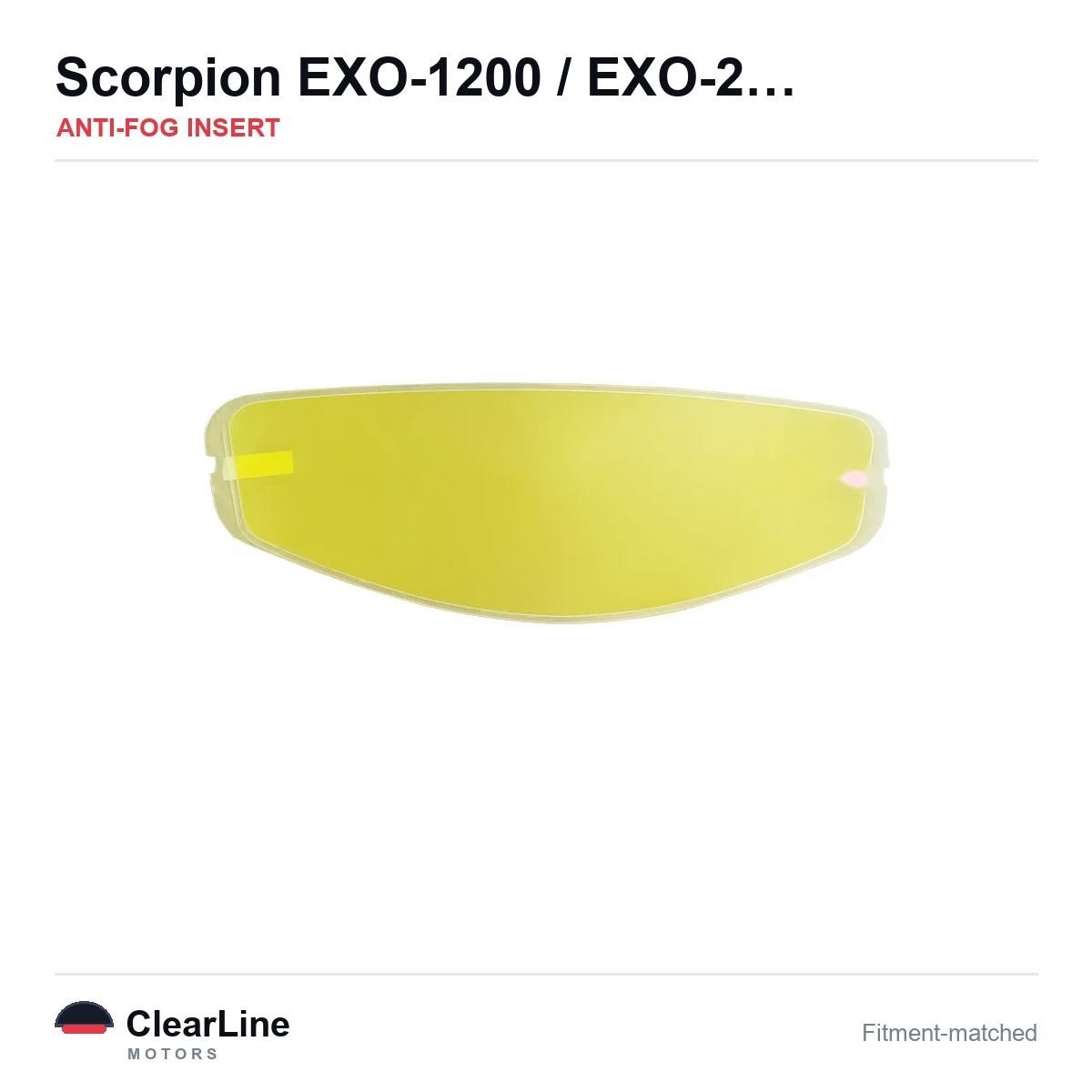
- Scorpion EXO-1200 / EXO-2000 / EXO-390 / EXO-410 & more Anti-Fog Insert — Stops Visor Fogging
- ILM 902 / 902BT / 902L Anti-Fog Insert — Stops Visor Fogging
- Pinlock-compatible anti-fog inserts
- Clear replacement visors
- Visors and inserts that fit Scorpion helmets
Frequently asked questions
Why does my new visor fog up more than my old one?
Usually because the old visor had an anti-fog insert or coating that did not travel across, and because a new visor seals more tightly so less of your breath escapes. Packing residue on the inner face and a visor that has not clicked fully onto its base plate account for most of the rest.
What causes full-face helmet visors to fog up and how can I reduce it?
Warm, moist breath meets a visor surface that is colder than the dew point, and the vapour condenses into light-scattering droplets. You reduce it by lowering the humidity inside the helmet and raising the surface temperature of the visor: open the chin vent, keep your nose and mouth outside a neck tube, crack the visor to its first detent when stationary, and fit an anti-fog insert so any condensation spreads into a clear film instead of droplets.
Can I move the anti-fog insert from my old visor to the new one?
Often yes, provided both visors use the same pin spacing and the insert’s silicone bead is still supple. Check the spacing before you order the visor rather than after it arrives. A bead that has gone hard or flattened will not seal again, and a fresh insert is the more reliable answer.
Should I wash a new visor before the first ride?
Yes. Warm water, a drop of mild detergent and a soft cloth, then let it air dry. Avoid solvents, glass cleaners and polishes, which can damage polycarbonate or leave a film that makes misting worse.
Does a new visor need breaking in before it stops fogging?
The visor itself does not, but the seal around the eyeport does. A fresh seal is tighter than a compressed one, so the helmet retains more humid air for the first few weeks. That part genuinely improves with use, unlike a missing insert, which never will.
Is fogging between the visor and the insert a different problem?
Yes, and it points somewhere specific. Fog trapped between the two layers means the insert’s seal is not holding, so the fix is pin tension or the correct pin spacing rather than more ventilation.