
Fit a communicator to your lid and a lot of riders notice the same thing on the first cold morning: the visor mists over faster than it used to, and it clears more slowly. Helmet intercom fogging is one of the most common complaints from riders who have just started running a comms unit, and it is almost always misread as a fault with the device itself.
It is not. The intercom does not generate heat or moisture in any quantity that matters. What it changes is the path air takes through your helmet, and how much warm, wet air you put into that helmet while you are riding.
The short answer: an intercom does not cause fog directly. It causes fog in three indirect ways — the microphone boom and cable hold the chin curtain or neck roll slightly open, which disturbs the low-pressure extraction that normally pulls your breath out of the chin bar; you talk far more than you did before, and speech pushes considerably more warm, humid air onto the back of the visor than quiet breathing; and speaker pockets can compress the helmet’s lining enough to change how air moves around your head. Fix the airflow and fit a proper anti-fog insert, and the comms unit becomes irrelevant to the problem.
Why helmet intercom fogging is an airflow problem, not an electronics one
A visor fogs when warm, moisture-laden air from your mouth and nose meets a surface that is colder than the dew point of that air. The water leaves the air and lands on the plastic as a film of tiny droplets, and those droplets scatter light in every direction, which is what you see as fog. Nothing about that process involves electricity.
What a comms unit does is sit in the airflow. The microphone is mounted directly in front of your mouth, on a boom or a stub, and the cable to it has to get from the speaker pocket down to the chin bar. Both of those things occupy space that was previously sealed.
That matters more than it sounds. A modern full-face helmet is designed so that air entering the chin vent passes across the inside of the visor and leaves through the bottom of the chin bar. That flow is what carries your breath away before it can condense. Interrupt the seal and the extraction weakens.
The chin curtain and the microphone cable
The chin curtain is the fabric skirt at the bottom of the chin bar. Its job is not warmth. It is there to stop air being drawn up into the helmet from below, so that the air moving across your visor goes in the direction the designer intended.
When you fit a comms unit, the cable usually has to be routed past that curtain, and the microphone boom often sits right where the curtain meets the shell. The curtain no longer seats flat. Cold air now enters from underneath, chilling the inside face of the visor at exactly the point where your breath lands on it.
This is the single most common cause worth checking first, and it costs nothing to test. Re-seat the curtain properly, route the cable behind the lining rather than across the opening, and see whether the misting changes on the next cold ride. If your helmet came with a breath guard, refit it — most riders remove it during installation and never put it back.
Talking puts far more moisture into a helmet than breathing
Quiet nasal breathing moves a modest volume of air, and much of it is directed downward. Speech is different. It is driven through the mouth at higher velocity, aimed forward, and it carries a great deal more water vapour with it.
If you have gone from riding in silence to holding a conversation with a pillion or a group for an hour, you have genuinely changed the amount of moisture arriving at the visor. The helmet has not got worse. The load on it has increased.
This is why the problem tends to appear on the first group ride after fitting a comms unit rather than on the commute. It is also why people who mostly use their unit for navigation prompts rarely report it. The variable is how much you speak, not what you installed.
Why cracking the visor open is a poor fix
Opening the visor a notch does clear fog, because it dumps the humid air and lets cold, dry air in. As a short-term measure at a standstill it is fine. As a riding strategy it has real costs.
An open visor lets in rain, road spray, grit and insects, and at speed the turbulence around a cracked visor is noisy and tiring. It also tends to become a habit — riders leave the visor cracked permanently through winter, which means they are riding with reduced protection for their eyes for months at a time.
The Highway Code is explicit that eye protection matters. Rule 84 of the Highway Code states that “it is also advisable to wear eye protectors, which MUST comply with the Regulations”, and warns that “scratched or poorly fitting eye protectors can limit your view when riding, particularly in bright sunshine and the hours of darkness”. A permanently cracked visor is a poorly fitting one by any practical reading.
How an anti-fog insert actually works
An anti-fog insert is a second lens that seals against the inside of your visor, usually held by a silicone bead and located by two pins. The trapped pocket of air between the insert and the visor acts as insulation. The inner surface that your breath reaches therefore stays much closer to the temperature inside the helmet, and never drops below the dew point, so condensation does not form.
That is a different mechanism from a coating. Coatings work chemically rather than thermally: a study of antifogging coatings published in Advanced Science (PMC9109053) describes how a hydrophilic coating causes condensed water to spread into a continuous pseudo-film rather than beading, so the light passes through instead of scattering. That is a materials study rather than a test of any particular insert.
Both approaches are valid, and they solve the problem at different points. We have a fuller comparison in our guide to anti-fog inserts versus coatings, which covers durability and how each behaves once it wears.
Fitting an insert when you already run an intercom
An insert and a comms unit do not conflict. They occupy different parts of the helmet and neither interferes with the other. There are two things worth getting right.
First, the insert has to match the visor, not the helmet. Pinlock-compatible inserts are sized to a specific visor shape and pin position, so a visor from a different model will not take the same insert even if the helmets look similar. Our motorcycle visor finder will narrow it down by helmet model.
Second, fit the insert with the visor at room temperature and clean on both faces. Any fingerprint or polish residue trapped behind the insert cannot be reached afterwards without removing it. If your visor is already scratched or hazed, replace it at the same time — a new insert behind a tired visor is wasted money. Our range of clear replacement visors covers most current helmets.
What to check, in order
Work through these in sequence rather than changing several things at once. Each one is reversible and costs nothing except the first ride to test it.
| Check | What you are looking for | Cost to try |
|---|---|---|
| Chin curtain seating | Curtain sits flat, not lifted by the mic cable | Free |
| Breath guard fitted | Guard still in place after the comms install | Free |
| Cable routing | Cable behind the lining, not across the chin opening | Free |
| Chin vent open | Vent slider fully open, not blocked by the mic | Free |
| Visor condition | No scratches or hazing on the inner face | Inspection |
| Anti-fog insert | Insert fitted, sealed all round, pins correct | Insert |
In most cases the problem is resolved before you reach the bottom of that list. If it is not, the visor itself is usually the limiting factor.
Venting, speaker pockets and helmet fit
Speakers sit in recesses beside your ears, and on a helmet with a snug lining they can press the padding inward. On some models that is enough to alter how air moves from the top vents down past your head. If your helmet was already a firm fit, adding speakers can make it firmer still.
If you suspect this, check whether your helmet has removable speaker pads in the ear pockets. Many do, and taking them out restores the clearance the speakers now occupy. It is a five-minute job and it often improves comfort as much as it improves misting.
Riders on adventure and touring helmets with a peak see this more often, because those shells tend to run more vents and rely on them more heavily. If that describes your setup, our notes on adventure helmet fogging go into the venting side in more detail.
A note on visor markings
It is worth separating two ideas that often get mixed together. Whether a visor mists is a thermal question. Whether a visor may be used on the road is a legal one, and the two are unrelated.
The Motor Cycles (Eye Protectors) Regulations 1999 require that an eye protector be “marked with an approved certification mark of an approved body”. The legal test is that marking on the individual item, not its colour, its tint name or how it was sold. We do not verify markings on individual items, so check the marking on the item in front of you.
Fitting an anti-fog insert does not change any of this. The insert sits behind the visor and is not itself the eye protector.
Before every ride
Rule 83 of the Highway Code puts it simply: “Before each journey check that your helmet visor is clean and in good condition.” That check takes a few seconds and it catches most of what causes misting to get worse over a season.
Look at the inner face in daylight. Fine scratches and a dulled surface hold moisture far more readily than fresh plastic, and they also make any fog that does form much harder to see through. If you run an insert, check that the silicone bead is still seated all the way round.
If the visor has reached the end of its life, our visors that fit the AGV K6 and the wider Pinlock-compatible anti-fog insert range are the places to start. For the broader picture, our main guide on how to stop a helmet visor fogging covers every cause in one place.
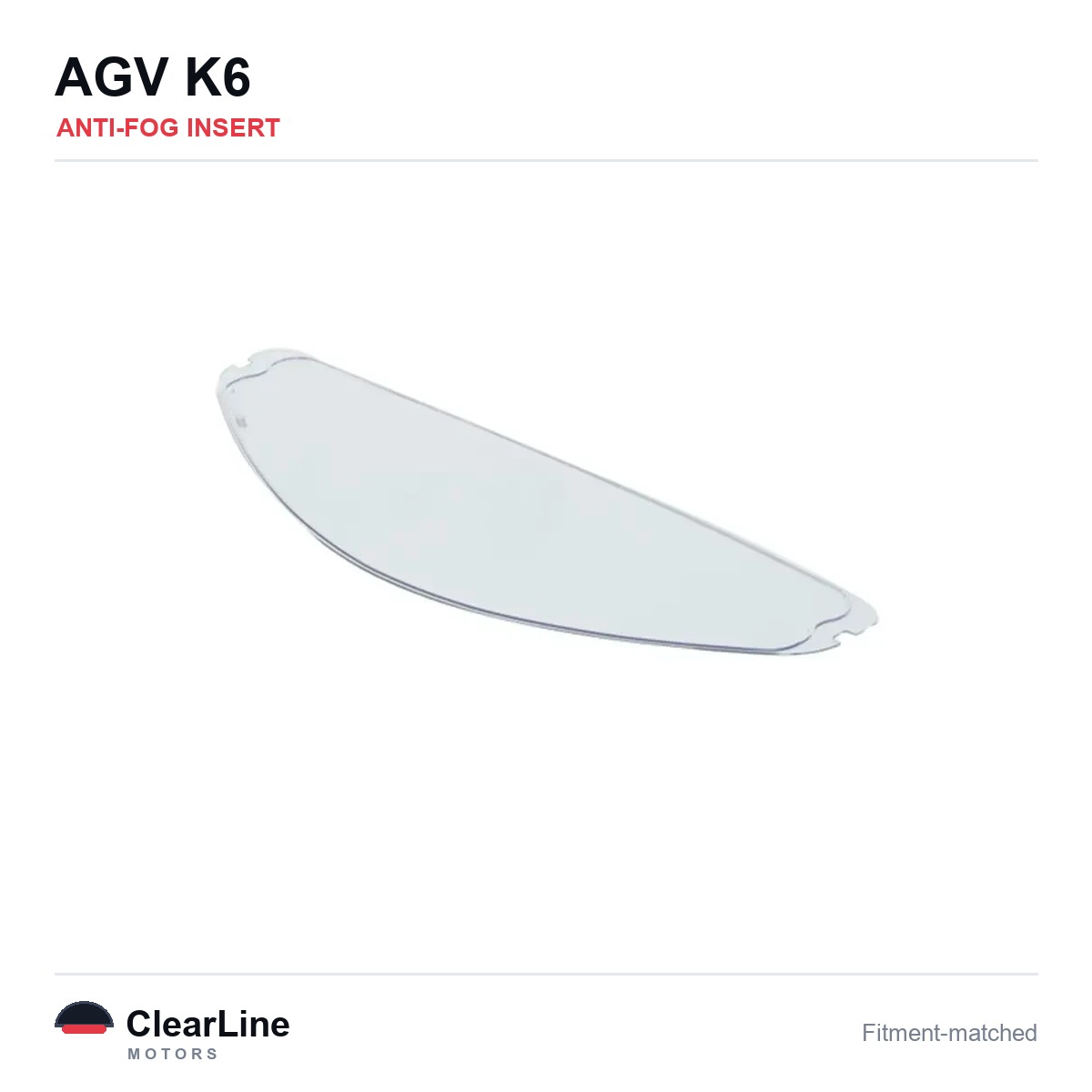
Visors and inserts mentioned in this guide
- AGV K6 Replacement Visor — Iridium, Smoke, Clear Tints
- AGV K6 Anti-Fog Insert — Stops Visor Fogging
- AGV K6 S / K6 Replacement Visor
Frequently asked questions
Does an intercom cause helmet visor fogging?
Not directly. An intercom produces no meaningful heat or moisture of its own. It contributes indirectly by disturbing the chin curtain seal, by encouraging you to talk far more than you otherwise would, and occasionally by compressing the lining around the speaker pockets. All three are fixable without removing the unit.
Can I fit an anti-fog insert with a microphone in the way?
Yes. The insert fits to the inside of the visor and the microphone sits below it in the chin bar, so the two never meet. Fit the insert with the visor removed from the helmet if you want more room to work.
Should I remove the chin curtain to reduce fogging?
No — that usually makes it worse. The chin curtain stops air being drawn up into the helmet from below, which is what keeps your breath moving in the direction the vents were designed to carry it. If it has been lifted out of place by a microphone cable, re-seat it rather than removing it.
Why does my visor only fog when I am stopped?
At speed, air is forced through the vents and carries moisture away quickly. At a standstill there is no ram air, so extraction depends on convection alone and the humid air lingers. This is normal behaviour and it is the one situation where briefly opening the visor is the sensible response.
Do I need a new visor as well as an insert?
Only if the visor is scratched or hazed. An insert seals against the inner face of the visor, so a damaged or uneven surface stops it sealing properly and lets moist air into the gap. On a visor in good condition an insert alone is enough.