
Internal sun visor fogging is the fault that catches riders out on the first properly cold morning of the year. The main visor stays clear, the drop-down tint mists over within a few breaths, and flipping it up leaves you squinting into a low sun instead. It happens because the drop-down sits on the warm, wet side of the helmet, closer to your breath than any other surface you look through.
The short answer: a drop-down internal sun visor fogs first because it sits between your face and the main visor, in the warmest and most humid air in the helmet, and because almost none of them will take an anti-fog insert. Fix the moisture at source with a chin curtain, a breath deflector and the main visor cracked onto its first detent, and keep the drop-down retracted until the air inside the helmet has warmed up. If the outer visor mists as well, an anti-fog insert for the outer visor removes most of the reason to ride with the tint down in poor light.
Why internal sun visor fogging starts before the main visor mists
A helmet with a drop-down has two transparent planes in front of your eyes, not one. The outer visor is cooled on its outside face by the airstream, but it is also the surface the top vents are designed to sweep. The drop-down sits inboard of it, in a pocket of still air that your breath reaches first and that the vents barely touch.
That geometry decides everything. Warm, saturated breath rises off the chin bar, meets the coldest surface it can find, and condenses there. When the drop-down is deployed, it is the coldest surface in that pocket, so it collects the condensation that the outer visor would otherwise have taken. Our guide on why a helmet visor fogs up and how to stop it covers the airflow side in more depth.
The second factor is coating. Most outer visors leave the factory with a hard anti-scratch coating and a set of pins for an insert. Drop-downs are usually moulded thin, tinted through the material, and finished with a scratch coating only — nothing on them is working against condensation.
What is actually happening on the plastic
Fogging is not a film of water. It is thousands of separate droplets, each one acting as a tiny lens, scattering light in every direction until the surface reads as opaque. The plastic itself is unchanged; you are looking through a haze of curved water surfaces.
That distinction is what anti-fog chemistry exploits. A materials study published in Advanced Science and archived at the US National Library of Medicine describes how hydrophilic coatings prevent surface fogging by making condensation form a continuous pseudo-film instead of droplets, so the light passes straight through. The same paper is candid about the weakness: those coatings suffer from short anti-fog duration, because the water film thickens as condensation continues.
That is the honest reason a treated drop-down works beautifully for one ride and disappoints on the next. The chemistry is real, the duration is limited, and nothing sprayed onto a thin tinted panel changes the airflow that put the moisture there.
Why you cannot fit an anti-fog insert to a drop-down
An anti-fog insert works by trapping a sealed layer of still air between itself and the visor, so the inner surface never falls to the temperature at which your breath condenses. It needs two things to do that: a pair of pins to tension against, and enough clearance for a second layer of plastic.
A drop-down sun visor has neither. There is no pin boss moulded into it, and the gap between the drop-down and the outer visor is measured in a couple of millimetres. Fitting anything into that space would foul the retraction mechanism, which is why the Pinlock-compatible anti-fog insert range is made for outer visors only.
This is the point most articles miss. You do not solve internal sun visor fogging on the drop-down itself — you solve it by making the drop-down unnecessary, or by getting the moisture out of the helmet before it arrives.
The fixes, in the order worth trying
Work down this list rather than buying the first thing you see. The early entries cost nothing and address the cause; the later ones manage the symptom.
| What you change | Why it works |
|---|---|
| Chin curtain fitted | Stops breath from being recirculated up the inside of the visor |
| Breath deflector fitted | Redirects exhaled air down and out of the chin bar |
| Main visor on its first detent | Admits a thin cross-flow that carries moisture out |
| Drop-down retracted below about 30 mph | Keeps the coldest surface out of the breath stream at low speed |
| Anti-fog insert on the outer visor | Removes the need to ride with the tint down in gloomy light |
| Neck tube worn below the chin, not over it | Prevents breath being funnelled straight up into the helmet |
Riders who commute in the dark often find the fourth and fifth entries do the work on their own. With a clear outer visor that stays clear, there is far less temptation to drop the tint as a wind shield, and the drop-down goes back to being a sunshade. Our walkthrough on how to demist a motorcycle visor at the roadside covers what to do when you are already fogged and moving.
Habits that make it worse
Three things reliably turn a mild mist into a blackout. The first is riding with the chin bar vent shut in traffic, which lets humidity build with nowhere to go. The second is a neck tube pulled up over the chin, which sends every breath upward into the exact pocket the drop-down occupies.
The third is deploying the tint before the helmet has warmed through. A drop-down that has been sitting in a cold garage all night is several degrees below the air inside your helmet, and putting it into the breath stream immediately guarantees condensation. Give it a few minutes of riding with the tint retracted and the problem often does not start.
Household glass cleaner belongs on the same list. It strips soft coatings and leaves a residue that condensation clings to, which is why a freshly “cleaned” drop-down often fogs faster than a dirty one. We go through the trade-offs in anti-fog inserts compared with anti-fog coatings.
Cleaning a drop-down without ruining the coating
The Highway Code asks riders to check that the helmet visor is clean and in good condition before each journey, and notes that scratched or poorly fitting eye protectors can limit your view, particularly in bright sunshine and the hours of darkness. A drop-down is inside the helmet, so it collects skin oils and hair product rather than flies, and it needs a gentler method than the outer visor.
Deploy it fully, rinse with lukewarm water, and let a damp microfibre cloth sit on any marks for a minute before you wipe. Wipe in one direction with almost no pressure, then let it air-dry rather than buffing it. Never use solvents, alcohol wipes, paper towel or anything abrasive.
If the drop-down is already hazed with fine scratches, cleaning will not bring it back. Scratches scatter light in the same way condensation does, and a scratched tint in low sun is genuinely dangerous. At that stage it is a replacement part from the helmet manufacturer, not a cleaning job — while the outer visor is something we can help with directly from the clear replacement visor range.
When the drop-down is worn out rather than fogged
Drop-down mechanisms wear. The slide can loosen until the tint creeps down under vibration, the pivot can develop play that leaves the panel sitting a few millimetres closer to your face, and the internal seal can degrade so that airflow finds its way into the pocket in the wrong direction. Any of those will make fogging appear on a helmet that never used to suffer from it.
Check it stationary. Deploy and retract the tint ten times and listen for a change in the click, then push gently on the deployed panel and watch for play at the pivot. A drop-down that no longer parks fully into the shell is sitting in the breath stream even when you think it is stowed.
We do not sell internal sun visors — those come from the helmet manufacturer — but if the outer visor has also aged, the visor finder for your helmet model will identify the right replacement, and the Scorpion EXO-1400 visors and inserts and Shoei GT-Air II visors and inserts pages cover two of the most common drop-down helmets on UK roads.
Is a tinted drop-down legal on roads in Great Britain?
A drop-down sun visor is an eye protector in law, and the test is the marking on the individual panel, not its colour or the name the manufacturer gave the tint. The Motor Cycles (Eye Protectors) Regulations 1999 prescribe Grade X in British Standard BS 4110:1979 and require the protector to be marked with an approved certification mark of an approved body. BS 4110 is the visor standard; BS 6658 is a helmet standard and is a different thing entirely.
Dark, mirrored and iridium panels transmit too little light to be legal for road use, day or night. Selling an eye protector as authorised for road use when it is not of a prescribed type is a seller offence under section 18(4) of the Road Traffic Act 1988, which is why we never describe any item in our catalogue as approved, certified or road legal — we do not verify the marking on individual items.
If you want the detail, our guide to tinted motorcycle visors and UK law goes through the marking rule properly. For a fogging problem specifically, the legality question usually resolves itself: the fix is to stop needing the tint down in poor light, not to run a darker one.
Visors and inserts mentioned in this guide
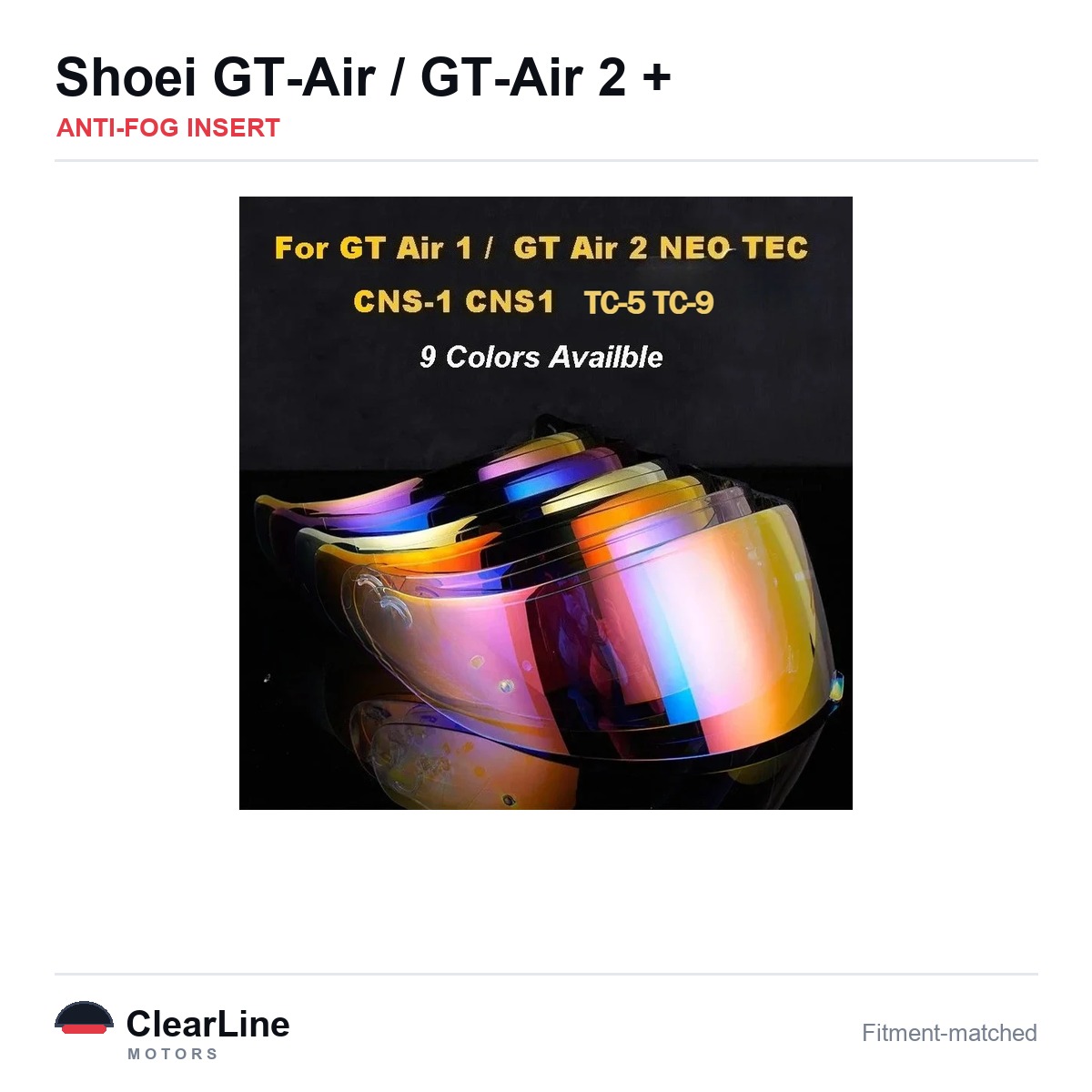
- Shoei GT-Air II / GT-Air / Neotec Anti-Fog Insert
- Shoei GT-Air II visors and inserts
- Scorpion EXO-1400 visors and inserts
- Pinlock-compatible anti-fog inserts
- Clear replacement visors
Questions riders ask
Why does my internal sun visor fog up when my main visor stays clear?
Because the drop-down sits inboard of the outer visor, in the pocket of warm humid air your breath fills first, and the top vents sweep the outer visor rather than the tint. The outer visor is also the one that usually carries an anti-fog insert or at least a factory coating, so it resists condensation that the bare drop-down cannot.
What causes full-face helmet visors to fog up and how can I reduce it?
Warm moist breath meeting a cooler plastic surface condenses into droplets that scatter light. Reduce it by getting the breath out of the helmet rather than trying to warm the plastic: fit a chin curtain and breath deflector, open the chin vent, crack the main visor onto its first detent at low speed, and fit an anti-fog insert to the outer visor so it stays clear in cold and wet conditions.
Can I use anti-fog spray on a drop-down sun visor?
You can, and it will help for a while, but manage your expectations. Hydrophilic treatments work by spreading condensation into a film rather than droplets, and their effect fades as that film thickens and as the coating wears. Apply it to a properly cleaned, dry panel, reapply often, and treat it as a supplement to airflow rather than a replacement for it.
Does riding with the internal sun visor down make fogging worse?
At low speed, yes. With the tint deployed you have added a cold surface directly into the breath stream and reduced the space that air has to move through. Retracting it below roughly 30 mph, and while stationary in traffic, is one of the cheapest improvements available.
How do I stop my visor misting up in the rain?
Rain is the hardest case because the outside of the visor is being chilled while humidity inside the helmet climbs. Keep the chin vent open, keep your neck tube below your chin, and fit an anti-fog insert to the outer visor — the trapped air layer is what keeps the inner surface above the temperature at which your breath condenses. Riding with the tint retracted in the wet also removes one cold surface from the equation.
Is it worth replacing a scratched drop-down sun visor?
Yes, if the scratches are in your line of sight. Fine scratches scatter light exactly as condensation does, and the effect is worst in the low sun the drop-down exists to deal with. Internal sun visors are a helmet manufacturer part rather than something we stock, but a fogging complaint that started after a clean is very often a coating problem rather than an airflow one.