
Riders ask about an iridium visor at night because they have been caught out once: the sun went down, the ride home was longer than planned, and the mirrored shield that was perfect at lunchtime suddenly felt like a closed curtain. This guide explains what an iridium coating does to the light reaching your eyes after dark, what the Highway Code says, and how to plan a ride that runs past sunset.
Need a visor that fits your helmet?
Aftermarket visors matched to the exact helmet model.
The short answer: do not ride with an iridium visor at night. An iridium or mirrored finish exists to cut the light coming through the visor, and after dark you need all the light you can get. Highway Code Rule 94 says: “At night or in poor visibility, do not use tinted glasses, lenses or visors if they restrict your vision.” If a ride might end after sunset, carry a clear visor and swap before the light goes.
What an iridium visor does to the light you see
An iridium visor is a visor with a thin reflective coating on the outer face. The coating bounces part of the incoming light away, and the visor underneath is often tinted as well. That is the whole point of the product: less light arrives at your eyes, so a bright day feels comfortable.
The coating has no way of knowing what time it is. It removes a share of the light at noon, and it removes a share of the light at midnight. At noon there is plenty to spare, while at midnight the same loss comes out of a very small budget.
The colour you see from the outside tells you little about this. A blue, red or gold mirror is a description of what the coating reflects towards other people, not of how much it lets through to you. Two visors that look alike on a shelf can behave very differently on the road, and our guide to motorcycle visor types sets out how the finishes differ.
Why an iridium visor at night is a different problem from daylight
In daylight, a dark visor mostly costs you comfort if you get it wrong. After dark, it costs you information, and the things you lose first are the things that matter most on a motorcycle.
- Unlit road edges. Kerbs, verges and the line of a bend are already low in contrast at night.
- Surface hazards. Gravel, diesel, potholes and wet leaves show up late even through a clear visor.
- Pedestrians and cyclists in dark clothing. They have no lights of their own to punch through a tint.
- Animals. On a country road, a deer or a fox may only be visible for a moment before it moves.
Headlights make this harder to judge. Street lights and oncoming beams still look bright through a coated visor, so the road can seem acceptable while everything between the lights has gone. You notice what you can still see, and you have no way of noticing what has dropped out of view.
Riding on a lit motorway and on an unlit lane are also very different tests. A visor that felt tolerable on the first says nothing about the second, and a single ride often includes both.
What the Highway Code says about tinted visors after dark
Two parts of the Highway Code rules for drivers and motorcyclists are directly relevant. Rule 94 is the one that answers this question, in the words quoted above: “At night or in poor visibility, do not use tinted glasses, lenses or visors if they restrict your vision.”
Rule 93 deals with the opposite problem: “Slow down, and if necessary stop, if you are dazzled by bright sunlight.” Together, the two rules describe why riders end up in trouble at dusk. A dark visor solves the glare at the start of the ride and becomes the hazard at the end of it.
The rules for motorcyclists add a practical point about the condition of what you look through. Rule 84 warns: “Scratched or poorly fitting eye protectors can limit your view when riding, particularly in bright sunshine and the hours of darkness.” A scuffed clear visor is therefore a night-riding problem too, and our guide on when to replace a motorcycle visor covers what to look for.
The law on iridium visors in Great Britain
This section applies to Great Britain only. In Great Britain the legal test is the marking on the individual visor, not its colour or the name of its tint. The Motor Cycles (Eye Protectors) Regulations 1999 prescribe BS 4110 grades and require the eye protector to be “marked with an approved certification mark of an approved body”.
Iridium, mirrored and dark smoke visors transmit too little light to be legal for road use in Great Britain, day or night. That is a statement about the road, at any hour, so it applies before you even reach the question of darkness.
Looking at an iridium or mirror finish? See how the options compare, ours and the helmet makers’ own, in our guide to the best iridium visors for motorcycle helmets.
Sellers carry responsibility too. Under section 18 of the Road Traffic Act 1988, offering an eye protector for sale as authorised for use on a motorcycle when it is not of a prescribed type is an offence. That is why ClearLineMoto never describes any visor as approved or certified, and we do not check the marking on individual items.
Our guides to iridium and mirrored visors on UK roads and tinted visor law in Great Britain go through the detail. Rules elsewhere are different, so riders in the US should start with our guide to visor tint rules in the US and check the law where they ride.
How the main visor (shield) types compare after dark
The table below compares the common options for a ride that continues after sunset. It is a guide to what each type is for, and it says nothing about the marking on any individual visor.
| Visor type | What it does to light | For riding in the dark |
|---|---|---|
| Clear | Lets the most light through of the options here | The one to use |
| Light tint | Removes some light all the time | Avoid: it restricts vision when you have none to spare |
| Dark smoke | Removes a large share of the light | Do not use |
| Iridium or mirrored | Reflects light away, often on top of a tint | Do not use |
| Photochromic | Darkens in strong light and clears as it fades | Depends on how far it clears, so check before relying on it |
If you want one visor for everything, clear is the only finish that makes sense, and our clear replacement visors page covers what to look for. Glare is then a separate problem, and our guide to motorcycle sun glare fixes sets out the options that do not leave you stuck after dark.
Where a photochromic visor fits in
A photochromic visor darkens in strong light and clears as the light fades, which is why riders on long days look at one. Our photochromic visors hub explains the trade-offs, and there is a photochromic visor for the Shark Skwal i3 if that is your helmet.
It does not remove the need to think about darkness. How clear a photochromic visor becomes varies from product to product, and it may lag behind a fast change in light. Test yours somewhere safe after dark before you trust it, and read our guide to photochromic visors for night riding first.
Planning a ride that ends after sunset
Almost every rider who has been stuck behind an iridium visor in the dark got there by accident. A little planning removes the problem completely.
- Check the sunset time before you leave. Add a margin for traffic, fuel and the stop you did not plan.
- Pack a clear visor. Wrap it in a soft cloth or a visor bag so it does not pick up scratches in a pannier or rucksack.
- Learn the swap at home. A visor change at the roadside in failing light is a poor time to try it for the first time. Our guide on how to remove a motorcycle helmet visor covers the general method, and your helmet’s manual covers the exact one.
- Swap early. Do it at the last fuel stop or lay-by while you can still see the mechanism clearly, not after the light has gone.
- Store the iridium visor carefully. A coated face marks easily, so follow our guide on how to store a motorcycle visor.
If your helmet has a drop-down internal sun visor, you already have a simpler setup. Keep a clear outer visor fitted and lift the sun visor out of the way as the light fades.
If you are caught out on the road
Do not push on and hope. If you are wearing an iridium visor as the light goes and you have no clear visor with you, slow down and make a plan early, while you can still see well enough to choose where to stop.
- Stop somewhere safe and lit. A fuel station or a car park is better than a verge on an unlit road.
- Do not ride with the visor raised at speed. Wind, grit, rain and insects are hazards to your eyes, and an open visor is no substitute for a clear one.
- Consider waiting or getting help. A friend with a spare visor or a recovery service costs less than a crash.
Fogging can make things worse at the same moment, because the air cools as the sun drops. Our guide on how to stop a helmet visor fogging and our page on anti-fog visor inserts cover the options for a clear visor.
Choosing a visor for riding in the dark
Start with the helmet, because a visor only works if it was cut for that shell. The visor finder narrows the choice by brand and model, and every product page lists the helmet models that listing is for. A listing that names several models is not proof that those helmets share a visor, so compare your old visor with the photo before you order.
Then keep the two jobs separate. Our iridium visors page is for bright conditions away from the road, while a clear visor is the one that comes home with you after dark. As an example, our Shark Skwal i3 visor range lists both finishes.
Whichever you use, keep it clean. Rule 83 of the Highway Code says: “Before each journey check that your helmet visor is clean and in good condition.” Dirt and fine scratches scatter headlight beams into a haze, and if you own a coated visor as well, our guide on how to clean an iridium visor explains how to protect the coating.
This guide was written by the ClearLineMoto team. ClearLineMoto is not affiliated with any helmet maker, and every part we list is described by the helmet models it fits.
Visors and inserts mentioned in this guide
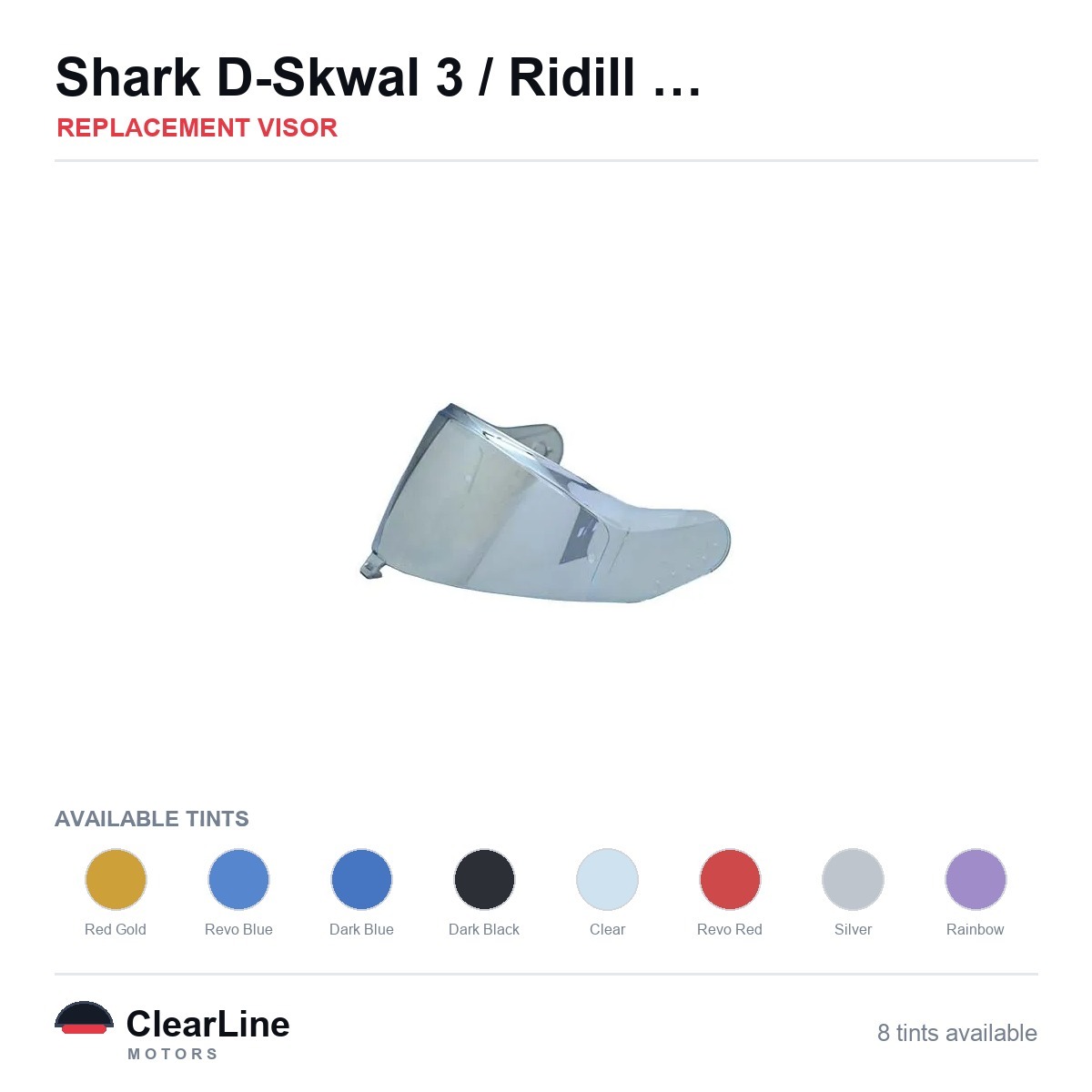
- Shark D-Skwal 3 / Ridill 2 / Skwal i3 / VZ 400 Replacement Visor — Iridium, Smoke, Clear Tints
- See the auto-tint visor for the Skwal i3
- All visors listed for the Shark Skwal i3
Frequently asked questions
Can you see out of an iridium visor at night?
You can often see lights, which is what makes it misleading. Street lamps and headlights still show through, but unlit road edges, surface hazards and people in dark clothing are much harder to pick out. Do not use one after dark.
Is it illegal to wear a tinted visor at night?
In Great Britain the legal test is the marking on the individual visor, and iridium, mirrored and dark smoke visors transmit too little light to be legal for road use, day or night. Highway Code Rule 94 also says not to use tinted visors at night if they restrict your vision. Rules elsewhere differ, so check the law where you ride.
What color visor is best for night?
Clear. Any colour or tint removes light that you need after dark, and a coloured mirror finish tells you nothing about how much reaches your eyes. Yellow or amber lenses are sometimes sold for night use, but a tinted lens still restricts light, so we do not recommend them for riding in the dark.
Which visor is best for day and night?
A clear visor is the only single choice that works in every condition. For glare, add a helmet with an internal sun visor or carry a second visor for the bright part of the ride. A photochromic visor is an option for some riders, but check how far yours clears before you depend on it after dark.
Can I use an iridium visor on the track at night?
Follow the organiser’s rules, and assume the answer is no unless they say otherwise. The loss of light is the same on a circuit as on a road, and any event held after dark will have its own equipment requirements.