The short answer: the best photochromic visors for Arai helmets are the ones made for your exact model, because Arai fits a different shield to its road, adventure and open-face helmets. Our overall pick is the ClearLineMoto range of photochromic visors for Arai helmets, each listed for one helmet family, for example the photochromic visor for the Arai RX-7V and RX-7X. Each one was in stock on the day we checked, has its price on the page and comes with a fit guarantee.
Aftermarket visors for Arai helmets
On Arai’s US parts site we found tinted shields and the Pro Shade System, and no shield that tints by itself. Those are ranked third to sixth below, after Pinlock’s light-reactive lens. If you ride another make, our wider comparison of the best photochromic motorcycle visors covers Shoei, AGV, HJC, LS2 and Bell.
Our overall pick: a ClearLineMoto photochromic visor matched to your Arai. See the RX-7V and RX-7X visor, or find another model in the visor finder, with free tracked shipping and 30-day returns.
Who wrote this and why it matters: we sell the three ClearLineMoto visors in this comparison, and we rank our own range first. The other five products are made by Arai and by Pinlock. Details of their products come from their makers’ own published pages, checked on 10 November 2026. We have not handled or tried them, and we say below where each of them is the better buy.
Every visor of ours on this page is an aftermarket part. ClearLineMoto is not connected with Arai, and the Arai name appears here only to say which helmet a visor fits.
Best photochromic visors for Arai helmets: the 8 compared
Eight products, ranked in six places. Our own three share first place as one range, because each of them fits a different helmet family and they do not compete with each other. Places two to six are made by Pinlock and by Arai.
Every price was checked on 10 November 2026 and is shown in the currency its page used, so nothing has been converted.
| Rank | Product | Made by | Fits | Price (checked on 10 November 2026) | Best for |
|---|---|---|---|---|---|
| 1 | Photochromic visor for the RX-7V | ClearLineMoto (aftermarket) | Arai RX-7V, RX-7X | 85.99 US dollars, in stock | Owners of the sport helmet who carry a second visor today |
| 1 | Photochromic visor for the Tour-X5 | ClearLineMoto (aftermarket) | Arai Tour-X5, XD-5, Tour-Cross V | 85.99 US dollars, in stock | Adventure riders who go from road to trail |
| 1 | Photochromic visor for the VZ-Ram | ClearLineMoto (aftermarket) | Arai VZ-Ram, RAM-X, SZ-R | 67.99 US dollars, in stock | Open-face riders who want a tint that changes with the light |
| 2 | PrecisionTone lens for the RX-7V | Pinlock | The Arai RX-7V visor, with Arai-specific pins | No price shown on Pinlock’s page | RX-7V owners who want anti-fog and a changing tint in one part |
| 3 | Pro Shade System, VAS-V shield | Arai (the helmet maker) | Helmets with a VAS shield | 101.95 US dollars on Arai’s US parts site, in stock | Riders who want Arai’s own answer to changing light |
| 4 | VAS-A MAX-V shield, semi tint | Arai (the helmet maker) | Arai XD-5 | 78.95 US dollars on Arai’s US parts site, in stock | XD-5 owners who want Arai’s own shield with a mild fixed tint |
| 5 | VAS-Z shield, light tint | Arai (the helmet maker) | Helmets with a VAS-Z shield | 75.95 US dollars on Arai’s US parts site, in stock | Open-face riders who want Arai’s own shield with a mild fixed tint |
| 6 | VAS-V Max-Vision shield, dark tint | Arai (the helmet maker) | Helmets with a VAS shield | 60.95 US dollars on Arai’s US parts site, in stock | Track days in strong, steady sun |
The table compares like with like on the points that decide the purchase: who makes it, what it fits and what it costs today. It has no star ratings and no scores, because we have none that we could stand behind.
How we ranked them
We used the same approach as in our comparison of photochromic visors across all makes, with one test added at the front. First, does the product change its tint by itself, because that is what this page is about. Second, does it exist for your helmet.
Third, is the price shown, and what happens if it does not fit. Fourth, how much the maker tells you about it.
Our own visors lead on the first three. They are photochromic visors, each is listed for a named Arai helmet family, each has its price on the page, and every purchase is covered by free 30-day returns for any reason, plus a fit guarantee on every listed helmet. Arai’s own shields lead on the fourth test, and two of them cost less than ours, which we say plainly in their entries.
What we did not do matters as much. We did not put the other makers’ products on a helmet, we did not measure any lens, and we did not use customer reviews to rank anything. Our three visors are ranked together as one entry and not as three, so that the list is not simply a catalogue of our own products.
What a light-reactive visor does on an Arai
A photochromic visor carries a layer that reacts to ultraviolet light and not to how bright the scene looks to you. In direct sun it darkens, and as the ultraviolet light drops it moves back towards clear. Our guide to how photochromic visors work covers the limits as well as the benefits.
Three limits matter. The layer reacts less behind glass or a tall screen that filters ultraviolet light. Cold weather generally means more darkening and slower clearing, and hot weather means less darkening. And a photochromic visor usually keeps a little tint at its lightest, so it is not the equal of a plain clear visor after dark.
If you are weighing a self-tinting visor against a fixed tint, photochromic versus tinted visors sets out the trade.
1. ClearLineMoto photochromic visors for Arai helmets
- Made by: ClearLineMoto, as aftermarket visors
- Fits: one Arai helmet family per visor, three of which are compared here
- Price: from 67.99 to 85.99 US dollars across the three, checked on 10 November 2026
- Returns: free for any reason within 30 days, with free tracked shipping
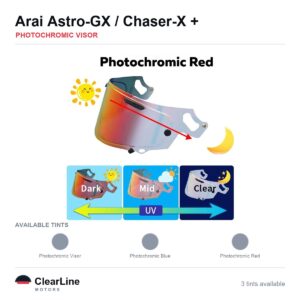
This is our pick, and it is our own product, so here is the argument in full. If you want a visor that tints by itself on an Arai, the first question is whether one exists for the helmet you own. Each of ours is listed for a named helmet family and nothing else. Each one darkens in bright sun and turns near-clear again as the light drops.
What you give up is just as plain. These are aftermarket visors. They are not made by Arai, and we do not publish a light-transmission figure for them.
Two of Arai’s own tinted shields also cost less than ours. If Arai’s name on the part matters most to you, entries 3 to 6 are the ones to buy.
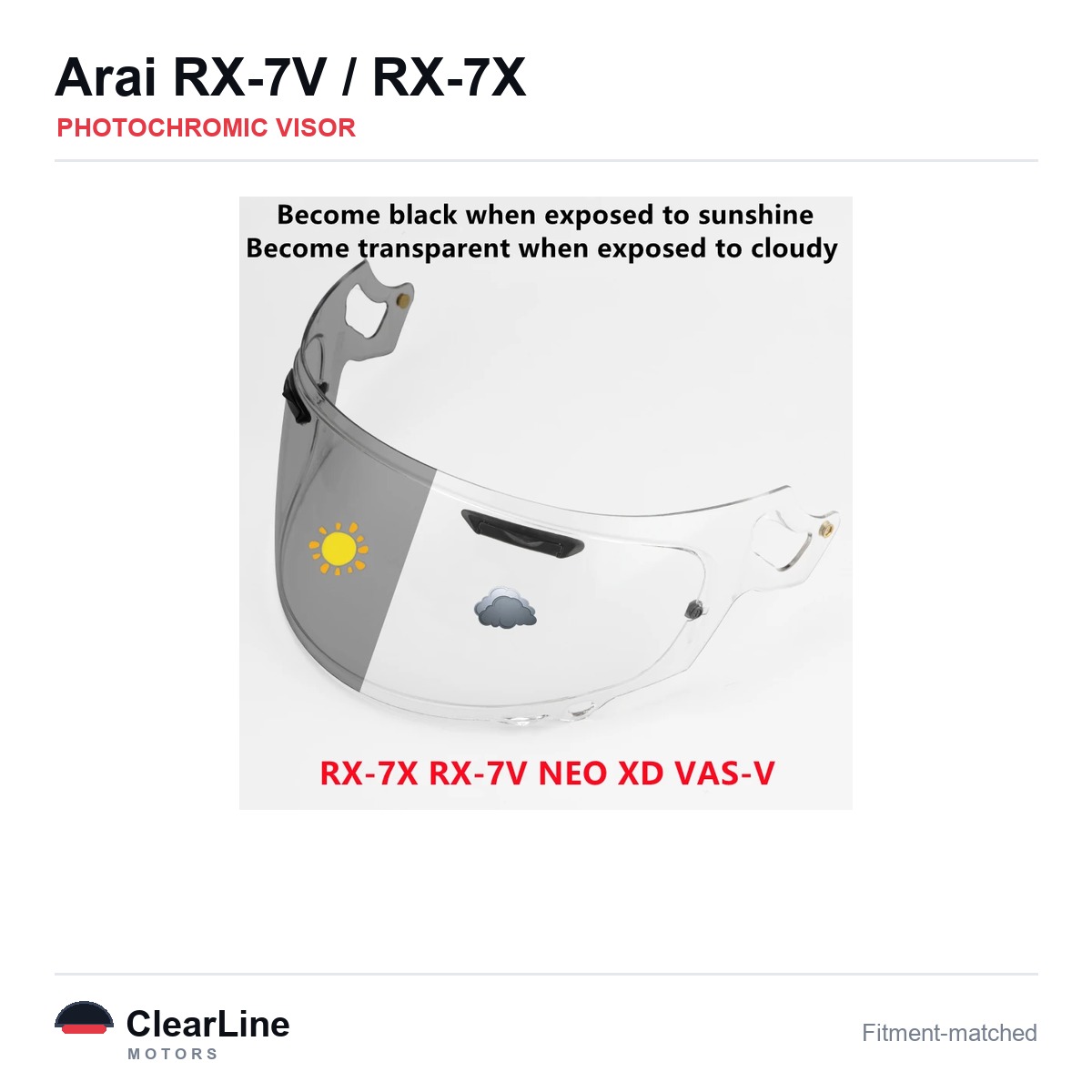
For the RX-7V and RX-7X
This is Arai’s sport and race helmet, and its owners have traditionally carried two visors, a clear one and a dark one. Our RX-7V photochromic visor replaces that pair with one visor that follows the light, and it costs 85.99 US dollars.
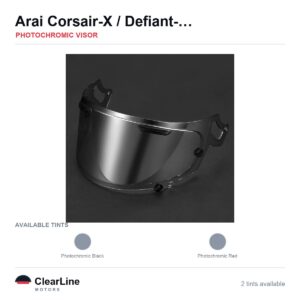
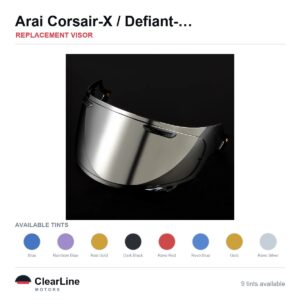
The same helmet is sold as the Corsair-X in North America, and we list a second photochromic visor that names the Corsair-X at 86.99 US dollars. Our guide to the RX-7V and the Corsair-X explains the names, and the rest of the range is on the Arai RX-7V visors page.
For the Tour-X5, XD-5 and Tour-Cross V
These are one adventure helmet under three names: Tour-X5 in Europe, XD-5 in North America and Tour-Cross V in Japan. Adventure riding moves between open road, tree cover and dust, which is the hardest job there is for a fixed tint. Our Tour-X5 photochromic visor costs 85.99 US dollars.
It is not for the earlier adventure helmets, which take a different shield. Our guide to the Tour-X5 and the XD-5 shows how to tell the generations apart, and more for this helmet is on the Arai Tour-X5 visors page.
Not sure which Arai you own? The model name is on the label inside the helmet. Pick Arai and your model in the visor finder and it shows only the visors listed for that helmet.
For the VZ-Ram, RAM-X and SZ-R
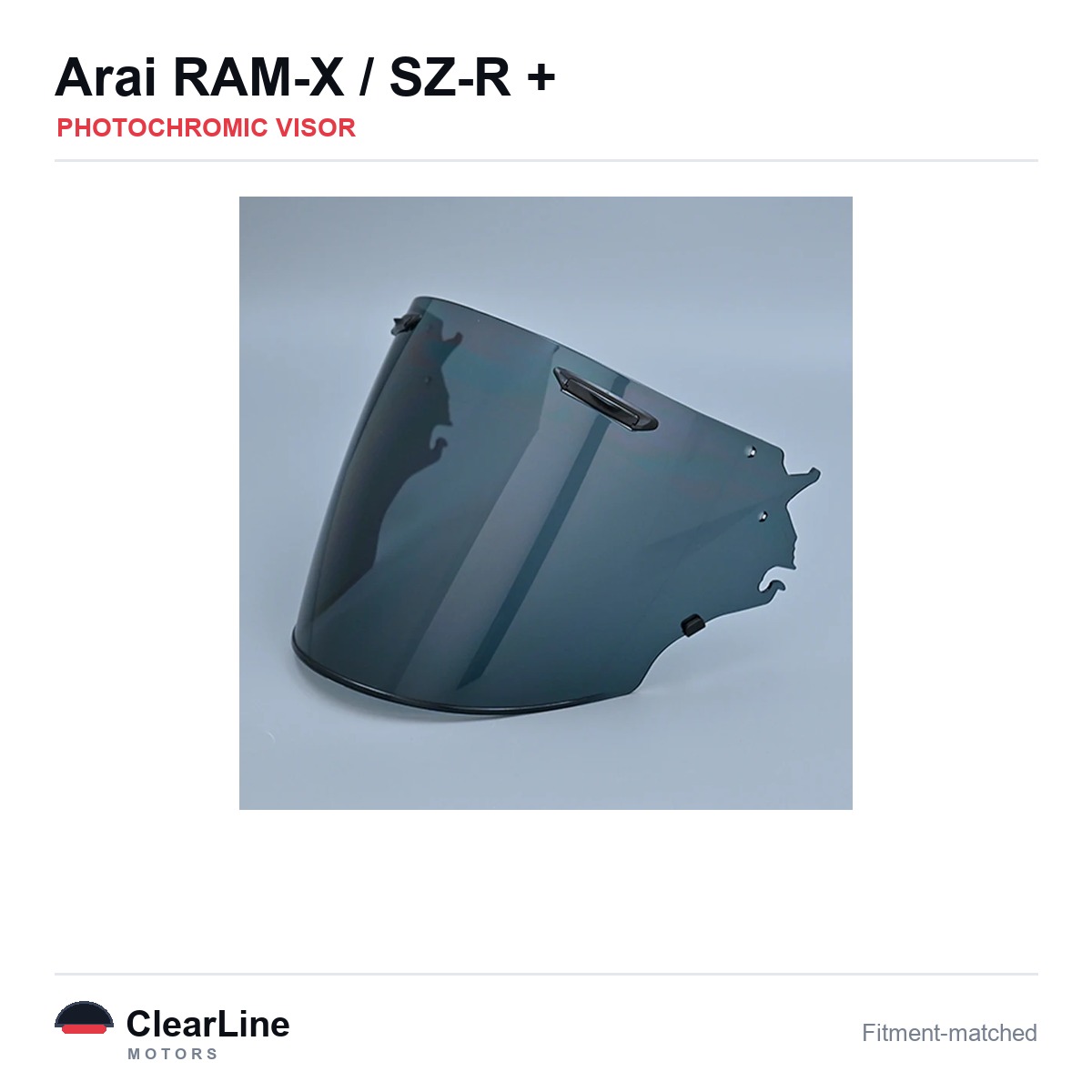
This is Arai’s open-face helmet, sold as the VZ-Ram, the RAM-X and the SZ-R in different markets. An open-face helmet is worn in town and on long, slow days, where the light changes street by street. Our VZ-Ram photochromic visor costs 67.99 US dollars, the least of our three.
Older Arai open-face helmets take a different visor, so check the name on the label. Our guides to the SZ-R and the VZ-Ram and to open-face visor fitment cover the differences, and the range is on the Arai VZ-Ram visors page.
Best for: Arai owners who want a visor that darkens in bright sun and turns near-clear again as the light drops, made for their helmet, with the price shown and free 30-day returns for any reason. Not for: riders who want Arai’s own part, a published lens specification or the least expensive tinted shield.
2. Pinlock PrecisionTone lens for the RX-7V
- Made by: Pinlock
- What it is: an anti-fog lens that changes tint, fitted inside the visor, and not a visor
- Fits: the Arai RX-7V visor only, using Arai-specific pins, according to Pinlock’s page
- Price: Pinlock’s page showed no price when we checked on 10 November 2026
This is the only other product we found that changes its tint without the rider doing anything. Pinlock’s page for the RX-7V lists the PrecisionTone lens for changing conditions, and Pinlock’s own products page says the lens changes colour by adapting to the light intensity.
It does one thing that our visor cannot. It is an anti-fog lens as well, so it deals with misting and with glare in a single part, and you keep the visor that came with the helmet. For a rider in a cold, wet climate, that pairing could fairly be ranked first.
We rank it second for three reasons. It is an insert and not a visor. Pinlock’s page showed no price and says that Pinlock does not sell its lenses direct, so you have to find a dealer. And the page we read is for the RX-7V visor alone, which leaves Tour-X5 and VZ-Ram owners to check Pinlock’s site for their own helmet.
Best for: RX-7V owners who want anti-fog and a changing tint together, and who are happy to buy through a dealer. Not for: riders who want to see the price before they choose, or whose visor has no pins.
3. Arai’s Pro Shade System, VAS-V shield
- Made by: Arai, for its own helmets
- Fits: described on Arai’s page as a direct replacement for any VAS shield, and not for helmets with the older SAL or SAI shield types
- Price: 101.95 US dollars on Arai’s US parts site, checked on 10 November 2026, and in stock there
- Anti-fog insert: accepts a Pinlock lens, which is sold separately, according to the same page
The Pro Shade System is Arai’s own answer to changing light. Arai’s page describes it as a clear shield with the Pro Shade installed. The page does not describe it as photochromic, so it is not a self-tinting visor, and that is why it ranks below the two products that are.
It has real advantages over ours. It is made by Arai for Arai’s own shield mechanism, it was in stock on the maker’s own site, and the page says it accepts a Pinlock anti-fog lens. It is a physical shade and not a reactive layer, so it does not have to wait for the light, where a photochromic layer takes a little time to react.
On price, it cost more than our RX-7V visor on the day, in the same currency. It is also listed for helmets with a VAS shield, so check which shield your helmet takes on Arai’s site before you order. Our guide to the VAS-V and the VAS-Z explains the two.
Best for: riders who want Arai’s own part and a physical shade on a clear shield. Not for: riders who want the tint to change without touching the helmet, or owners of helmets with the older shield types.
4. Arai’s VAS-A MAX-V shield, semi tint
- Made by: Arai, for its own helmets
- Fits: the XD-5, according to Arai’s page
- Price: 78.95 US dollars on Arai’s US parts site, checked on 10 November 2026, and in stock there
- Anti-fog insert: comes with the cavity and pins for a Pinlock lens, which is sold separately
This is Arai’s own tinted shield for the adventure helmet. It is a fixed tint, described by Arai as semi tint, so it stays the same shade in a tunnel and at dusk.
It beats our Tour-X5 visor on two points. It is Arai’s own part, and it cost less than ours on the day in the same currency. Arai’s page also states that it has the pins for a Pinlock lens, which we cannot match with a published claim for our own visor.
It ranks below the first three because it does not change. A mild fixed tint suits a rider whose days are mostly bright. It suits a rider who starts before sunrise or finishes after sunset less well, because the tint is still there when the light has gone.
Best for: XD-5 owners who ride mostly in daylight and want Arai’s own shield at a lower price than ours. Not for: riders whose days run into dusk, or owners of other Arai helmets.
5. Arai’s VAS-Z shield, light tint
- Made by: Arai, for its own helmets
- Fits: Arai’s page names the VAS-Z shield type and does not list helmet models
- Price: 75.95 US dollars on Arai’s US parts site, checked on 10 November 2026, and in stock there
- Pro Shade: the page states that this shield cannot receive Pro Shade System parts
The VAS-Z is the shield type that our own open-face visor’s product page names, so this is Arai’s nearest equivalent to it. It is a light fixed tint from the helmet’s maker.
Its strength is the plain one: it is Arai’s own shield, made for Arai’s own mechanism, and it was in stock on the maker’s site. If you want every part of the helmet to carry the same name, this is the one.
It ranks fifth for the same reason as entry 4, and for one more. It does not change with the light, and on the day it cost more than our photochromic visor for the same helmet family in the same currency. Arai’s page did not list the helmets it fits, so confirm that with a dealer before you order.
Best for: open-face riders who want Arai’s own shield with a mild tint for daytime use. Not for: riders who want a visor that clears as the light drops.
6. Arai’s VAS-V Max-Vision shield, dark tint
- Made by: Arai, for its own helmets
- Fits: described on Arai’s page as a replacement shield for the VAS system
- Price: 60.95 US dollars on Arai’s US parts site, checked on 10 November 2026, and in stock there
- Anti-fog insert: accepts a Pinlock lens, sold separately, and the page says to use a clear one only
This is the least expensive product in the comparison, and it costs less than any of our own visors. If all you want is a dark shield for strong, steady sun and you want it from Arai, it is the obvious buy.
It ranks last here because it is the opposite of what this page is about. A dark tint is dark all the time. It stays dark as the light drops, where a photochromic visor turns near-clear again.
It also has a legal limit that you should know before you order. A dark-smoke visor is not road legal in Great Britain, day or night. Treat it as a track visor there, and check the rules of your own state in the United States.
Best for: track days in bright, steady light, at the least cost on this list. Not for: road use in Great Britain, or any ride that ends after dark.
Decided on a visor that changes by itself? Start with your helmet. Browse all our photochromic visors by helmet, each covered by the fit guarantee on the helmets listed on its product page.
Arai helmets this comparison does not rank
Three more Arai helmet families are missing from the table on purpose: the Concept-X and Rapide-Neo, the QV-Pro and Signet-X, and the Quantic and Contour-X. Our photochromic visors for those helmets are on listings that cover more than one helmet family, so we have not ranked them here.
If you own one of them, use the visor finder with your exact model. Our guides to the Concept-X and the Rapide-Neo, the QV-Pro and the Signet-X and the Quantic and the Contour-X explain which shield each one takes. The full list is in visors that fit Arai helmets.
How to choose in two minutes
- Read the model name on the label inside your helmet. Arai sells the same helmet under different names in different markets.
- Look for your helmet in the table above. If it is there, that entry is your starting point.
- Decide whether you want the tint to change by itself. If you do, the choice is between entries 1 and 2.
- Decide whether you want Arai’s own part. If you do, choose between the Pro Shade System and a fixed tint, and accept that neither changes by itself.
- If you ride in the cold or the wet, check whether the visor takes an anti-fog insert before you order. Our guide to running an insert in a photochromic visor explains what to look for.
Keep your clear visor whichever way you go. A photochromic visor is an addition to it and not a replacement for it, and a scratched visor of any kind should be replaced and not ridden with.
A note on the law
In Great Britain the legal test is the approval marking on the individual visor and not its colour or the name of its tint. The rules are in the Motor Cycles (Eye Protectors) Regulations 1999, and the Highway Code rules for motorcyclists cover visors and eye protection. We do not check the markings on individual items, so we make no claim about road use for any visor in this comparison, ours included.
For a photochromic visor the state that matters is the darkest one, because that is the state it will be in on a bright day. Iridium, mirrored and dark-smoke visors are not road legal in Great Britain, day or night, and our guide to tinted visor law in the UK covers the rules in full. In the United States the rules are set state by state, which our guide to tinted visors in the US explains.
Common questions
Which photochromic visor fits an Arai RX-7V or Corsair-X?
The one listed for the RX-7V family, which is sold as the RX-7X in Japan and the Corsair-X in North America. Check the name on the label inside the helmet against the list on the product page before you order.
What is the best photochromic shield for an Arai RX-7V?
That depends on what you want from the part. If you want the visor itself to change tint, our RX-7V photochromic visor in entry 1 is listed for the RX-7V and RX-7X. If you would rather keep Arai’s own visor and add anti-fog as well, Pinlock lists its PrecisionTone lens for the RX-7V visor.
Where can I buy an Arai-fit photochromic visor for the RX7V or Quantic?
We sell one for the RX-7V, our RX-7V photochromic visor, listed for the RX-7V and RX-7X. The Quantic is a different helmet, and our photochromic visors for it are on listings that cover more than one helmet family. Use the visor finder with your exact model, and check that the product page names your helmet before you order.
Is there a photochromic visor for the Arai Tour-X5 or XD-5?
Yes, an aftermarket one. Our Tour-X5 photochromic visor is listed for the Tour-X5, the XD-5 and the Tour-Cross V. On Arai’s US parts site, the tinted shield we found for the XD-5 was a fixed semi tint.
Does Arai make a photochromic visor?
We did not find one on the pages we read. On 10 November 2026, Arai’s US parts site listed fixed-tint shields and the Pro Shade System for these helmets, and none of those pages described a shield that tints by itself. Ask an Arai dealer if you want to be certain for your market.
Is there an Arai VAS-V transition shield, and what is its price?
We did not find one. On 10 November 2026, Arai’s US parts site listed no VAS-V shield that tints by itself. Arai’s own answer to changing light there was the Pro Shade System VAS-V shield, a clear shield with a shade fitted, at 101.95 US dollars, checked on 10 November 2026.
How easy is it to add an auto-tint visor to an Arai helmet?
The swap itself is short: our RX-7V product page describes it as a couple of minutes with no tools. Choosing comes first: find the model name on the label inside the helmet, then look for it in the table above or the visor finder. You can instead keep your visor and fit a light-reactive insert where its maker lists one, as Pinlock does for the RX-7V visor.
Can I ride at night with a photochromic visor?
A photochromic visor usually keeps a little tint at its lightest, so it is not the equal of a plain clear visor after dark or in poor visibility. Check the marking on the visor and the law where you ride.
Are the ClearLineMoto visors genuine Arai parts?
No. Every ClearLineMoto visor on this page is an aftermarket part made to fit an Arai helmet, and ClearLineMoto is not connected with Arai. Arai’s own shields are entries 3 to 6, and they are sold by Arai and its dealers.
Which Arai helmets are on the photochromic visor compatibility list?
The visors ranked here are listed for the RX-7V, RX-7X and Corsair-X, for the Tour-X5, XD-5 and Tour-Cross V, and for the VZ-Ram, RAM-X and SZ-R. We also list photochromic visors for the Concept-X and Rapide-Neo, the QV-Pro and Signet-X, and the Quantic and Contour-X, on listings that cover more than one helmet family. Each product page lists its own helmets, so check yours against the label inside the helmet.
The verdict
For most owners the best photochromic visors for Arai helmets are the ClearLineMoto visors matched to their model, because they change tint by themselves, one exists for the helmet, the price is on the page and the fit is covered. That is our own product and our own ranking, which is why the disclosure sits at the top of this page.
- You own an RX-7V, RX-7X or Corsair-X: our visor in entry 1, or entry 2 if fog is your first problem.
- You own a Tour-X5 or XD-5: our visor in entry 1, or entry 4 if you ride mostly in daylight and want Arai’s own shield.
- You own a VZ-Ram, RAM-X or SZ-R: our visor in entry 1, or entry 5 for Arai’s own light tint.
- You want Arai’s own answer to changing light: entry 3.
- You ride a Shoei as well: see our photochromic visors for Shoei helmets.
Products mentioned and sources
- ClearLineMoto photochromic visor for the Arai RX-7V and RX-7X
- ClearLineMoto photochromic visor for the Arai Corsair-X, RX-7V and RX-7X
- ClearLineMoto photochromic visor for the Arai Tour-X5, XD-5 and Tour-Cross V
- ClearLineMoto photochromic visor for the Arai VZ-Ram, RAM-X and SZ-R
Sources for other makers’ products, read as plain public pages and checked on 10 November 2026: parts.araiamericas.com, the product pages for the Pro Shade System VAS-V shield, the VAS-V Max-Vision dark tint shield, the VAS-A MAX-V semi tint shield and the VAS-Z light tint shield; pinlock.com, the lens page for the Arai RX-7V and the products page. Our own prices come from our product pages on that date.
Free 30-day returns for any reason: full refund, and we refund your return postage.