If you are searching for the HJC RPHA 12N vs RPHA 12 visor difference, you are probably holding a cracked or scratched visor (shield) and wondering whether a listing written for one helmet will fit the other. The two names look like different generations, and plenty of riders assume they need different parts.
Aftermarket visors for the HJC RPHA 12N
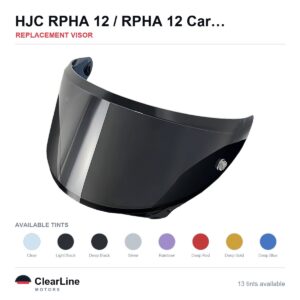
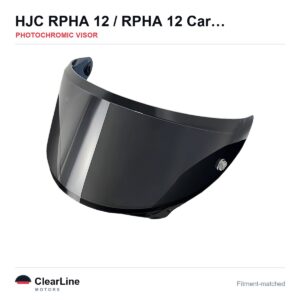
The short answer: HJC’s own shield-type chart lists the RPHA 12, the RPHA 12N and the RPHA 12 Carbon together under one shield code, HJ-42. On the maker’s own word, those three helmets take the same visor. What the chart does not tell you is anything about tints, inserts or the marking a visor needs for road use in Great Britain, so those still need checking item by item.
- Shield code: HJ-42, per HJC’s chart.
- Helmets HJC lists under it: RPHA 12, RPHA 12N, RPHA 12 Carbon.
- What to check before ordering: the model name on your helmet’s label, and the shield code on the old visor if it is still readable.
- What the chart cannot settle: insert fit, tint, and the road-use marking.
What the maker’s chart says about the RPHA 12 and RPHA 12N
HJC publishes a shield-type chart that groups its helmets by the shield code each one uses. It is the manufacturer’s own statement of fitment, which makes it the only document we treat as proof that two helmets share a visor.
On that chart, the code HJ-42 carries three model names: the RPHA 12, the RPHA 12N and the RPHA 12 Carbon. We recorded the chart from HJC’s US site on 29 September 2026, and our fitment map for HJC is built from it rather than from listing titles.
So when the question is “will an RPHA 12 visor fit my RPHA 12N?”, the honest answer is that HJC says the two helmets use the same HJ-42 shield. That is a stronger basis than any retailer’s title, ours included.
HJC RPHA 12N vs RPHA 12 visor at a glance
The table below sets out what is known from HJC’s chart and what you still have to confirm yourself. It deliberately says nothing about the helmets’ shells, linings or vents, because those are not visor questions and we do not sell helmets.
| Question | RPHA 12 | RPHA 12N | Source |
|---|---|---|---|
| Shield code | HJ-42 | HJ-42 | The maker’s shield-type chart |
| Shares its shield with | RPHA 12N, RPHA 12 Carbon | RPHA 12, RPHA 12 Carbon | The maker’s shield-type chart |
| Anti-fog insert fit | Check the pins on your visor | Check the pins on your visor | The visor itself |
| Road use in Great Britain | Depends on the marking | Depends on the marking | SI 1999/535 |
The first two rows are the maker’s statement. The last two rows are where most ordering mistakes happen, and they apply to any visor on either helmet.
Why the two names cause so much confusion
Helmet makers often reuse a model name with a letter added, and riders reasonably expect the letter to mean a new visor. Sometimes it does. Shoei’s CWR-F2 and CWR-F2R, for example, are separate shields with separate part names, so “same family” is never a safe guess on its own.
That is exactly why the chart matters. The suffix on a helmet’s name tells you nothing about its shield, but the shield code does. For the RPHA 12 and RPHA 12N, HJC has put both names under one code, so the suffix does not change the visor.
Our guide to helmets sold under different names walks through other cases where one shell carries several badges. It is worth reading if you own more than one helmet and want to share spares between them.
How to confirm which helmet and shield you actually have
Before trusting any chart, make sure you are reading the right row of it. Two quick checks cover almost every case.
- Read the helmet label. Lift the comfort lining at the back or under the chin and look for the model name and size label. It should say RPHA 12, RPHA 12N or RPHA 12 Carbon.
- Read the old visor. Some original visors carry a printed or moulded part code. If yours is still readable and says HJ-42, you have your answer.
- Keep the old visor until the new one fits. It is your reference for shape, pivot and pin position if anything feels wrong.
If the code has worn away, our guide on finding and reading a visor part number shows the usual places makers hide it. When neither label nor code is readable, the visor finder narrows things down by helmet model.
What a different shield code does and does not prove
HJC’s chart is positive evidence only. If two helmets sit under one code, the maker is telling you they share a shield. If they sit under different codes, the chart is simply silent on whether one visor could be made to fit the other.
That distinction keeps you out of two traps. The first is assuming that every RPHA model shares a visor because the names look alike, which the chart does not support. The second is assuming a part definitely will not fit because its code differs, which the chart does not prove either.
For the RPHA 12 family the question is easy, because all three names share HJ-42. For anything else in the range, start from the chart and from our overview of visors that fit HJC helmets, which groups models by shield code rather than by name.
Reading our own listings for the RPHA 12 and RPHA 12N
Our catalogue lists visors by the helmets they fit, and some listings name two models while others name three. That reflects how each listing was written, not a difference in the part. A listing that names only the RPHA 12 is not evidence that it fails to fit the RPHA 12N.
Listings for this family sit in the RPHA 12 visor range, and those filed under the 12N name also appear in the RPHA 12N visor range. If you ride the 12N, the second page is the quicker place to start because it only shows listings filed for that name.
Whichever page you use, compare the listing photo with your old visor’s pivot area before ordering. A matching shape around the pivot is a good sign you are looking at the right part.
Anti-fog inserts on the HJ-42 visor
A Pinlock-compatible insert sits on two small pins moulded into the inner face of the visor. If your visor has those pins, it can take an insert sized for it; if it has no pins, no insert will seat properly.
Our insert listings for this family name the RPHA 12 and RPHA 12 Carbon. We do not have an insert listing filed under the RPHA 12N name, so we will not tell you a particular insert fits a 12N. Check the pins on your own visor first, and compare the insert’s outline with the area between them.
The guide to Pinlock-compatible anti-fog inserts explains how the pin system works and why an insert has to sit under even tension. A gap at one corner is usually where fogging starts.
Choosing a tint for either helmet
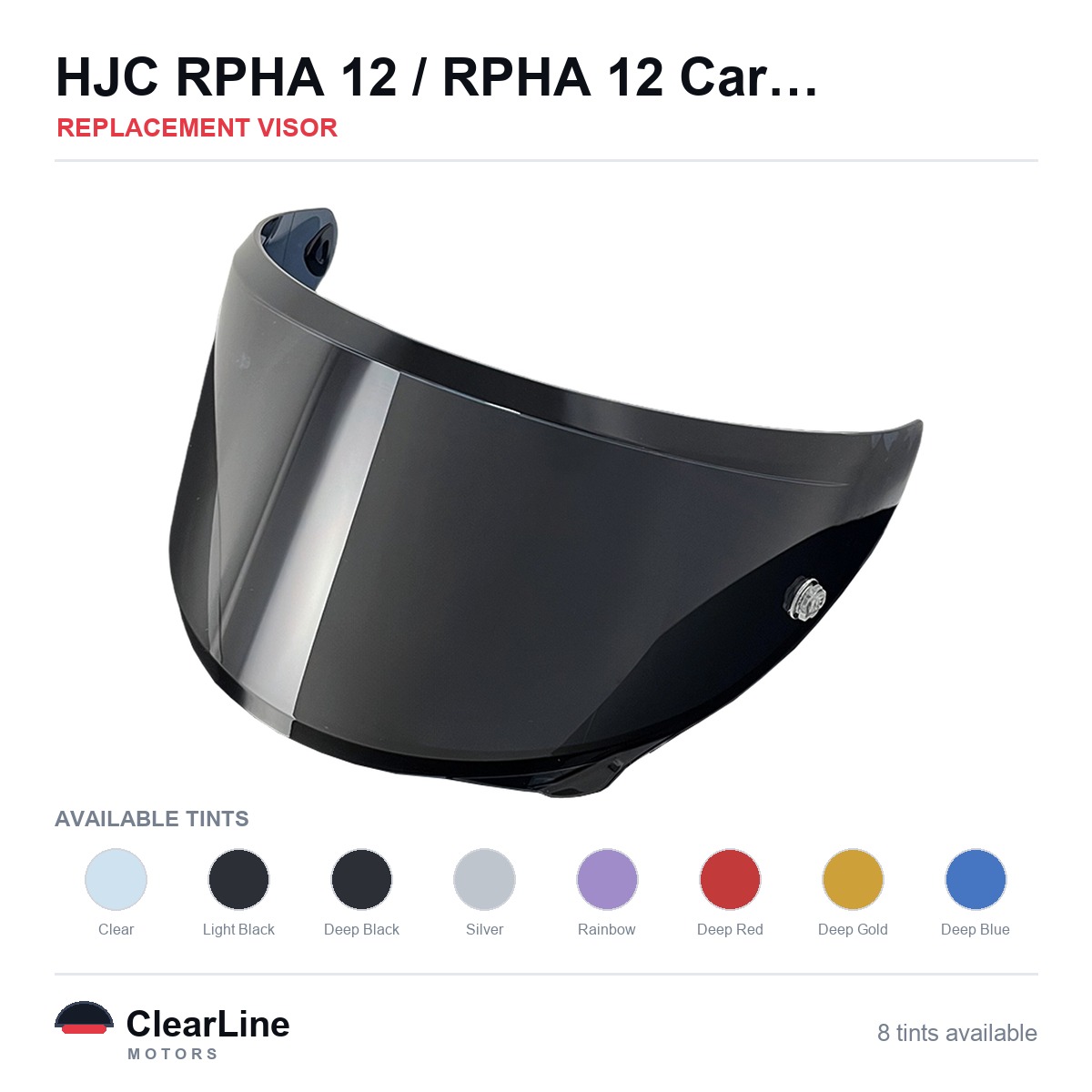
Because both helmets take the same shield, the tint choice is the same for both. The common options in this family are clear, light and dark smoke, photochromic, and iridium or mirrored finishes.
- Clear: no tint. See our clear replacement visors.
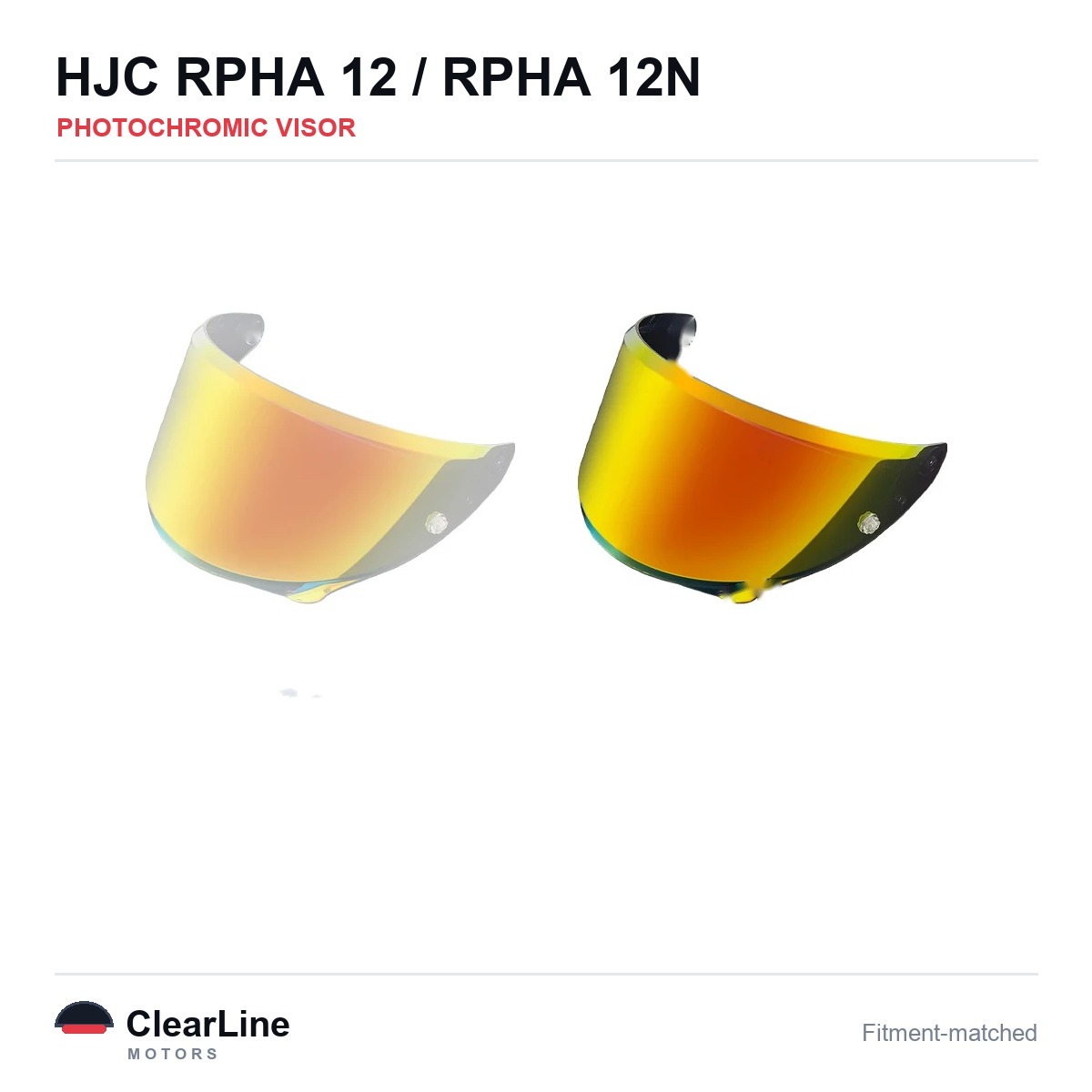
- Photochromic: darkens in sunlight and clears again as light falls. The photochromic visor range covers the HJ-42 options.
- Iridium and mirrored: track and off-road items, explained below. See the iridium visor range.
If you ride in both markets we serve, the terms differ slightly: a UK “visor” is a US “shield”, and “smoked” and “tinted” usually mean the same thing. The law on tints differs far more, and the section below covers Great Britain only.
Tints, markings and the law in Great Britain
The legal test in Great Britain is the marking on the individual visor, not its colour or its tint name. The Motor Cycles (Eye Protectors) Regulations 1999 require an eye protector to be “marked with an approved certification mark of an approved body”, against standards that include BS 4110, the visor standard.
So a visor is only road legal in Great Britain if it carries the marking. We do not verify markings on individual items, and nothing in our catalogue should be read as saying a particular visor is approved or certified.
Iridium, mirrored and dark smoke visors are never road legal in Great Britain, day or night: they transmit too little light to be legal for road use. Selling one as suitable for road use is an offence under section 18 of the Road Traffic Act 1988, and it is a non-endorsable offence.
Visibility matters for its own sake too. The Highway Code rules for motorcyclists say “Scratched or poorly fitting eye protectors can limit your view when riding, particularly in bright sunshine and the hours of darkness.” A visor that has reached that point is due for replacement whichever helmet it sits on.
Swapping the visor on the RPHA 12 or RPHA 12N
Since both helmets use the same HJ-42 shield, the swap works the same way on each. In outline, open the visor fully, release the catch on the side plate, and lift the visor away one side at a time.
Refitting is the reverse, and it is only finished when both sides click home and the visor closes onto the seal all the way round. Our step-by-step guide to HJC RPHA 12 visor removal covers the detail, including what to do if the visor whistles afterwards.
Always confirm the release position against the manual supplied with your own helmet. HJC has used more than one arrangement across the RPHA range, and the manual is the final word for your specific helmet.
Visors and inserts mentioned in this guide
- HJC RPHA 12 Carbon / RPHA 12 / RPHA 12N Replacement Visor
- Photochromic visor for the RPHA 12 and RPHA 12N
- See the three-name photochromic listing
- Anti-fog insert for the RPHA 12 and RPHA 12 Carbon
- RPHA 12N visor options
- Every visor we list for HJC helmets
ClearLine is not affiliated with HJC. Our visors are aftermarket parts described by the helmets they fit, and free shipping applies. This guide was written by the ClearLineMoto team.
Frequently asked questions
Does the RPHA 12N use the same visor as the RPHA 12?
Yes, according to HJC. Its shield-type chart lists the RPHA 12, RPHA 12N and RPHA 12 Carbon under the same shield code, HJ-42. That is the manufacturer’s own statement, and it is the basis we use for fitment.
What does the HJ-42 code mean?
HJ-42 is the shield code HJC gives the visor used on the RPHA 12 family. Helmets listed under one code share that shield. A helmet under a different code is not proven to be incompatible, only not proven to share it.
Will an RPHA 12 Carbon visor fit an RPHA 12N?
HJC lists the RPHA 12 Carbon under HJ-42 alongside the RPHA 12N, so the maker says they share a shield. Check your helmet label to confirm the model, then compare the pivot area with your old visor before fitting.
Can I use an anti-fog insert on the RPHA 12N?
Only if your visor has the two locating pins on its inner face. Our insert listings name the RPHA 12 and RPHA 12 Carbon, not the 12N, so check the pins and the insert outline against your own visor first.
Is an iridium HJ-42 visor legal on the road in Great Britain?
No. In Great Britain, iridium and mirrored visors transmit too little light to be legal for road use, at any time of day. They are track and off-road items, whichever RPHA 12 model they are fitted to.
Is there an HJC RPHA 12 vs RPHA 12N visor difference?
No, according to HJC. Its shield-type chart lists both helmets under HJ-42, so the maker says they share one shield. The chart does not cover tints, inserts or the road-use marking.
What is HJ-42 visor compatibility for the RPHA 12?
HJ-42 is the shield code HJC gives the visor used on the RPHA 12 family. HJC lists the RPHA 12, RPHA 12N and RPHA 12 Carbon under it, so the maker says all three take the same visor.
Does an RPHA 12 visor fit an RPHA 12N Carbon?
HJC’s chart, as we recorded it on 29 September 2026, has no helmet named RPHA 12N Carbon. It lists the RPHA 12, RPHA 12N and RPHA 12 Carbon under HJ-42, which the maker says take the same visor, so read your helmet label to see which one you have.
Is there an HJC RPHA 12N replacement visor in stock?
We list the HJC RPHA 12 Carbon / RPHA 12 / RPHA 12N replacement visor for the 12N. Its product page shows live stock, so check it on the day you order.
Where can I buy an HJC RPHA 12 iridium shield?
The HJC RPHA 12 Carbon / RPHA 12 / RPHA 12N replacement visor listing names iridium among its tints. Iridium and mirrored visors are not road legal in Great Britain, day or night, so they are track and off-road items. For any tint, the marking on the individual visor decides road use.
How to fit a Pinlock 120 on an HJC RPHA 12?
Pinlock’s own site lists a 120 lens for the RPHA 12 and says it only fits that visor with HJC-specific pins (checked on 11 November 2026). Pinlock’s fitting instructions start with taking the visor off the helmet. We do not sell Pinlock lenses, and our product pages do not say a replacement visor takes one, so look for the pins first. Our anti-fog insert for the RPHA 12 and RPHA 12 Carbon is a separate product. Its product page says most of our inserts fit between two small pins on the inside of the visor, so the same check applies.