Riders who spend their days moving between bright open roads, tree-lined lanes and tunnels usually end up asking the same thing: should the helmet handle changing light with a light-reactive shield, or with a tinted inner shade you flick down when the sun comes out? This guide sets out the photochromic visor vs internal sun visor choice in plain terms, explains how each one reacts when the light changes, and shows where using both together makes sense.
The short answer: a photochromic visor darkens and clears by itself in response to ultraviolet light, so it needs no hands but it changes gradually and clears slowly. An internal sun visor is a separate tinted shade inside the shell that you lower and raise with a slider, so it changes the instant you want it to but only if you remember to use it. For sudden light changes the drop-down shade usually copes better; for long rides in steady sun the photochromic shield is the more relaxed option.
- Your helmet has to have a sun visor built in; you cannot add one later. A photochromic shield only needs a visor made for your shell.
- A photochromic visor reacts to UV, not to how bright the road looks, so it can stay lighter or darker than you expect.
- Running both together gives you the most control, as long as you raise the shade the moment the light drops.
How a photochromic visor and an internal sun visor each work
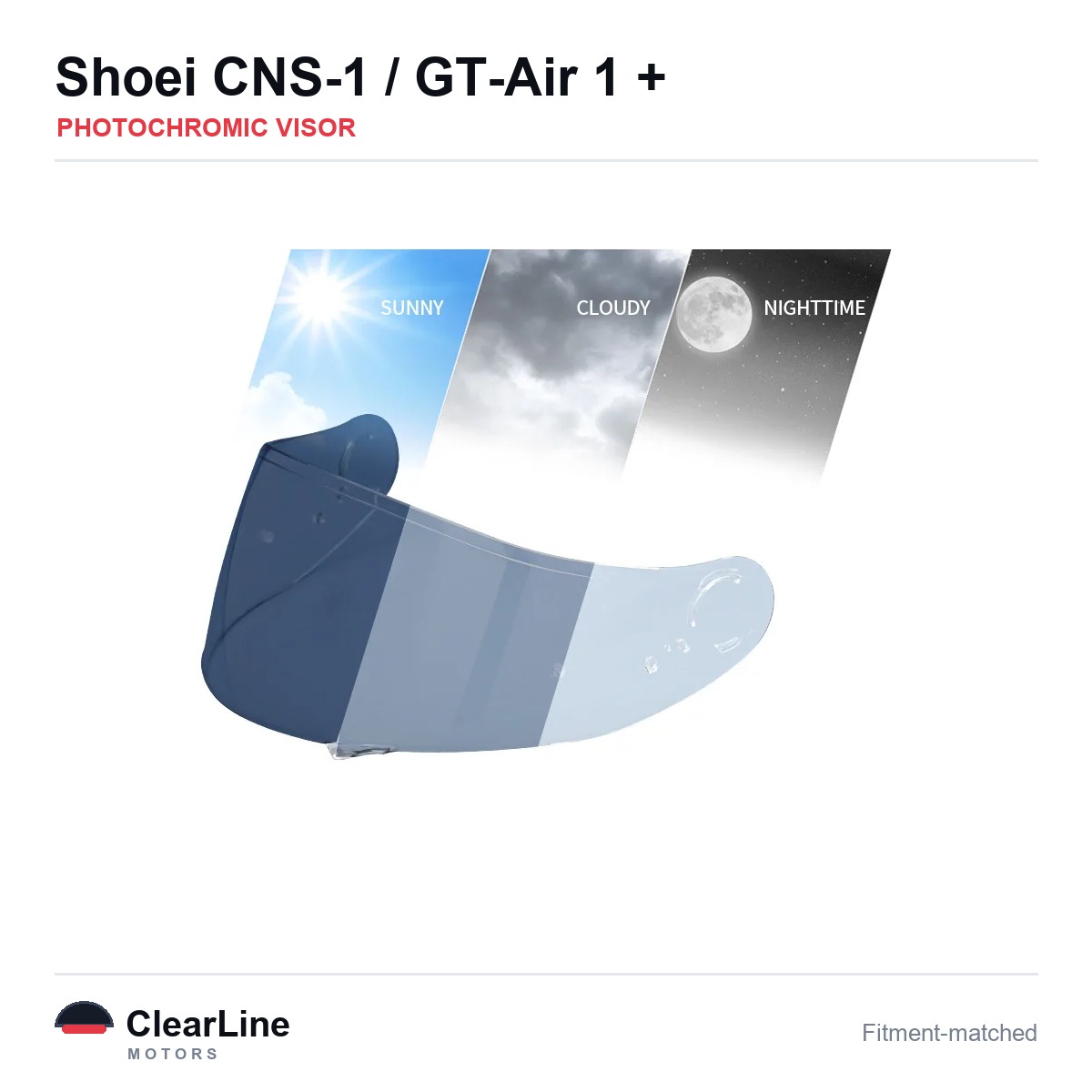
A photochromic visor is the main outer shield of the helmet with light-reactive dye in or on the plastic. When ultraviolet light reaches the dye, its molecules switch to a coloured form and the shield darkens; when the UV fades, they switch back and the shield clears. Our explainer on how photochromic visors work covers the chemistry in more detail.
An internal sun visor, sometimes called a drop-down sun shield, is a second, smaller tinted shade that lives inside the helmet shell between the outer visor and your eyes. A slider or lever on the shell lowers it in front of your eyes and lifts it back out of sight. It has a fixed tint, so it is either fully in front of you or fully out of the way.
The two designs answer the same problem from opposite directions. One is automatic and gradual, the other is manual and immediate. Almost every practical difference between them comes from that single contrast.
Photochromic visor vs internal sun visor: the comparison table
The table compares the two on the points riders ask about most. It describes how each type generally behaves; individual helmets and shields vary, so read it as a guide to the trade-offs rather than a specification for any one product.
| Point of comparison | Photochromic visor | Internal sun visor |
|---|---|---|
| How the tint is controlled | Automatically, by UV reaching the shield | By hand, with a slider or lever on the shell |
| Speed of change | Darkens fairly quickly, clears more slowly | Instant in both directions |
| Behaviour in a tunnel | Still partly tinted on the way in | Clear as soon as you raise the shade |
| Effect of cold weather | Clears even more slowly | No effect on the tint |
| Needs the helmet to be designed for it | Only a shield made for your helmet’s mechanism | Yes, the shade must be built into the shell |
| Tint level | Varies with the amount of UV | One fixed tint |
| Extra parts to fog or scratch | None beyond the main shield | A second surface that can mist or mark |
| Riding with the main visor open | Tint goes up with the shield | Shade still sits in front of your eyes |
Neither column wins on every row. The photochromic shield asks nothing of you, while the drop-down shade gives you a decision you can make in a fraction of a second.
Which copes better with sudden changes in light
Sudden changes are where the two designs separate most clearly. Riding out of bright sun into a tunnel, a forest road or a multi-storey car park, you want the tint gone now, not in a little while.
An internal sun visor handles this best because you control it directly. Flick the slider before the tunnel mouth and the shade is out of your line of sight before you reach the dark. The catch is that you have to remember, and you need a free hand at the right moment.
A photochromic visor cannot move that fast in the clearing direction. The dye darkens quickly in the sun but takes noticeably longer to relax back to clear, so you enter the tunnel with some tint still in place. The practical escape route is to lift the main shield briefly at a safe moment, which gives you clear air straight away.
Which copes better with long rides in steady sun
On a long summer day with consistent sunshine, the balance shifts. A photochromic visor settles at a tint that matches the UV level and stays there, so there is nothing to adjust and nothing to forget.
An internal sun visor works too, but its single fixed tint is a compromise. Some riders find a shade that suits bright midday sun feels too dark under passing cloud, and end up raising and lowering it repeatedly. Others simply leave it down for hours, which is fine until the light starts to fade.
If most of your riding is long daytime touring in settled weather, the hands-free shield is usually the calmer choice. Our comparison of photochromic vs tinted visors looks at the same question against a fixed-tint outer shield.
Dusk, night riding and winter
The end of the day is the hardest case for anything tinted. Light falls steadily, and the eye needs every bit of it, so the question is how quickly each design gets out of the way.
A drop-down shade clears the moment you raise it, which is its biggest advantage at dusk. A photochromic shield should clear as UV disappears, but cold slows the dye down, so a winter ride that starts in low bright sun and finishes after dark is the toughest situation for it. Our guides to photochromic visors and night riding and photochromic visors in cold weather set out what to expect.
The Highway Code is direct about this. Rule 94 says: “At night or in poor visibility, do not use tinted glasses, lenses or visors if they restrict your vision.” That applies to a drop-down shade left down as much as to a shield that has not yet cleared, so plan evening rides around whichever layer is slowest to give you full light.
Many riders who commute through the darker months keep a plain shield to hand as well. Our range of clear replacement visors covers that job when neither tint option is the right tool.
Using a photochromic visor and an internal sun visor together
If your helmet has a sun visor built in, you do not have to choose. Fitting a photochromic outer shield and keeping the drop-down shade gives you an automatic layer for general brightness and a manual layer for glare.
The combination works well in bright sun with low glare, such as riding towards a setting sun or across wet roads, where the extra shade cuts the reflection. Touring and modular helmets such as the Shoei Neotec and the HJC i71 are built with a drop-down shade, and we stock a light-reactive outer shield for each. Neotec owners can start from visors for the Shoei Neotec, and i71 owners from visors for the HJC i71.
The risk is stacking two tints at the wrong moment. A shield still darkened from the afternoon, plus a shade left down, can leave far too little light as the sun drops. Treat the drop-down shade as the first thing you raise whenever the light starts to fall.
Fogging, fit and the practical side
A drop-down shade is a second surface in front of your eyes, and it can mist up on its own even when the outer visor is clear. Our guide to internal sun visor fogging explains why that happens and what helps. If a shade sticks part-way, the brand-specific fixes in our guides to an HJC sun visor that is stuck and an LS2 sun visor that is stuck are a good place to start.
The outer shield fogs as well, whichever type you choose. A pinned anti-fog insert keeps its inner surface warmer than your breath, and we stock anti-fog inserts for Pinlock-ready visors. Whether a particular light-reactive shield is prepared for an insert varies by product, so check the product page; our guide to using an insert with a photochromic visor covers what to look for.
Fit is the other practical limit. A sun visor needs space in the shell, so many sport and race helmets have none, and there is no way to add one afterwards. For those helmets a photochromic shield is the only way to get a tint that changes on the bike.
Which option suits which rider
The right answer depends far more on your helmet and your riding than on the technology itself. These are the common cases.
- Sport or race helmet with no sun visor: a photochromic shield is the only automatic option, and it suits riders who want one shield for the whole day.
- Touring or modular helmet with a sun visor, mixed riding: keep the drop-down shade and consider a light-reactive outer shield for long sunny stretches.
- Lots of tunnels, woods or town riding: the drop-down shade usually copes better, because you can clear it instantly.
- Regular winter or evening commuting: a clear shield with the drop-down shade for low sun keeps the most light available after dark.
- Glasses wearers: both work, but check the shade clears your frames when lowered; our comparison of photochromic visors and photochromic glasses covers the lens side.
Photochromic visors, sun visors and the law in Great Britain
The legal question for a visor is about the marking on the individual shield, not its colour or the fact that it is photochromic. In Great Britain, the Motor Cycles (Eye Protectors) Regulations 1999 prescribe eye protectors that meet a grade of BS 4110 and are “marked with that Grade and the number of that standard”. BS 4110 is the visor standard; BS 6658 is a helmet standard.
A visor is only road legal in Great Britain if it carries the required marking. ClearLine does not verify the markings on individual items, so we make no legality claim about any visor we sell, and you should check the marking on the shield in your hand. We have not researched how the rules treat a drop-down sun visor specifically, so this guide makes no legal claim about one.
The Highway Code also asks riders, in Rule 83, to check before each journey “that your helmet visor is clean and in good condition”. Our explainer on tinted motorcycle visors and the law in Great Britain covers the wider rules, and this section describes the position in Great Britain only.
Finding a photochromic visor that fits your helmet
Visors fit by shield mechanism, not by brand, so two helmets with similar names can take different shields. The quickest way to narrow it down is the motorcycle visor finder, which matches your helmet model to the shields made for it.
You can also browse every photochromic motorcycle visor we stock and filter by your helmet. ClearLine sells aftermarket visors and is not affiliated with or authorised by any helmet manufacturer; model names describe fitment only.
This guide was written by the ClearLine team. Shipping is free.
Visors and inserts mentioned in this guide
- Shoei GT-Air 1 / GT-Air II / Neotec Photochromic Visor
- photochromic visor for the HJC F71 and i71
- See the Shoei Neotec range
- See the anti-fog inserts
Photochromic visor and sun visor questions riders ask
Is a photochromic visor better than an internal sun visor?
Neither is better in every situation. A photochromic visor is hands-free and suits long rides in steady sun, while an internal sun visor clears instantly and copes better with tunnels and sudden shade. Many riders with a sun visor in their helmet use both.
Can I fit a photochromic visor to a helmet with a drop-down sun visor?
Usually, yes, as long as the photochromic shield is made for that helmet’s visor mechanism. The drop-down shade sits inside the shell and works independently of the outer visor. Check the fitment list on the product page or use the visor finder.
Can I add an internal sun visor to my helmet?
No. A drop-down shade needs a slot and mechanism built into the shell, so it has to be designed in from the start. If your helmet has none, a photochromic visor is the way to get a tint that changes on the bike.
Why does my photochromic visor stay dark in a tunnel?
The dye darkens quickly but clears more slowly, and it clears slower still in cold weather. Riding from bright sun into a tunnel catches it part-way through clearing. Lifting the shield at a safe moment gives you clear air straight away.
Should I raise my sun visor at night?
Yes. Rule 94 of the Highway Code says not to use tinted glasses, lenses or visors at night or in poor visibility if they restrict your vision. Raise the drop-down shade as soon as the light starts to fall.