If you wear glasses on the bike, the question comes up sooner or later: is it better to buy a light-reactive shield for the helmet, or to ride in light-reactive lenses behind a clear one? This guide puts the photochromic visor vs photochromic glasses choice side by side, explains why the two behave so differently once a helmet is involved, and shows where combining them helps and where it quietly works against you.
The short answer: both technologies darken in response to ultraviolet light rather than visible brightness. A photochromic visor sits in open sky and gets the full UV dose, so it reacts as designed. Photochromic glasses worn behind a closed visor only receive whatever UV the visor lets through, so they can stay much lighter than you expect, and stacking a dark visor on dark lenses can leave you with too little light at dusk.
- For a rider who does not need prescription lenses, a photochromic visor is the simpler tool.
- For a rider who wears glasses anyway, photochromic lenses behind a clear visor are workable, but test how dark they actually go with the visor closed.
- Running both together is the combination that needs the most care, especially in winter and on evening rides.
How photochromic visors and photochromic glasses both work
The chemistry is the same family in both products. Photochromic dye molecules switch between a colourless form and a coloured form when ultraviolet light hits them, and switch back when the UV stops. Our explainer on how photochromic visors work goes through the mechanism in detail.
The important consequence is that brightness, as your eyes judge it, is not the trigger. A grey but UV-heavy afternoon can darken the dye more than you would guess, while a bright scene seen through UV-filtering glass can leave it nearly clear. Everything else in this comparison follows from that one fact.
The two products differ in where the dye sits relative to the light. A visor is the outermost layer of your vision with nothing but sky in front of it. Glasses sit behind the visor, inside the helmet, so the light they react to has already passed through a sheet of plastic.
Photochromic visor vs photochromic glasses: the comparison table
The table compares the two on the points riders actually ask about. It describes how each type behaves in general; individual products vary, so treat it as a guide to the trade-offs rather than a specification.
| Point of comparison | Photochromic visor | Photochromic glasses behind a clear visor |
|---|---|---|
| What triggers the tint | UV from open sky, reaching the visor directly | Only the UV that gets through the visor in front |
| How dark it gets on the bike | Close to its full range in direct sun | Depends on the visor; can stay noticeably lighter |
| Visor up versus visor down | No change; the tint is on the shield | Darker with the visor open, lighter with it closed |
| Prescription correction | None; you still need lenses or contacts | Built in, which is the main reason riders choose it |
| Fogging | Fogs like any shield; an anti-fog insert helps | Lenses fog separately from the visor |
| Off the bike | Stays with the helmet | Works for walking, cafe stops and driving |
| Fit inside the helmet | No effect on fit | Frames have to sit under the padding comfortably |
Neither column wins outright. The visor reacts more predictably on the bike, while the glasses solve an eyesight problem the visor cannot touch.
Why photochromic glasses often stay light inside a helmet
This is the behaviour that surprises most riders who wear light-reactive lenses. They ride out on a sunny day with the visor closed, glance in a mirror at a stop, and find the lenses have barely changed colour.
The reason is the same one that stops photochromic lenses darkening properly in a car. Glazing between the sky and the lens can filter out much of the UV, and a lens that receives little UV stays close to clear however bright the road looks. We cover the car case in our guide to photochromic visors, UV and windscreens, and a closed visor plays a similar role for the glasses behind it.
How much UV a particular visor passes varies, and visors are rarely sold with a UV transmission figure you can compare. So the honest answer is that you have to test your own combination. Ride a known sunny route with the visor closed, then stop somewhere safe and check how dark the lenses actually went.
Wearing both at once: when the tints stack up
Some riders run a photochromic visor and photochromic glasses together, reasoning that two light-reactive layers must be better than one. In bright sun this can feel fine. The trouble comes when the light drops faster than the layers can clear.
Both layers darken quickly and clear slowly, and both slow down further in the cold. Ride from bright low sun into a wooded lane or a tunnel, and you are looking through two tints that are each still on their way back to clear. That is a much bigger loss of light than either layer causes on its own.
The Highway Code is direct about this. Rule 94 says: “At night or in poor visibility, do not use tinted glasses, lenses or visors if they restrict your vision.” A lens or shield that has not yet cleared at dusk is, in practice, a tinted one, so plan your evening rides around the slowest layer you are wearing.
Glasses, fog and fit: the practical side
Glasses add a second surface that can mist up, and it mists independently of the visor. A dry visor in front of fogged lenses is still a blind ride. Our guide to stopping glasses fogging in a motorcycle helmet covers breath deflection, venting and lens treatments.
The visor’s own fogging is a separate problem with a separate fix. A pinned insert on the inside of the shield keeps that inner surface warmer than your breath. We stock anti-fog inserts for Pinlock-ready visors, which fit shields already prepared with the pins. Check your shield has the two small pin positions at the sides before ordering one.
Fit matters too. Thick or wide frames can press against the temples once the cheek pads close in, and that pressure gets worse over a long ride. If you are choosing new frames mainly for riding, take the helmet to the optician and try them together.
Speed of change: tunnels, trees and winter
The darkening direction is fast for both products, and the clearing direction is slow. That asymmetry is the main practical limitation of anything photochromic, and it applies whether the dye is in a visor or a lens.
Temperature makes it worse. In cold weather the dye molecules relax back to their clear form more slowly, so a February ride that starts in bright low sun and ends at dusk is the hardest case. Our article on photochromic visors and night riding sets out what to expect after dark.
The two products give you different escape routes. With a photochromic visor you can lift the shield for an instant view through clear air. With photochromic glasses there is no quick fix, because the lenses stay in front of your eyes whatever the visor is doing.
Which option suits which rider
The right answer depends far more on your eyes and your riding than on the technology. These are the common cases.
- No prescription, mostly daytime riding: a photochromic visor is the cleaner solution. One layer, no frames under the padding, and you can still lift it in a hurry.
- Prescription wearer, mixed riding: clear prescription glasses behind a photochromic visor keep the tint where it reacts best and leave your lenses clear for the evening.
- Prescription wearer who already owns photochromic lenses: they will work, but expect less tint with the visor closed. Test them on a sunny ride before relying on them.
- Regular night or winter commuting: keep a plain shield to hand. Our clear replacement visors are made for exactly that job.
If you are weighing a light-reactive shield against a fixed-tint one instead, our comparison of photochromic vs tinted visors ranks them across seven kinds of ride.
Photochromic visors, glasses and the law in Great Britain
The legal question for the visor is about the marking on the individual shield, not its colour or the fact that it is photochromic. In Great Britain, the Motor Cycles (Eye Protectors) Regulations 1999 prescribe eye protectors that meet a grade of BS 4110 “and are marked with that Grade and the number of that standard”. BS 4110 is the visor standard; BS 6658 is a helmet standard.
A visor is only road legal in Great Britain if it carries the required marking. ClearLine does not verify the markings on individual items, so we make no legality claim about any visor we sell, and you should check the marking on the shield in your hand. Our explainer on tinted motorcycle visors and the law in Great Britain covers the wider rules.
Your glasses are a separate question from your visor, and the Highway Code rules quoted above apply to tinted lenses as well as tinted shields. It also asks riders, in Rule 83, to check before each journey “that your helmet visor is clean and in good condition”. This guide describes the position in Great Britain only.
Finding a photochromic visor that fits your helmet
Visors fit by shield mechanism, not by brand, so two helmets with similar names can take different shields. The quickest way to narrow it down is the motorcycle visor finder, which matches your helmet model to the shields made for it.
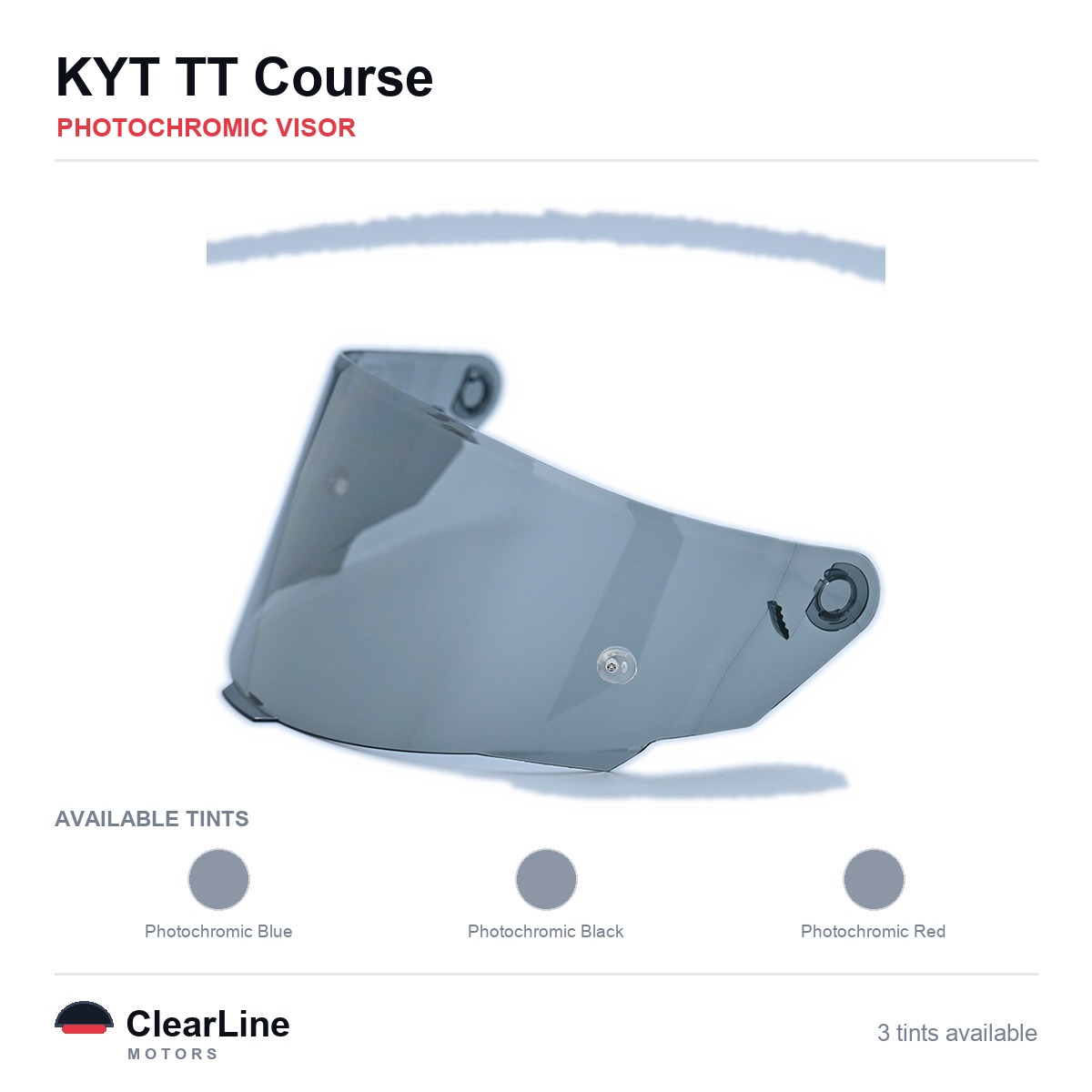
You can also browse every photochromic motorcycle visor we stock, or start from a model page. For example, riders with a KYT TT Course can go straight to visors for the KYT TT Course, and KYT R2R owners to visors for the KYT R2R.
This guide was written by the ClearLine team. ClearLine sells aftermarket visors and is not affiliated with or authorised by any helmet manufacturer; model names describe fitment only. Shipping is free.
Visors and inserts mentioned in this guide
Photochromic visor and glasses questions riders ask
Do photochromic glasses work under a motorcycle helmet?
They work, but usually not as well as they do in open air. With the visor closed the lenses only receive the UV that passes through the visor, so they often stay lighter than expected. With the visor open they react normally.
Is a photochromic visor better than photochromic glasses for riding?
For on-bike tint alone, the visor usually reacts more predictably because it faces open sky. Glasses win when you need prescription correction or want one pair of lenses for riding and walking. Many glasses wearers combine clear prescription lenses with a photochromic visor.
Can I wear photochromic glasses with a photochromic visor?
You can, but the two tints stack, and both clear slowly when the light drops. That combination is the one most likely to leave you with too little light at dusk or in a tunnel. Rule 94 of the Highway Code says not to use tinted glasses, lenses or visors at night or in poor visibility if they restrict your vision.
Why don’t my photochromic glasses darken when I ride?
The dye responds to ultraviolet, not brightness. A closed visor in front of the lenses can filter much of the UV out of the light path, so the lenses stay close to clear even in strong sun. Lift the visor at a safe stop and you will usually see them start to darken.
Do I still need an anti-fog insert with photochromic glasses?
Yes, if the visor itself fogs. The insert keeps the inner face of the shield clear, while the glasses need their own anti-fog approach. The two surfaces mist independently, so treat them as two problems.