
Arai sells its long-oval sport-touring full-face under one name in Europe and another in the United States, so riders who buy across borders often ask whether the shields match. This guide settles the Arai QV-Pro vs Signet-X visor question: how the two helmets relate, which shield they share, and what to check before you order. It also covers tints, photochromic options, the law in Great Britain and anti-fog inserts.
Aftermarket visors for the Arai QV-Pro
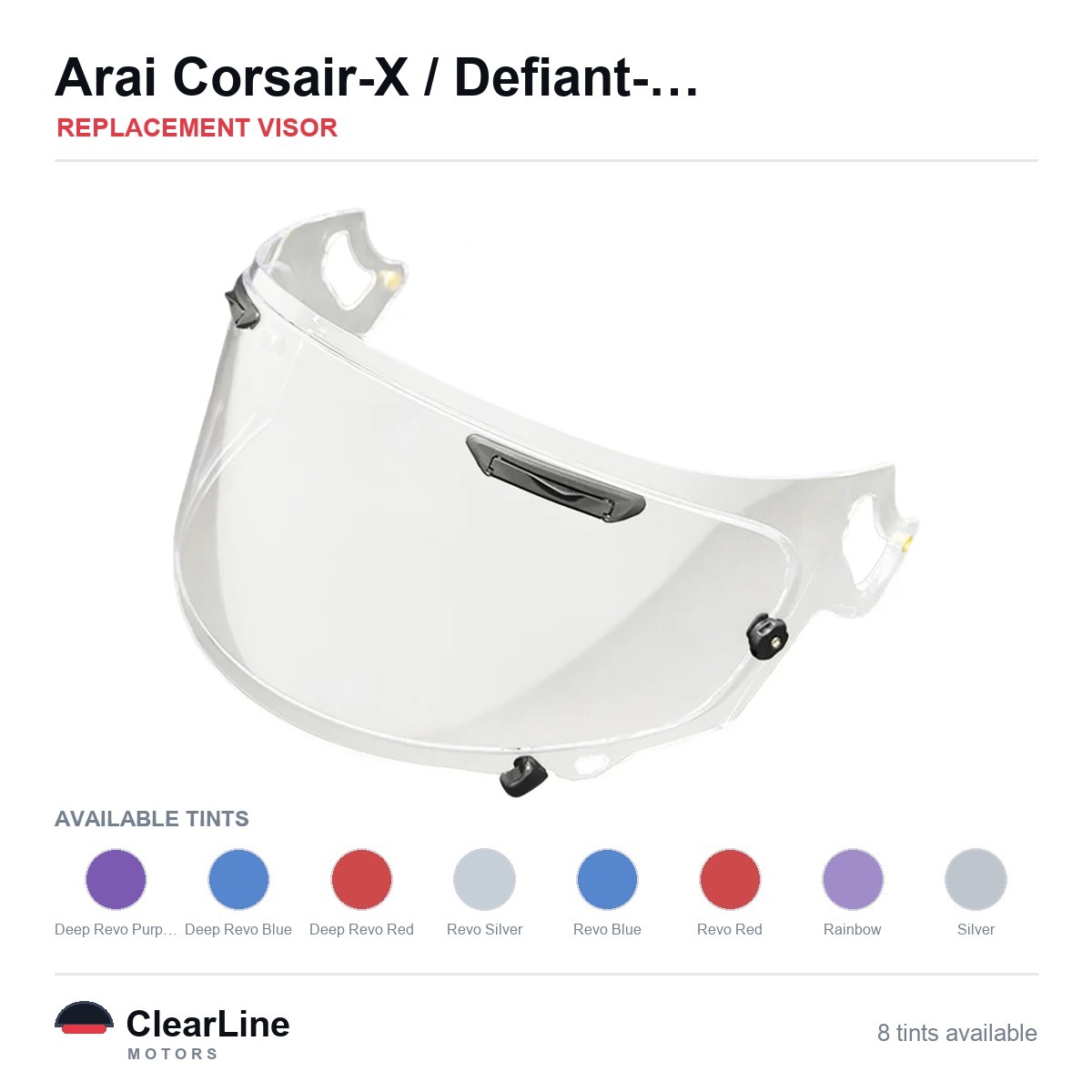
 ReplacementArai Corsair-X / Defiant-X / Quantum-X / RX-7V & more Replacement Visor — Iridium, Smoke, Clear Tints
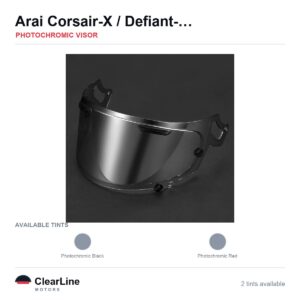 PhotochromicArai Corsair-X / Defiant-X / Quantum-X / Rapide-Neo & more Photochromic Visor
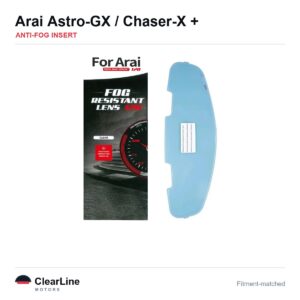 Anti-fogArai Astro-GX / Chaser-X / Concept-X / Contour-X & more Anti-Fog Insert — Stops Visor Fogging
The short answer:
- The QV-Pro and the Signet-X sit together in one verified group in our fitment data, on one shared shield.
- That shield is the VAS-V Max Vision, the wide, insert-ready version of Arai’s VAS-V design.
- The QV-Pro is the name used in Europe and the UK, while the Signet-X is the US name, and our notes treat them as separate helmet models that share a replacement shield.
- Both store categories currently carry the same thirteen products, so you can shop from whichever label is inside your helmet.
Arai QV-Pro vs Signet-X visor: the same shield on both
Arai builds a long-oval road helmet aimed at sport-touring riders. Riders in Europe and the UK know it as the QV-Pro. In the United States the counterpart is sold as the Signet-X.
Our fitment notes are precise about what is and is not shared. The two names are not treated as one identical helmet, because the US and European ranges are positioned differently. What they do share is the VAS-V Max Vision replacement shield, and that is the part a visor buyer needs to get right.
So the practical answer to an Arai QV-Pro vs Signet-X visor comparison is simple. Order a shield listed for the name on your helmet’s label, and you are buying the same shield type a rider in the other market would buy.
How the QV-Pro and Signet-X compare
The table separates what changes between the two names from what stays the same. Treat it as a guide to labels and markets rather than to two shield systems.
| Detail | QV-Pro | Signet-X |
|---|---|---|
| Main market | Europe and the UK | United States and North America |
| Helmet type | Long-oval road full-face | Long-oval road full-face |
| Shield in our verified data | VAS-V Max Vision | VAS-V Max Vision |
| Insert-ready shield | Yes, two pins on the inside face | Yes, two pins on the inside face |
| Treated as one helmet | No, but the replacement shield is shared | |
| Products in our category | 13 | 13, the same list |
A helmet bought abroad or second-hand follows the same rule. The badge on the shell matters less than the model name printed on the label inside.
What the store lists for each name
At the time of writing, the QV-Pro visor category and the Signet-X visor category hold the same thirteen products. That match is what you would expect from two helmets on one verified shield.
Three of those listings carry the QV-Pro in their own catalogue name. They are a replacement visor, a photochromic visor and an anti-fog insert, each named for the Corsair-X, Defiant-X, Quantum-X and QV-Pro. The other ten are named after different Arai helmets but are still listed in both categories.
Signet-X owners will not find their helmet in any product title, and that is normal. Long product names get cut short, so the category list and the fitment notes on each product page are the reliable guide, not the title.
The VAS-V Max Vision shield explained
VAS stands for Variable Axis System. Rather than pivoting from one fixed point high on the shell, a VAS shield moves on a lower, variable pivot. That keeps the side of the shell smoother and closer to the head.
VAS-V is the version made for Arai’s road and sport full-faces. Max Vision is its wide form, cut for a broad field of view and fitted with two small pins on the inside face so it can carry an anti-fog insert.
Two other shield names from the same maker turn up in parts listings, and neither belongs on these helmets. SAI is an older design from earlier generations, and VAS-A is the peaked shield used on Arai’s adventure helmets.
Checking your helmet before you buy
Most wrong shield orders for these helmets come from mixing up generations or model names. These checks take a couple of minutes and remove the doubt.
- Read the label inside the shell. Lift the comfort liner at the back and find the model name. It should read QV-Pro or Signet-X.
- Look at the side pivots. A VAS-V helmet has a low pivot under a cover plate on each side. Compare it with the photos on the product page.
- Check your current shield. Two small pins near the edges of the inside face mean an insert-ready Max Vision shield.
- Read the fitment notes. Each product page lists the helmets it is listed for, so read that list rather than relying on the title.
If the label has worn away, the visor finder takes you from brand to model. Our overview of visors that fit Arai helmets covers the wider range.
Why other Arai names need their own check
Many Arai helmets use a VAS-V shield, but a shared shield family is not proof of a shared part. We only state that two helmets share a visor when both sit in one verified fitment group, and this group holds exactly two names: the QV-Pro and the Signet-X.
Several other pairings have their own guides. The intermediate-oval pair is covered in Profile-V vs Regent-X visor, the flagship racing helmet in RX-7V vs Corsair-X visor, and the round-oval touring pair in Quantic vs Contour-X visor.
Product titles that list four or five Arai models are supplier listing data, not a fitment promise for every helmet named. Start from your own helmet’s category and you avoid that trap entirely.
Choosing a tint for the QV-Pro or Signet-X
Once fitment is settled, the next decision is tint. These are touring helmets, often worn on long days that run from morning into dusk, so a shield that works in every light is usually the first buy.
Clear
A clear shield is the everyday choice, from early starts to night riding. The replacement visor for the QV-Pro, Corsair-X and Quantum-X is listed in both categories, and our clear visor range covers other helmets.
Iridium, mirrored and dark smoke
These finishes look sharp on a touring helmet, but iridium, mirrored and dark-smoke visors are never road legal in Great Britain, day or night. They transmit too little light to be legal for road use, so keep them for track days and private land. Our guide to iridium and mirrored visor legality explains why, and the iridium visor range is listed for track and off-road use.
Arai Signet-X photochromic visor options
Riders often ask about a photochromic shield for the Signet-X, because touring days cross from bright sun into shade and back. A photochromic lens darkens under UV light and clears again as the light drops, so one shield covers a wider range of conditions.
The Corsair-X / Defiant-X / Quantum-X / QV-Pro photochromic visor is listed in both the QV-Pro and the Signet-X categories. Three more photochromic listings named after other Arai helmets also appear in both lists. One of them, the Corsair-X / Defiant-X / Neo XD / Quantum-X photochromic visor, lists the Signet-X among its matched models.
Photochromic lenses react to UV, so on dull days the change is slower and less marked than in bright sun. Our explainer on how photochromic visors work covers the trade-offs, and the photochromic visor range shows what else is available.
What the law in Great Britain actually tests
In Great Britain, eye protection for motorcyclists is covered by the Motor Cycles (Eye Protectors) Regulations 1999. They refer to BS 4110, the British Standard for visors, and require the protector to be marked with an approved certification mark.
That means a visor is only road legal in GB if it carries the marking. Neither the helmet name nor the shield colour settles it. We do not check the markings on individual items, so we make no road-legal claim for any visor we sell, including the ones named here.
Signet-X owners in the United States should check the rules where they ride. Requirements differ between countries and, in some places, from one state to another.
Anti-fog inserts for the QV-Pro and Signet-X
Touring means cold mornings, rain and slow traffic, which is when a shield fogs most. A Pinlock-compatible insert fixes that by holding a sealed second layer against the inside of the shield, keeping warm breath off the cold outer lens.
The Max Vision shield has the pins an insert needs. The QV-Pro anti-fog insert is listed in both categories. Our guide to Pinlock-compatible anti-fog inserts explains how they work, and the Pinlock 70 vs 120 comparison covers insert grades.
Fit the insert with the shield off the helmet and lying on a soft cloth. Bow it gently, seat one end against a pin and then the other, and check that the seal sits evenly all round.
Swapping the shield on a VAS-V helmet
The low pivot sits under a side cover on each side of the shell. The covers are sturdy, but forcing them is the usual way owners crack a plate or scratch a new shield.
- Work on a towel with the helmet on its back and the chin bar facing you.
- Raise the shield fully before you release either side.
- Release one side at a time, and lay the old shield face up so its outer surface stays off the bench.
- Fit the new shield, then open and close it several times to check it seals evenly against the gasket.
The owner’s manual for your helmet shows the release for your exact version. Our walkthrough on how to remove a motorcycle helmet visor covers the general method and the common mistakes.
Looking after the new shield
Rule 83 of the Highway Code rules for motorcyclists says: “Before each journey check that your helmet visor is clean and in good condition.” That habit is worth keeping wherever you ride.
Clean the shield with lukewarm water and a soft microfibre cloth, and keep solvent cleaners away from any coating. When fine scratches sit in your line of sight, a new shield is usually a better fix than polishing. Our visor care guide goes further on cleaning, drying and storage.
Store the helmet with the shield cracked open in a dry place out of direct sun. A shield left shut in a damp bag is the one most likely to fog and streak on the next ride.
Visors and inserts mentioned in this guide
- Arai Corsair-X / Defiant-X / Quantum-X / QV-Pro and more Replacement Visor — Iridium, Smoke, Clear Tints
- Photochromic visor for the QV-Pro and Quantum-X
- See the Corsair-X / QV-Pro anti-fog insert
- All QV-Pro visors
- All Signet-X visors
- Every Arai helmet we list visors for
Written by the ClearLine team.
Frequently asked questions
Will a Signet-X visor fit a QV-Pro?
Yes, for the shared shield. Our verified fitment data places the Signet-X and the QV-Pro in one group on the VAS-V Max Vision shield. Still read the fitment notes on the product page before you order.
Are the QV-Pro and the Signet-X the same helmet?
Our notes treat them as separate models sold in different markets. They do share the same replacement shield, which is what matters when you buy a visor.
Can I fit an anti-fog insert to a QV-Pro or Signet-X?
Yes, if it wears the Max Vision shield with two small pins on the inside face. A Pinlock-compatible insert sized for that shield sits between the pins.
Are tinted visors for the QV-Pro road legal?
In Great Britain the test is the certification marking on the individual visor, not its colour. Iridium, mirrored and dark-smoke visors are never road legal in Great Britain, day or night, and we make no road-legal claim for any visor we sell.