
The question how long do Pinlock inserts last usually expects a number of months or miles. There is no honest single figure, because the question hides two different timers. One is how long an insert keeps a visor clear during a single ride, and the other is how long it stays useful before it needs replacing.
Need a visor that fits your helmet?
Aftermarket visors matched to the exact helmet model.
This guide separates the two, shows the signs that an insert is finished, and explains what shortens or extends its life.
The short answer: a pin-style insert has no fixed lifespan. It lasts until its anti-fog surface is worn, scratched or contaminated, or until it no longer seals against the visor. Careful cleaning with cool water and handling by the edges keeps it working far longer than rubbing and wiping. Replace it when fog returns at the same temperature and humidity that it used to handle, when you see scratches or peeling, or when the seal no longer sits flat.
How long do Pinlock inserts last? Two different questions
When someone says an insert “stopped working”, they can mean either of two things. The first is that it fogged up halfway through a cold, wet ride. The second is that it used to work for a whole season and now misted over in the first five minutes. These have different causes and different fixes.
The first is a limit of the technology. Every anti-fog surface has a finite capacity to deal with moisture in a given moment. The second is wear, and wear is something you can influence.
Pinlock is a third-party trademark, and ClearLine inserts are not Pinlock-brand parts. We sell Pinlock-compatible anti-fog inserts, and the points below apply to pin-style inserts in general.
How long an insert keeps a visor clear during one ride
An anti-fog surface works by absorbing and spreading the moisture in your breath instead of letting it bead into droplets. Research on hydrophilic anti-fog coatings in Advanced Science explains the mechanism: “In the case of hydrophilic antifogging coating, condensed water spreads into a pseudo‐film shape immediately to avoid fogging”. The same paper also names the limit. It says these coatings “suffer from short antifogging duration due to water film thickening with further condensation”.
For a rider, that means a hard working surface can reach a point where it has taken in all it can. The paper adds that once the water film grows past a certain thickness it “becomes mobile”, which often results in image distortion. That is the wobbly, streaky view you get when an insert is overwhelmed rather than broken.
Three things push an insert towards that limit within a single ride:
- Cold air outside and warm breath inside. The bigger the temperature gap, the more condensation forms.
- Rain or humid air. There is already moisture around the visor before your breath adds more.
- Breath reaching the visor. A loose breath deflector, an open chin curtain or a gap in the mouthpiece sends more moist air up to the lens.
If the insert clears again after a minute of moving air, it is working and simply hit its limit. If it never clears, move on to the wear signs below.
How long an insert lasts over months of use
The second timer is the one most riders mean. It depends on how the insert is cleaned, stored and handled far more than on the calendar. A well-kept insert stays effective far longer than a mistreated one. We will not put a number on it, because any figure would be a guess about your riding, your climate and your cleaning habits.
The anti-fog treatment sits on the inner face of a thin plastic lens. Our guide to cleaning a Pinlock insert without damaging it explains why that matters: scrubbing the coated face removes the function, not just the dirt. Most early failures trace back to a cloth, a finger or a cleaning product touching that face.
The lens also has to seal against the visor. A pin-style insert is held on two small pins, with a sealed layer of air between the two lenses. If the lens warps, the seal lifts, or the pins no longer hold it flat, moist air gets into the gap and the insert fogs from the inside.
What wears an insert out faster
These are the habits that most often cut an insert’s life short. Each one is easy to avoid once you know it matters.
- Wiping it dry. A dry cloth drags grit across a soft surface and scratches it.
- Cleaning products. Sprays, polish and alcohol wipes can strip or cloud the anti-fog layer.
- Hot water. Our cleaning guide notes that hot water can distort a thin plastic lens and soften the coating.
- Touching the coated face. Fingerprints and skin oils leave marks that are very visible a few millimetres from your eye.
- Loose storage. An insert left in a bag with keys, gloves or tools picks up scratches.
- Levering it off. Forcing the insert off its pins can crack the lens or stretch the seal.
Dirt matters too. Road film, insect remains and dried breath residue build up on the surface and block it from absorbing moisture. A gentle soak in cool water removes most of it without any rubbing.
Signs your insert is finished
You do not need to guess. These signs tell you whether an insert is worn or just dirty, and what to do about each.
| What you see | Likely cause | What to do |
|---|---|---|
| Fog returns in conditions it used to handle | Worn or contaminated anti-fog surface | Rinse in cool water and test again; replace if it still fogs |
| Fog forms between the insert and the visor | Seal not sitting flat, or the insert is loose on its pins | Refit it; replace it if the seal is damaged |
| Visible scratches or haze in your eye line | Surface damage from wiping or loose storage | Replace it; do not try to polish the coated face |
| Streaks or a wobbly view that stays | Surface saturated or permanently marked | Let it dry fully, then retest; replace if the streaks remain |
| Cracks, warping or lifting edges | Heat, force or age | Replace it straight away |
Check the insert in low sun or against a lamp. Scratches and haze that are invisible in a dull room show up clearly when a bright light hits them, and they scatter light from oncoming headlights at night. Our guide on when to replace a motorcycle visor covers the same signs for the outer visor.
How to make an insert last longer
The routine is short, and it works because it keeps anything abrasive away from the coated face.
- Rinse it in cool running water after a dirty ride. Let the water carry away the dust and salt.
- Soak, do not scrub. Leave stubborn residue submerged in cool water for a while, then rinse again.
- Let it dry in the air. Stand it on its edge somewhere clean and still. Do not rub it dry.
- Handle it by the edges. Keep fingers off the coated face at all times.
- Store it flat in a clean bag or case. Keep it away from gloves, tools and anything gritty.
- Remove it only when needed. Every removal risks stretching the seal or catching the lens on a pin.
Also keep the outer visor clean. The Highway Code gives a simple instruction: “Before each journey check that your helmet visor is clean and in good condition.” A dirty outer visor adds glare, and a rider who cannot see well tends to crack the visor open, which lets cold air hit the insert unevenly.
Check the pins, the seal and the fit before blaming the insert
An insert that fogs is not always an insert that has worn out. The usual cause of a fault that seems sudden is a fitting problem, so check these before spending money:
- Both pins are fully engaged. A pin that has slipped lets one side of the insert lift.
- The seal is clean and flat. A speck of grit under the seal breaks the air barrier.
- The insert is the one listed for your visor. A part shaped for a different visor does not seal around the edge.
- The visor closes fully. If the visor sits proud of the eye port gasket, humid air gets in around the edge.
If you need to refit it, our guide to fitting a Pinlock insert shows the method. If fog still forms between the two lenses, our article on why a Pinlock insert fogs up goes through the causes in order.
Replacing the insert: what to buy
An insert is shaped for one visor, so buy the one listed for your helmet model. A part from a neighbouring model will not necessarily clip onto the pins or seal around the edge. If you are not sure which model you have, the visor finder will help you narrow it down.
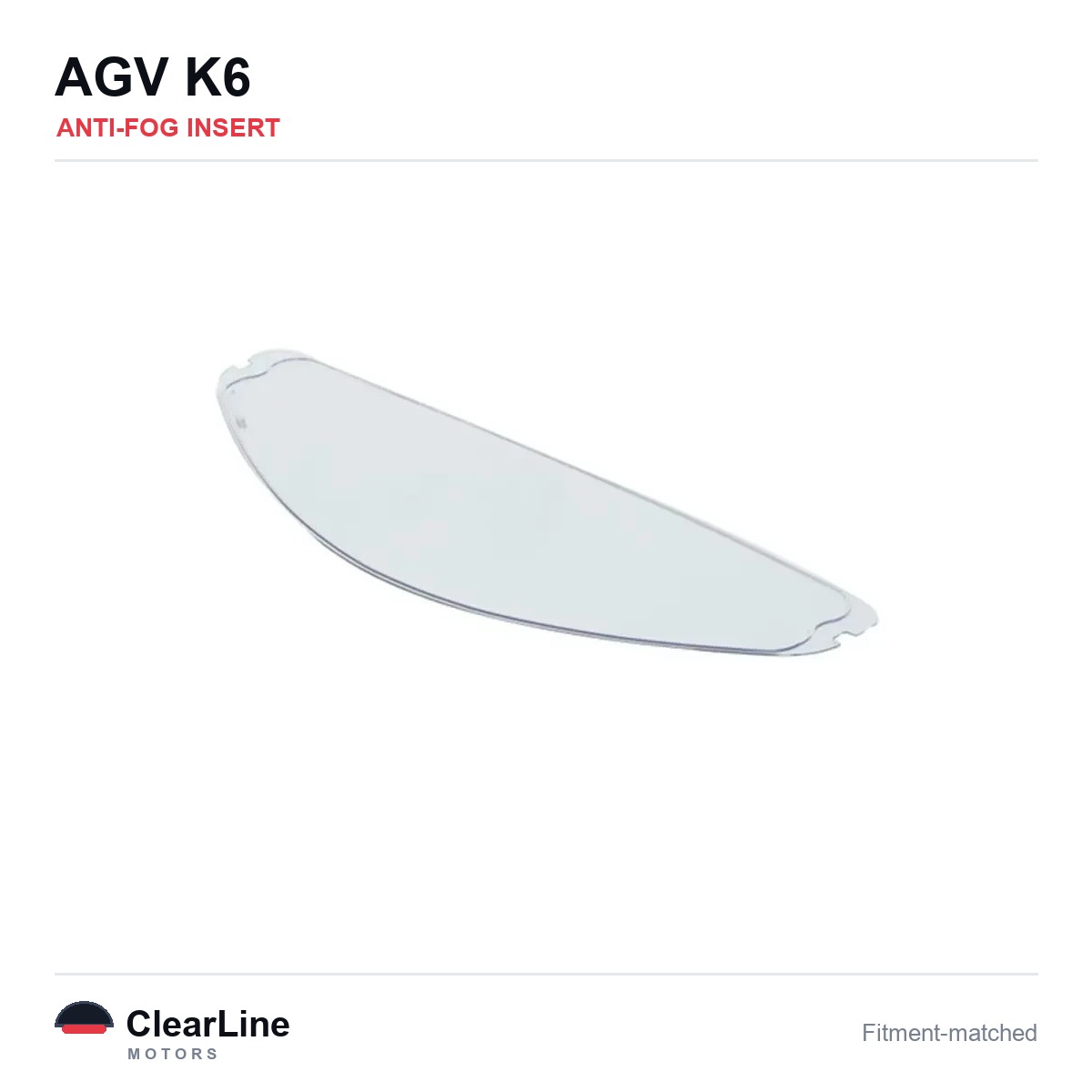
If you have owned the helmet for years, the outer visor may be due for replacement too. A scratched visor with a new insert behind it still scatters light. Our clear replacement visors are an option, and you can pair one with a new insert in a single job. For example, a rider with an AGV K6 can browse the AGV K6 visors and inserts.
If the cost or the fit puts you off a new insert, there are other routes. Our comparison of a Pinlock alternative and our guide to anti-fog film for a motorcycle visor cover them, and our comparison of Pinlock 70 versus Pinlock 120 sets out how the two compare.
The law in Great Britain: the marking on the visor is the test
An insert sits behind the outer visor, so the legal status of what you wear in Great Britain still comes down to the outer visor. The Motor Cycles (Eye Protectors) Regulations 1999 prescribe BS 4110 and require that a protector is marked with an approved certification mark of an approved body. A visor is only road legal in GB if it carries that marking, whatever its colour or tint name.
Iridium, mirrored and dark smoke visors transmit too little light to be legal for road use in Great Britain, day or night. Selling eye protection for road use when it is not of a prescribed type is an offence under section 18 of the Road Traffic Act 1988. That is why ClearLine never describes any visor or insert as approved or certified: we do not check the marking on individual items.
Our guide to tinted visor law in Great Britain has the detail. If you ride in the United States, the rules differ by state, so start with our guide to visor tint rules in the US.
Visors and inserts mentioned in this guide
- AGV K6 Anti-Fog Insert — Stops Visor Fogging
- Replacement visors for the AGV K6
- Pinlock-compatible anti-fog inserts
- Clear replacement visors
This guide was written by the ClearLine team.
Frequently asked questions
How often should I replace a Pinlock insert?
There is no set interval. Replace it when you see scratches or peeling, when fog returns in conditions it used to handle, or when it no longer seals flat against the visor. A well-kept insert lasts far longer than a neglected one.
Can I clean a fogged insert instead of replacing it?
Often, yes. Rinse it in cool running water, soak any stubborn residue and let it dry in the air without rubbing. If it fogs again in the same conditions after that, the surface is probably worn.
Does an insert wear out faster in cold, wet weather?
Not by itself. Cold and wet weather push an insert to its moisture limit during a ride, but wear comes from cleaning, handling and storage. A good routine matters more than the weather.
Why does my insert fog even though it is new?
Check the fit first. A new insert fogs if a pin is not engaged, if grit sits under the seal, or if it is the wrong part for your visor. Confirm the model before you replace it again.