An Arai helmet visor not sealing usually announces itself in one of three ways: a whistle that starts at motorway speed, a thin cold draught across your eyes, or rain creeping in along the top edge of the eye port. The cause is nearly always mechanical, and it is rarely the visor itself.
We don’t sell side pods, shield locks or eye-port seals for Arai helmets. If the checks below show the visor itself is at fault, or that it was made for another shield system, these are the clear replacement visors we stock for Arai helmets:
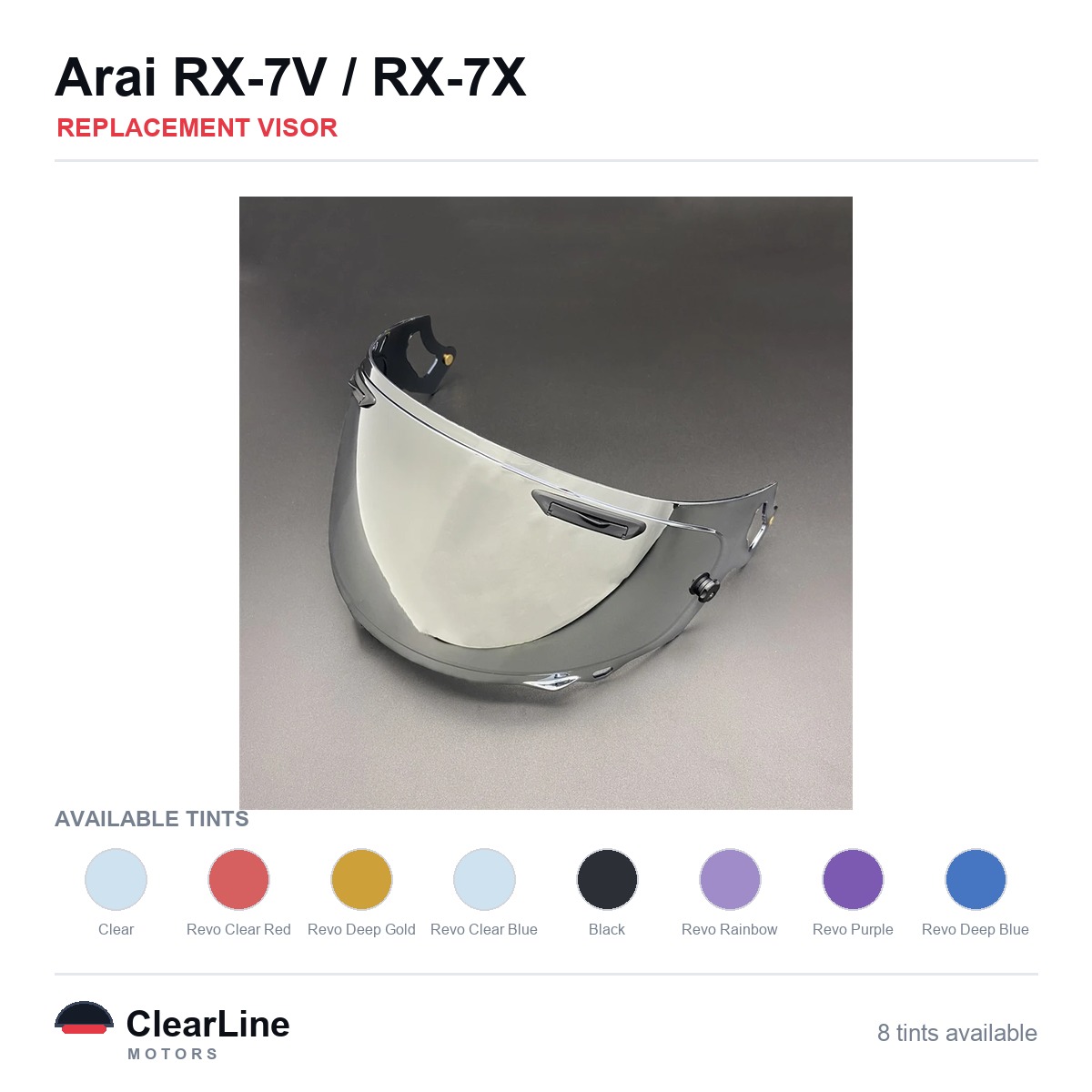
- Arai RX-7V, RX-7X, Corsair-X, Quantum-X and Signet-X replacement visor
- Arai Astro-GX, Chaser-X, Concept-X and Contour-X replacement visor
- Arai Astro-IQ, Axces II, Axces III and Quantum-J replacement visor
- Arai SZ-R, VZ-Ram and RAM-X replacement visor
- Arai Tour Cross 3 and XD-4 replacement visor
- Arai Tour-Cross V, Tour-X5 and XD-5 replacement visor
Free 30-day returns for any reason: full refund, and we refund your return postage.
The short answer: work from the simplest check to the most involved one. Check that both side pods are clipped fully home, that the shield lock is engaged, and that the rubber seal around the eye port is clean, seated and not flattened. Only then look at the visor, which is the part most riders replace first and the part least often at fault.
- Most common cause: a side pod that has not clicked fully home after a visor change.
- Easiest to miss: a visor that sits closed but is not locked, so it lifts at speed.
- Slowest to develop: a dirty, dried or flattened eye-port seal.
- Least likely: a warped visor, or one made for a different shield system.
This guide sticks to two things: what Arai publishes about its shield systems, and checks you can do at a kitchen table with your own hands. Arai’s parts catalogues list visors by system, but we could not find a published seal-adjustment procedure we were able to verify, so we do not invent one here.
How the visor on an Arai helmet seals against the shell
Arai calls its current visor mechanism VAS, short for Variable Axis System. The visor pivots on a mechanism hidden under a cover on each side of the shell, and Arai sells those covers and their holders as spare parts. Arai’s own US parts catalogue lists them as holder and pod sets, which tells you they are a wear item that can be swapped.
When you close the visor, its edge presses onto a rubber seal that runs around the eye port of the shell. The seal does the actual sealing. The pivot geometry and the lock decide how hard the visor is pressed onto that rubber.
That gives you three places where a seal can fail: the pivot (the side pods and what sits under them), the lock that holds the visor shut, and the rubber itself. The visor is a fourth, but it comes last for a reason. A brand-new visor on a pod that is not clipped home will leak exactly like the old one did.
Need a replacement visor for your helmet? Find it by model
Signs that your Arai helmet visor is not sealing
Some symptoms point straight at a seal problem. Others feel similar but have a different cause, so it is worth being sure before you start taking parts off.
- Whistle or hiss at speed that changes when you press the visor shut with a gloved finger. That is air passing a gap.
- A draught across the eyes from one corner only. That points at the pod or seal on that side.
- Water tracking in along the top edge in rain, often with drops running down the inside of the visor.
- The visor drifting up from fully closed at speed. That is usually the lock, not the seal.
A simple bench test helps. Close and lock the visor, then slide a strip of thin paper between the visor and the rubber at several points around the eye port. Where the paper slides out with no drag at all, the visor is not pressing on the seal.
You can also sit in a dark room with a torch inside the helmet. Light escaping around the edge of a closed visor shows you the gap. If the noise is a general roar rather than a whistle, read our guide to diagnosing motorcycle visor wind noise first, because neck-roll and vent noise can sound like a leaking visor.
Check 1: the side pods are fully clipped home
This is the most common cause by a distance, and it nearly always follows a visor change or a clean. One side pod sits slightly proud of the shell, so the visor on that side pivots from the wrong place and never quite reaches the seal.
Look along the side of the helmet at eye level. The pod should sit flush with the shell all the way round its edge. A pod that is proud at one corner, or that rocks when you press it, has not engaged.
Take the visor off and refit it slowly, following the method for your model. Seat the visor on the pivot first, then press the pod home until you feel it click on each of its fixing points. Never force a pod that will not go; something is misaligned underneath, and forcing it is how the plastic tabs crack.
If a tab has already cracked, the pod will never hold the visor at the right angle. A replacement holder or pod set from an Arai dealer costs far less than a visor and fixes the problem at its source.
Check 2: the shield lock is engaged
Many current Arai full-face helmets have a shield lock on the lower edge of the visor. With the lock engaged, the visor is held against the seal. Without it, the visor can rest closed in the garage and then lift slightly once air pressure builds at speed.
Close the visor firmly and feel for the lock engaging. If you cannot feel a definite click, look at the lock and the part of the visor that meets it. Dirt and grit packed into that area can stop it seating, and a brush and lukewarm water usually clear it.
If the tab or the lock is worn or cracked, no amount of cleaning will fix it. Depending on which part has worn, the answer is a new visor or a new lock part from an Arai dealer. A visor that will not lock is also a visor that can open unexpectedly at speed, so treat it as a priority rather than an annoyance.
Check 3: the rubber eye-port seal
The rubber around the eye port is the part that actually stops air and water. Over time it collects road grime, insects and polish residue, it dries out, and it can flatten where the visor presses on it most. Any of these leaves a gap the visor cannot close.
Clean it first. Use lukewarm water with a drop of mild soap and a soft cloth, work it gently along the whole length, then dry it. Avoid solvents and household cleaners, which can harm both the rubber and the visor. Our guide to cleaning the visor seal and base-plate mechanism covers this step in more detail.
Then inspect it. Run a finger along the rubber and check that it sits fully in its channel all the way round, because a section that has lifted out will leak however clean it is. Press any lifted section gently back into place. If the rubber is torn, split or permanently flattened, it needs replacing, and an Arai dealer can tell you which seal your helmet takes.
Check 4: the visor matches your helmet’s shield system
Arai has used several visor systems over the years, and they are not interchangeable. Arai’s own parts list for full-face helmets, Arai Japan’s full-face parts list, groups models under the system their visor belongs to. It lists VAS-V shields against one set of models, and the older SAI and SAL shields against different ones.
A visor from the wrong system may clip on, but it will not close onto the seal in the right place. This usually happens when a helmet is sold under a different name in another market. The RX-7V and RX-7X, for example, are regional names for one flagship helmet and take the same visor; an older RX-7 from the SAI era does not.
If you are unsure which system you have, read our explanation of what the Arai VAS-V and VAS-Z names mean, then check the model label under the comfort lining. Our guide to working out which visor fits your helmet shows where to find it. For a quick list by model, see visors that fit Arai helmets.
Check 5: the visor itself
Once the pods, lock and seal are ruled out, the visor is the remaining suspect. Polycarbonate visors can distort if they are left in heat, such as on a car’s parcel shelf in summer or close to a heater. A distorted visor touches the seal in some places and misses it in others.
Lay the visor on a flat table with its inside face down. It should rock evenly, not spring at one corner. Compare it with how the edge meets the rubber when it is fitted, using the paper test from earlier.
An anti-fog insert can matter too. A Pinlock-compatible insert is held between two pins, and if those pins pull the insert too tight they can bow the visor slightly. Remove the insert, refit the visor and repeat the paper test.
If the seal improves, loosen the pins a little before refitting the insert. Our guide to Pinlock-compatible anti-fog inserts explains how the pin tension works.
Cold weather, new parts and bedding in
Rubber stiffens in the cold. A seal that is fine in summer can leak a little on a frosty morning simply because it no longer moulds itself to the visor edge. If a leak only ever appears in winter, clean and inspect the seal before you replace anything.
New parts can feel different at first. A fresh visor can close more firmly than a worn one, and a new seal can feel tight for the first few closes. That is normal, and a little patience beats trimming or packing anything.
Any aftermarket visor, ours included, is made for the shield system listed on its product page. Check that the listing names your exact model, because a close match in name is not a match in fit. A misted visor can also feel like a leaking one. If your problem is fog rather than draught, our guide on how to stop a helmet visor fogging is the better starting point.
When to replace the visor rather than keep fixing it
Sometimes the honest answer is a new visor. The Highway Code rules for motorcyclists say: “Before each journey check that your helmet visor is clean and in good condition.” Rule 84 adds that “Scratched or poorly fitting eye protectors can limit your view when riding, particularly in bright sunshine and the hours of darkness.”
Replace the visor if it is warped, if the lock tab is cracked, if it is deeply scratched, or if it is from the wrong system. A clear replacement is the simplest choice, and our clear replacement visors are grouped by helmet model to make the match easier.
If you ride in Great Britain and are considering a tint, the legal test is the marking on the individual visor, not its colour. The Motor Cycles (Eye Protectors) Regulations 1999 require an eye protector to be marked with an approved certification mark. Iridium, mirrored and dark-smoke visors transmit too little light to be legal for road use in Great Britain, day or night.
Common mistakes when fixing a visor that will not seal
- Replacing the visor first. It is the least likely cause, and a new visor on a pod that is not clipped home leaks just like the old one.
- Forcing a side pod. A pod that will not click home is misaligned underneath. Forcing it cracks the tabs.
- Over-tightening anything. Screws and clips on a helmet are plastic-to-plastic. Snug is enough.
- Using solvents on the seal. They dry the rubber out and can craze the visor.
- Packing or trimming the seal. Tape or foam behind the rubber changes how the visor closes and can stop the lock engaging.
- Assuming a similar name means a similar visor. Check the shield system, not just the model name.
If you have worked through every check and the visor still will not seal, take the helmet to an Arai dealer. A helmet that has been dropped can have a damaged pivot mount, and that is not a home repair. Use the visor finder to match a replacement once you know which part has failed.
Visors and inserts mentioned in this guide
- Arai RX-7V / RX-7X Replacement Visor — Iridium, Smoke, Clear Tints
- Replacement visors for the Arai RX-7X
- Visors listed for the Arai RX-7V
- All visors for Arai helmets
- Pinlock-compatible anti-fog inserts
Written by the ClearLineMoto team.
Frequently asked questions
Why does my Arai helmet whistle at speed with the visor shut?
A whistle that changes when you press the visor closed with a finger is air passing a gap between the visor and the eye-port seal. Check that both side pods are flush with the shell, that the shield lock is engaged, and that the rubber seal is clean and sitting in its channel.
Can I adjust the visor pressure on an Arai helmet?
We could not verify a user adjustment for visor pressure in Arai’s published material, so we do not recommend improvising one. Correct sealing comes from the pods being fully home, the lock engaging and the seal being in good condition. If all three are right and it still leaks, an Arai dealer can check the pivot.
Can a Pinlock-compatible insert stop the visor sealing?
It can, if the pins pull the insert so tight that the visor bows slightly. Remove the insert and repeat the paper test. If the seal improves, ease the pin tension a little before refitting the insert.
Is a visor that does not seal a safety problem?
A small draught is mostly a comfort problem, but a visor that will not lock can lift or open at speed, and water on the inside of the visor reduces your view. The Highway Code expects your visor to be clean and in good condition before each journey, so fix it before you ride far.