
A motorcycle visor anti fog film is a thin, clear sheet you stick to the inside of your visor so that breath and rain-damp air stop turning into a grey mist across your view. It is cheap, it is sold as “universal”, and it fits visors that have no pins for an insert. Whether it is the right fix depends on your visor, how you ride and how much care you are willing to put into fitting it.
The short answer:
- A stick-on anti-fog film works by spreading condensation into an even, see-through layer instead of light-scattering droplets.
- A pin-mounted anti-fog insert works differently: it traps a sealed air gap that keeps the inner surface warm, which usually holds up better when you stop.
- Film is the option for a visor with no insert pins; if your visor is pin-ready, an insert made for your helmet is normally the stronger choice.
- Fitting quality decides most of the result: dust, bubbles and lifting edges cause the distortion riders complain about.
- In Great Britain the legal test is the marking on the visor itself, so never use film to tint or mirror a visor.
This guide explains how anti-fog film works, how it compares with an insert and a coating, how to fit one cleanly and when to skip it. It sits inside our wider guide on how to stop helmet visor fogging, which covers every fix from airflow to breath guards.
What motorcycle visor anti fog film actually is
Anti-fog film is a flexible clear sheet with a moisture-loving surface on one side and either a light adhesive or a static-cling layer on the other. You apply it to the inner face of the visor, the side that sees your breath. Most are sold flat and oversized so you can cut them to the shape of the eye port.
Sellers usually describe these films as universal. That word only means the sheet is not pre-cut for a particular helmet, so you do the shaping yourself. It says nothing about how well it will sit on a strongly curved visor.
You will also see “anti-rain” film. That is a different product with a different job: it goes on the outside of the visor and makes raindrops bead and run off. Some kits include both, and the two are easy to confuse in a listing photo.
How anti-fog film stops a visor fogging
Fog is condensation. When warm, damp air from your breath meets a visor that is colder than its dew point, water comes out of the air as thousands of tiny droplets. Each droplet bends light in a different direction, and together they read as a white haze.
An anti-fog surface does not stop the water arriving. It changes the shape the water takes. A 2022 paper in Advanced Science on antifogging coatings puts it plainly: In the case of hydrophilic antifogging coating, condensed water spreads into a pseudo‐film shape immediately to avoid fogging.
You can read it in full on PubMed Central.
That is a materials paper about the chemistry, not a test of any visor film on the market. It does explain why a good film stays see-through: the water is still there, but as a thin even layer rather than scattered beads. It also explains the weakness, which is that the layer can only absorb or spread so much water before it starts to run or blur.
Anti-fog film vs a pin-mounted insert
A pin-mounted insert is a second, thinner lens held against the inside of the visor by two small pins. A soft silicone bead around its edge seals a pocket of air between the two lenses. That trapped air insulates the inner lens, so it stays warmer than the dew point and fog has far less chance to form at all.
A film has no air gap. It sits directly on the cold visor and relies on its surface chemistry alone. On a slow, cold, damp commute with plenty of stopping at junctions, that difference is usually where riders notice the insert pulling ahead.
The insert’s catch is fitment. It needs a visor with pins, and it has to match that visor’s size and shape. If you want to understand the hardware side, our guide to Pinlock 70 vs 120 inserts explains how the different grades of insert compare.
Film, insert and coating compared
There is a third option too: a visor whose inner face was given an anti-fog coating at the factory, or a coating you wipe on yourself. Our anti-fog insert vs coating guide goes deep on that pairing. Here is how stick-on film fits alongside both.
| Option | How it works | Needs visor pins? | Main weakness |
|---|---|---|---|
| Stick-on anti-fog film | Hydrophilic surface spreads condensation into a clear layer | No | Fitting errors, edge lift and distortion on curved visors |
| Pin-mounted anti-fog insert | Sealed air gap keeps the inner lens above the dew point | Yes | Must match your visor; adds a second surface to keep clean |
| Anti-fog coating | Chemistry applied straight to the visor surface | No | Wears with cleaning; easily damaged by the wrong products |
| Airflow fixes | Chin vent, cracked visor or breath guard moves damp air away | No | Lets cold air in; limited help in heavy rain |
No single row wins everywhere. The honest ranking depends on whether your visor has pins and how often you ride in the cold and wet.
When anti-fog film makes sense
Film earns its place on visors that cannot take an insert. Plenty of open-face, budget and older full-face helmets have no pins, and for those riders a film is one of the few fixes that sits on the visor itself.
It also suits riders who want a quick trial before spending more. A sheet is easy to try on a spare or older visor first. If the fog is mild and mostly appears when you pull away, a film may be all you need.
Film is less convincing when your visor is already pin-ready. In that case you are choosing a weaker mechanism over one the visor was designed for. Our guide to anti-fog options that need no insert pins compares the rest.
How to fit a motorcycle visor anti fog film without bubbles
Most complaints about film come down to the fitting, not the material. Take your time and work somewhere clean and still, ideally indoors and away from fans.
- Remove the visor. Fitting it on the helmet makes it harder to press the film flat, and you risk touching the inner surface.
- Clean the inner face properly. Use lukewarm water and a drop of mild soap, then rinse and dry with a clean microfibre cloth. Our guide on how to clean a motorcycle helmet visor lists what to avoid.
- Check for dust against the light. A single speck under the film becomes a permanent bubble right in your line of sight.
- Dry-fit and mark the shape. Hold the sheet against the inside of the eye port and trim it slightly inside the edge, leaving clear margins all round.
- Start in the middle. Peel the backing and lay the film from the centre outwards, pressing out air with a soft card wrapped in a cloth.
- Leave it to settle. Follow the maker’s instructions for curing before you ride, and do not wipe the film hard in the meantime.
Keep the film clear of the visor’s edges and its seal. A sheet that overlaps the gasket can lift every time the visor closes, and it may stop the visor sealing properly.
Problems riders run into with anti-fog film
The most common issue is distortion. A flat sheet laid onto a compound curve has to stretch or crease somewhere, and that shows up as wavy edges or a faint ripple in your peripheral view. If you see any distortion in the area you look through, remove the film.
Edge lift is the second. Heat, washing and the visor flexing as you open it all work on the edges, and once one corner lifts, moisture gets underneath. Trapped water under a film fogs in a way nothing on the surface can fix.
The third is cleaning damage. Anti-fog surfaces are soft compared with the visor, and household glass cleaners or rough paper towels can strip or scratch them. Treat the film as gently as you would a coated visor, and see our list of chemicals that damage a motorcycle visor before you reach for a spray.
- Do not stack a film on top of a visor that already has an inner anti-fog coating; the two can fight each other and removal can take the coating with it.
- Do not put film over a pin-mounted insert; the insert already does the job and you add another surface to scratch.
- Peel an old film slowly and at a shallow angle, and never scrape the visor with anything hard.
Anti-fog film, visibility and the law in Great Britain
Any change to a visor changes what you see through it, so treat clarity as the first test of a film. The Highway Code is direct about this. Rule 83 says: Before each journey check that your helmet visor is clean and in good condition.
Rule 84 adds: Scratched or poorly fitting eye protectors can limit your view when riding, particularly in bright sunshine and the hours of darkness.
A bubbled, creased or lifting film is exactly the kind of defect that rule describes, so if one develops, take it off.
For eye protectors used on GB roads, the legal test is the marking on the visor, not how it looks. The Motor Cycles (Eye Protectors) Regulations 1999 prescribe BS 4110 grades and require the protector to be marked with an approved certification mark of an approved body
. Never use a film to darken or mirror your view, and check your visor’s own marking and the maker’s guidance before adding anything to it.
We do not check the markings on individual items, so we make no legal claim about any visor, film or insert.
Is an anti-fog film or an insert better for your helmet?
Start by looking at the inside of your visor. Two small pins near the edges of the eye port mean it is ready for an insert, and that is usually the better investment for regular wet or cold riding.
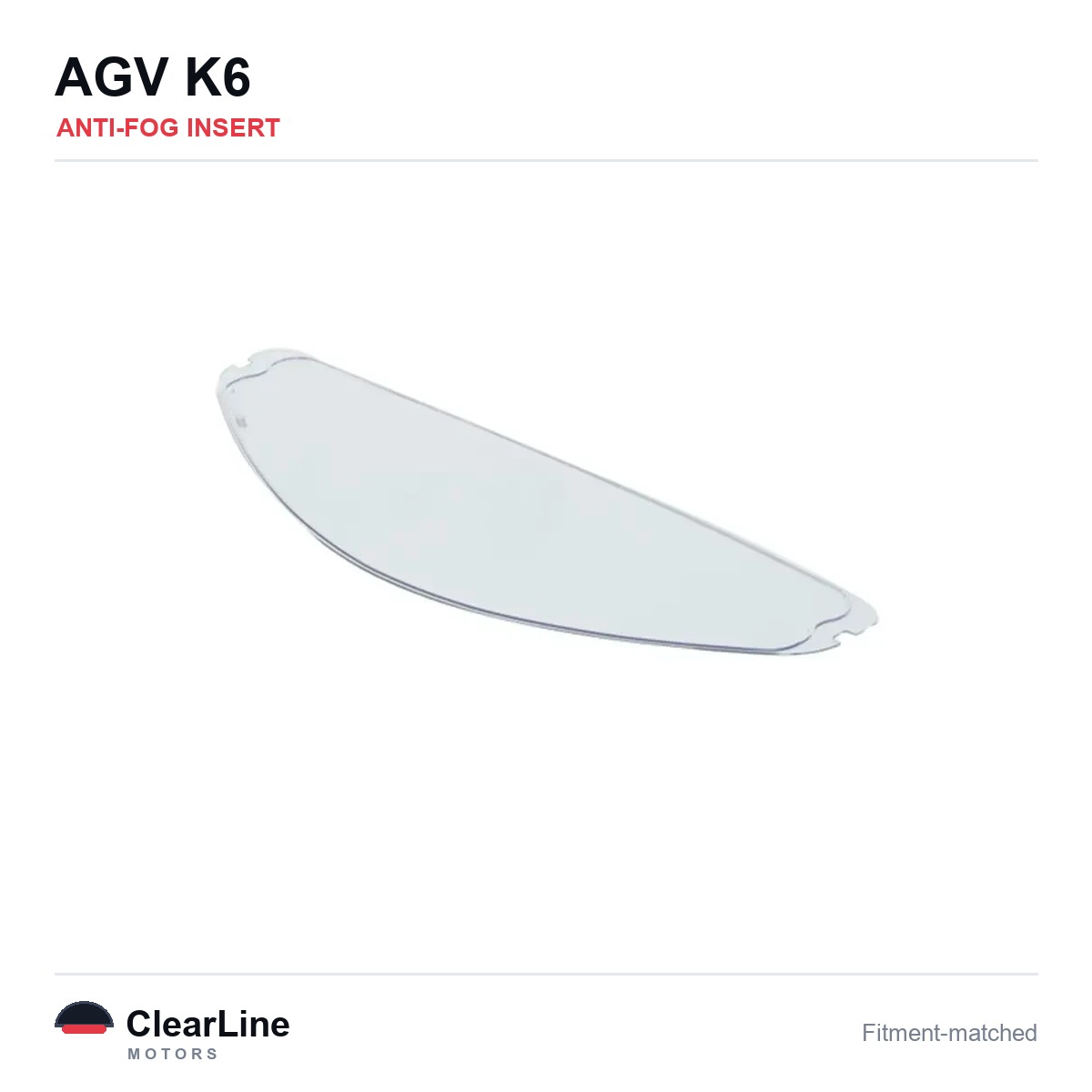
For example, riders with an AGV K6 can look at visors and inserts for the AGV K6, and Shoei Glamster owners can browse the Shoei Glamster visor range. HJC RPHA 1N riders will find their options under HJC RPHA 1N visors and inserts, and LS2 FF910 owners under LS2 FF910 visors and inserts.
No pins and no plans to change the visor? Then a carefully fitted film, paired with sensible airflow, is a reasonable fix. If the visor is scratched or hazy as well, a fresh one from our clear replacement visors range may help more than any film; the visor finder narrows it down by helmet model.
Looking after your visor once the film is on
Rinse road grime off the outside first, so you are not dragging grit across the inside when you wipe it. Clean the film side with plain water and a soft microfibre cloth, using light pressure and straight strokes.
Let the visor air-dry before you close it into the helmet, and store the helmet somewhere dry. Our motorcycle visor care hub covers drying, storage and the cleaning mistakes that shorten a visor’s life.
Check the film before each ride, just as Rule 83 asks you to check the visor. Once it starts to haze, ripple or lift, remove it rather than riding with a compromised view.
Visors and inserts mentioned in this guide
- AGV K6 Anti-Fog Insert — Stops Visor Fogging
- Shoei Glamster Anti-Fog Insert
- anti-fog insert for the HJC RPHA 1N
- See the LS2 FF910 insert
- Pinlock-compatible anti-fog inserts by helmet model
Frequently asked questions
Does anti-fog film work on a motorcycle visor?
Yes, it can, as long as it is fitted cleanly and kept clean. It spreads condensation into a clear layer instead of droplets, which keeps your view readable. It generally copes less well than a pin-mounted insert when you stop in cold, damp air.
Can I put anti-fog film on a Pinlock-ready visor?
You can, but there is little reason to. A pin-ready visor is designed for an insert, and an insert’s sealed air gap usually outperforms a film. Never stack a film under or over an insert.
How long does anti-fog film last?
It varies with the product, how often you clean it and how much sun and heat the visor sees. Replace it as soon as it hazes, ripples or lifts at the edges rather than waiting for a set date.
Is anti-fog film the same as anti-rain film?
No. Anti-fog film goes on the inside and spreads condensation, while anti-rain film goes on the outside and makes rain bead and run off. Using one in the other’s place will not help.
Can I remove anti-fog film without damaging the visor?
Usually, if you peel it slowly at a shallow angle and clean off any residue with water and a soft cloth. Avoid solvents and anything hard, because both can mark the visor surface.
Written by the ClearLine team. ClearLine sells aftermarket visors and Pinlock-compatible anti-fog inserts with free shipping; we are not affiliated with any helmet maker named in this guide.