
A motorcycle helmet breath guard is the soft fabric or foam baffle that sits over your nose inside the chin bar. It has one job: to send warm, wet exhaled air downwards and out of the chin vent instead of straight up the inside of your visor. Riders usually meet one either as a part that came in the helmet box and went in a drawer, or as the thing they start hunting for on the first cold morning of the year.
This guide covers what the part actually does, where it stops working, and what to fit alongside it so the visor stays clear.
The short answer
- A breath guard redirects exhaled air away from the visor. It reduces how much moisture reaches the plastic; it does not change the plastic itself.
- It works best at speed and with the chin vent open, because it needs somewhere for the diverted air to go.
- It is weakest exactly where riders need help most: stopped at lights, filtering, and riding slowly in cold, damp air.
- A breath guard and an anti-fog insert solve different halves of the same problem. Fitted together they cover far more of the ride than either does alone.
- A breath guard is a comfort and airflow part. It has no bearing on whether your visor meets the legal requirement, which turns on the marking the visor carries.
What a motorcycle helmet breath guard actually does
Your breath leaves your body close to body temperature and almost fully saturated with water vapour. Inside a closed helmet that plume rises, meets a visor chilled by the air outside, and drops below its dew point. The vapour turns back into liquid on the coldest surface it can find, which is the inside of the visor.
A breath guard intercepts the plume before it gets there. By sealing the gap between the top of the chin bar and your nose, it forces the exhaled air down towards the chin vent rather than up the inside face of the visor. Less moisture arriving means less condensation forming, and a longer delay before the fog appears.
That is the whole mechanism, and it is worth being precise about it. The guard is a piece of airflow management, not a treatment. Nothing about it changes how water behaves once it does land on the plastic.
Why your breath is what fogs a visor
Fog is not dirt and it is not a fault in the visor. It is thousands of separate water droplets sitting on a cold surface, each one bending light in its own direction. Enough of them together and the surface stops being transparent.
The temperature difference is what drives it. A visor at outside air temperature on a cold morning can be twenty degrees or more below the air you are breathing out, so condensation starts almost at once. This is why a helmet that behaves perfectly in summer fogs within seconds in November.
It also explains why fog is worst when you are not moving. At speed, air flowing through the vents carries moisture out and warms the visor slightly. At a standstill there is no flow, the guard has nowhere to push the air, and moisture accumulates faster than it can leave.
Understanding that sequence is what makes the fixes obvious rather than a matter of trial and error. We work through the full set in our guide to how to stop a helmet visor fogging, which covers the airflow, the surface and the rider in one place.
Breath guard, chin curtain or anti-fog insert?
These three parts get used interchangeably in conversation and they are not the same thing at all. Two of them manage air and one of them manages the surface where water lands. Mixing them up is the most common reason a rider buys the wrong part twice.
| Part | Where it sits | What it does | Where it falls short |
|---|---|---|---|
| Breath guard | Over the nose, inside the chin bar | Diverts exhaled air down and out through the chin vent | Needs airflow to work; little help at a standstill |
| Chin curtain | Across the bottom opening of the helmet | Blocks cold air and noise rising from below | Can trap warm, damp air inside the helmet |
| Anti-fog insert | Pinned to the inside face of the visor | Creates a second pane with a sealed air gap, keeping the inner surface above the dew point | Needs a visor with the correct pin positions |
A chin curtain deserves a specific warning. It makes the helmet quieter and warmer, but by sealing the bottom opening it can hold humid air inside, and some riders find fogging gets worse rather than better once one is fitted. If you run both parts, treat the chin curtain as the first thing to remove when the visor starts misting.
The insert is the outlier here because it does not touch airflow at all. It raises the temperature of the surface your breath lands on, which is why it keeps working when you are stationary. Our comparison of an anti-fog insert against a sprayed coating sets out how long each approach lasts in practice.
When a breath guard is enough, and when it is not
On a dry autumn commute at road speed, with the chin vent open and a well-fitting helmet, a breath guard on its own is often all you need. The volume of moisture reaching the visor stays low, and the airflow clears what does arrive.
It starts to lose the argument in three situations. Cold and wet weather raises the temperature gap and the humidity together. Slow or stationary riding removes the airflow the guard depends on. And a poor seal around the nose lets the plume escape upwards anyway, which is common if your nose sits high against the chin bar or you wear a neck tube pulled up over your chin.
Glasses make all of this sharper, because the lenses fog before the visor does and no amount of airflow management reaches the space between your face and the frames. That problem has its own set of answers in our guide to glasses fogging inside a motorcycle helmet.
Fitting a breath guard without creating new problems
Most breath guards locate into the same channel or press studs that hold the chin bar lining, and they come out just as easily. Check the helmet manual before you force anything: on some designs the guard shares its mounting with the chin vent housing, and levering it can distort the vent.
Fit is everything. The guard should touch the bridge of your nose lightly with the helmet on and the visor closed, with no gap you can see in a mirror. Too loose and the plume escapes upwards; too tight and it presses on your nose for the whole ride, which is why guards get removed after a week.
Open the chin vent once it is fitted. A breath guard with a closed chin vent has nowhere to send the air it has just diverted, so the moisture simply finds another route to the visor. If your helmet has a closable chin vent, treat it as part of the same system rather than a separate control.
The same principle applies to the top and rear vents in winter. Our notes on helmet vents in winter riding explain which ones actually move air at low speed.
What the law asks of your visor
A breath guard is not regulated equipment and fitting one changes nothing about your legal position. What the law does have something to say about is the visor itself, and it is worth knowing which test applies.
The Highway Code, rule 83, asks riders to check that the helmet visor is clean and in good condition before each journey. Rule 84 adds that scratched or poorly fitting eye protectors can limit your view, particularly in bright sunshine and the hours of darkness. Neither rule mentions fogging, but a fogged visor fails the spirit of both.
The legal test for an eye protector in Great Britain is the marking it carries, not its colour and not what it is called. The Motor Cycles (Eye Protectors) Regulations 1999 prescribe protectors conforming to Grade X, XA, YA or ZA in British Standard BS 4110:1979, and require in each case that they are marked with an approved certification mark of an approved body. BS 4110 is the standard that applies to eye protectors, and it is a different standard from the one that applies to the helmet shell itself.
ClearLine does not verify the markings on individual items, so we make no claim that any product we sell meets that requirement. Check the marking on the visor in your hand. Everything in this section describes the position in Great Britain.
Still fogging? work through the causes in order
If the guard is fitted correctly and the visor still mists, the cause is almost always somewhere else in the chain. Working through it in order saves buying parts you do not need.
- Check the seal at your nose. A visible gap with the visor closed means the guard is doing very little.
- Open the chin vent. Diverted air needs an exit.
- Remove the chin curtain temporarily. If the misting improves, the curtain was trapping humid air.
- Drop your neck tube below your chin. Fabric pulled over the mouth defeats the guard completely.
- Look at the visor surface. If fog forms in seconds even at speed, the surface is the problem and only an insert or a coating will change it.
One more possibility catches people out on a new lid. Fresh visors sometimes carry a film from manufacturing or packaging that makes condensation cling, and the behaviour settles after a proper clean. We cover that case in why a new visor fogs up, and the quick roadside options in how to demist a motorcycle visor.
Pairing a breath guard with the right visor and insert
The pairing that covers the most riding is a breath guard for the air and an insert for the surface. The insert works by holding a sealed pocket of air against the visor, so the inner pane stays warmer than the dew point of the air in the helmet. That is a different physical mechanism from a surface coating, which works by changing how the water spreads.
The materials research is clear about that distinction. In a 2022 Advanced Science paper on antifogging coatings (PMCID PMC9109053), the authors describe how, in the case of hydrophilic antifogging coating, condensed water spreads into a pseudo‐film shape immediately to avoid fogging — a continuous film instead of light-scattering droplets. It is a materials study rather than a product test, and it describes coatings, not inserts.
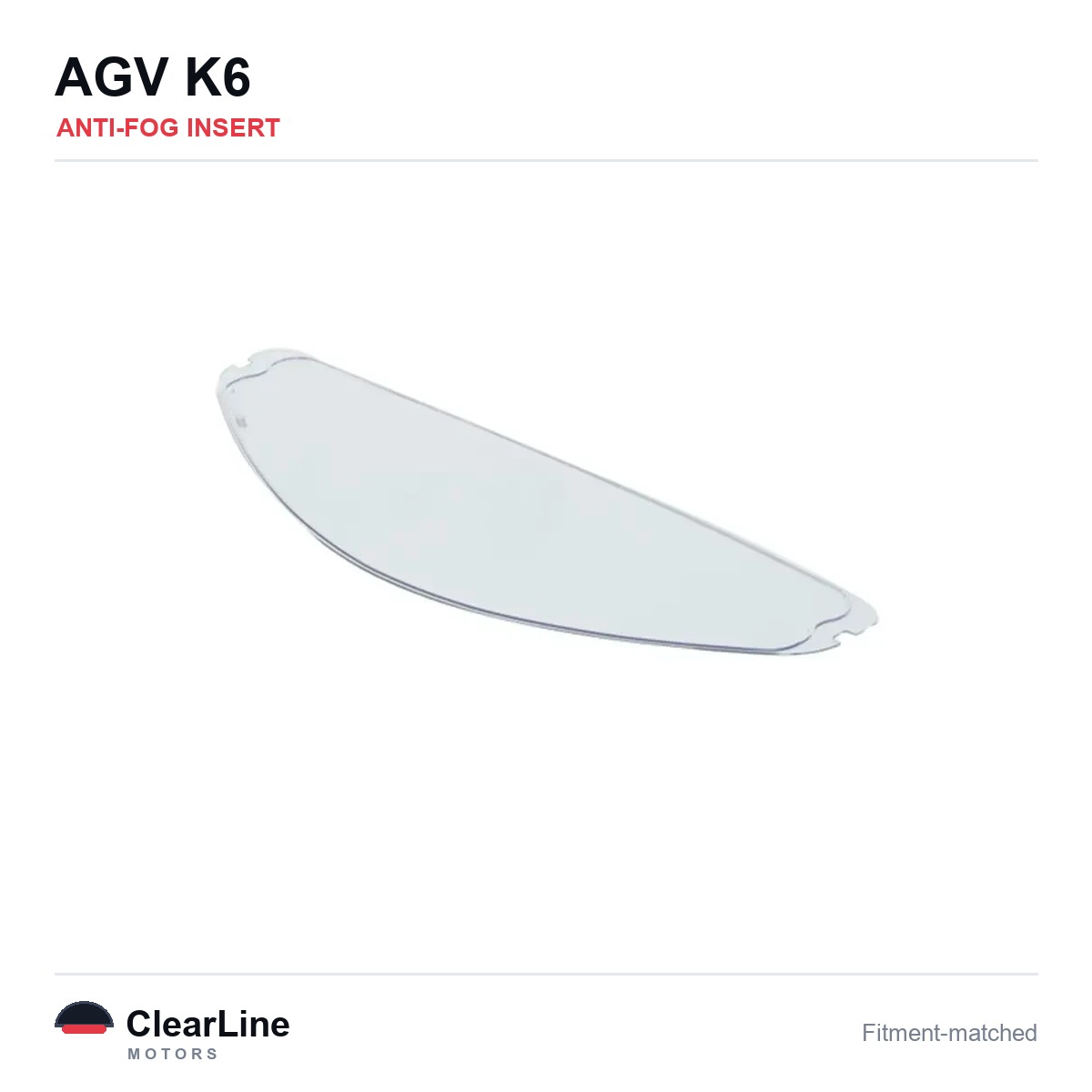
Practically, that means a coating changes what the droplets do and an insert stops them forming in the first place. Riders who are out in genuinely cold, wet conditions tend to end up with the insert. If you are choosing an insert, the fitment is set by your visor’s pin positions, so start from the model: a visor and insert range for the AGV K6 and the Shoei GT-Air II fitment range are two examples of how the catalogue is organised.
If you are not certain which visor your helmet takes, the ClearLine visor finder narrows it down by make and model. From there, the Pinlock-compatible anti-fog inserts hub lists the inserts that fit each Pinlock-ready visor. Shipping is free on every order, and the delivery estimate is shown at checkout.
Visors and inserts mentioned in this guide
- AGV K6 Anti-Fog Insert — Stops Visor Fogging
- anti-fog insert that fits the Shoei GT-Air II, GT-Air and Neotec
- See the full AGV K6 visor range
- Shoei GT-Air II visors and inserts
Frequently asked questions
Does a motorcycle helmet breath guard stop fogging completely?
No. It reduces how much exhaled moisture reaches the visor, which delays fogging and often prevents it at road speed. At a standstill, or in cold and wet air, moisture still reaches the visor and condenses. Pairing the guard with an anti-fog insert is what covers the stationary case.
Is a breath guard the same as a chin curtain?
No. A breath guard sits over your nose and redirects exhaled air downwards. A chin curtain closes off the bottom opening of the helmet to cut cold air and noise. They are separate parts, and a chin curtain can make misting worse by holding humid air inside the helmet.
Can I fit a breath guard to any helmet?
Not universally. Breath guards locate into helmet-specific channels or studs, so a guard shaped for one shell will often not seat properly in another. Check what your helmet manufacturer supplies for your model before buying a generic part, and check the helmet manual before removing any chin bar trim.
Does fitting a breath guard affect whether my visor is legal?
No. A breath guard is an airflow part and carries no legal requirement of its own. For the visor, the test in Great Britain is the marking it carries under the Motor Cycles (Eye Protectors) Regulations 1999, so check the marking on the visor itself.
Why does my visor fog more in winter even with a guard fitted?
The temperature gap between your breath and the visor is much larger in cold weather, so condensation begins sooner and forms faster. Cold riding also tends to mean slower speeds and closed vents, which removes the airflow a breath guard depends on. This is the point at which most riders add an insert.