
A drop-down sun shield that refuses to move is one of the most common faults riders report on modular and touring lids. An HJC sun visor stuck halfway across your sight line is irritating on a bright morning and genuinely dangerous at dusk. The mechanism behind it is simple, largely serviceable, and far less often broken than people assume.
The short answer: a drop-down sun shield that sticks is almost always caused by debris in the slider track, a lever arm that has slipped off its cam, or residue left behind by the wrong cleaning product. Work the slider slowly through its full travel, clean the track with warm water and a soft cloth, then check that the lever is seated in its slot. If the shield is cracked, delaminated or jammed in the down position, treat it as a fault to fix before your next ride rather than a tint you have chosen.
How the drop-down sun shield actually works
The internal sun shield is a thin, tinted plastic screen that lives between the outer visor and the EPS liner. A slider or lever on the left of the shell drives a short arm, and that arm rotates the shield down into your sight line or back up into the shell. HJC gives its sun shields their own part numbers, separate from the main visor, and the shield-type chart on the maker’s own site lists codes such as HJ-V10 alongside the outer shield codes.
Two things follow from that design. The shield travels in a narrow channel with very little clearance, so a grain of road grit is enough to stop it. And because the arm is a plastic cam rather than a geared drive, it can skip out of position without anything actually snapping.
That is why a stuck shield is usually a cleaning job rather than a parts job. It is also why forcing the slider is the one thing that turns a cheap fix into an expensive one. If you are not sure which parts of your lid come apart, the walkthrough in our guide to removing the visor on an HJC i90 covers the surrounding hardware without touching the sun shield at all.
Why an HJC sun visor sticks: the five real causes
Across forum reports and workshop practice the same handful of causes turn up again and again. None of them requires a new helmet, and only one of them requires a new part.
Grit and road film in the track. Dust, salt and insect residue collect at the two ends of the shield’s travel, where it parks. The shield then binds precisely at the point you use most.
A slipped actuator arm. The lever arm sits in a slot on the edge of the shield. A sharp knock, or refitting the outer visor carelessly, can lift it clear so the slider moves and the shield does not.
Cleaning residue. Silicone polishes, solvent wipes and visor cleaners containing ammonia leave a tacky film in the channel. The shield feels sticky rather than gritty, and the drag gets worse as the film builds.
Liner and cheek-pad pressure. A freshly washed comfort liner that has been refitted slightly proud of its clips can press on the shield’s housing. The symptom is a shield that moves freely with the liner out and binds with it in.
Heat distortion. A helmet left on a hot parcel shelf or in a sealed top box can warp a thin shield enough to bind. This is the one cause that normally ends in a replacement.
Match the symptom to the likely cause
Work from what the slider is doing, not from what you fear is broken. The table below is the quickest route from symptom to the right first action.
| What you notice | Most likely cause | First thing to try |
|---|---|---|
| Slider moves, shield stays put | Actuator arm out of its slot | Remove the outer visor and reseat the arm |
| Shield stops at the same point every time | Grit at a park position | Flush the track with warm water, dry, re-test |
| Shield moves but feels tacky and slow | Polish or solvent residue | Wash the channel with mild soap, no solvents |
| Free with the liner out, binds with it in | Liner refitted proud of its clips | Unclip and reseat the liner, then re-test |
| Shield is bowed, hazy or cracked | Heat distortion or age | Stop using it and plan a replacement |
| Slider itself is loose or floppy | Broken slider or cam | A parts repair, not a cleaning job |
How to free an HJC sun visor stuck part-way
Do this with the helmet on a table in good light, not balanced on your knee at a fuel stop. Give yourself twenty minutes and take the outer visor off first so you can see the channel.
- Remove the outer visor. On most HJC models the base plate has a release catch that frees the main visor without tools. Set it aside somewhere it cannot be scratched.
- Look before you touch. With the shield half-way, look along the channel at both ends of its travel. Grit shows up as a dark line against the plastic.
- Flush, do not scrape. Run warm water through the channel and lift debris with a soft brush or a cotton bud. Metal picks and compressed air both do more harm than the grit did.
- Dry it fully. Blot with a microfibre cloth and leave the helmet open until the channel is dry. Water trapped behind the shield leaves marks you cannot reach later.
- Cycle the slider slowly. Move it through the full stroke five or six times. Resistance that fades as you work it is residue clearing; resistance that stays put is mechanical.
- Check the actuator arm. Watch the arm as you move the slider. If it moves and the shield does not, the arm has come out of its slot and needs easing back in by hand.
- Refit and test. Put the outer visor back on, confirm it seats and seals, then test the shield again with the liner in place.
If the shield is still binding after a proper clean and a reseated arm, stop. Repeated force is what breaks the cam, and a broken cam is the one failure on this assembly that cannot be nursed along.
Cleaning the track without wrecking the shield
The sun shield carries a thin anti-scratch coating and, on some models, a tint layer that sits below the surface. Both are softer than the outer visor, and both are destroyed by the products riders reach for most readily.
Use warm water and a drop of mild dish soap, applied with a microfibre cloth. Nothing else is needed, and almost everything else causes harm. Our note on chemicals that damage a motorcycle visor lists the specific agents to keep away from polycarbonate.
Avoid alcohol wipes, ammonia-based glass cleaner, petrol-station screen wash, silicone polish and any abrasive cloth. Avoid dry-wiping a dusty shield, which drags grit across the coating in a single pass. Avoid the dishwasher entirely, which is less far-fetched a suggestion than it sounds.
For the seal and base-plate area around the outer visor, the method in our guide to cleaning a motorcycle visor seal applies unchanged. A clean seal is also what stops the outer visor from loading the sun shield housing when you close it.
When the shield is stuck down: visibility and the law
A sun shield that will not retract leaves you riding behind a darkened screen into tunnels, under trees and after sunset. Rule 83 of the Highway Code sets the baseline: “Before each journey check that your helmet visor is clean and in good condition.” Rule 84 adds that “Scratched or poorly fitting eye protectors can limit your view when riding, particularly in bright sunshine and the hours of darkness.”
The legal position in Great Britain rests on the marking, not on the colour of the plastic. The Motor Cycles (Eye Protectors) Regulations 1999 prescribe grades drawn from BS 4110 and require that an eye protector be “marked with an approved certification mark of an approved body”. A tint name on a box tells you nothing about whether a particular item meets that test.
Darker screens transmit too little light to be legal for road use, which is the whole reason the drop-down shield is built to retract. ClearLine does not verify the markings on individual items, so we make no road-legal claim about anything in our range. You can read the detail in our explainer on tinted motorcycle visors and the law in Great Britain, and the Highway Code rules for motorcyclists are worth a read in full.
The practical conclusion is simple. A jammed-down shield is a fault, and riding on it at night is a choice you did not mean to make.
What can be replaced, and what cannot
The drop-down shield itself is a serviceable part on most HJC models, sold under its own code and fitted from inside the shell once the outer visor is off. The slider, the actuator arm and the housing are a different matter. On several models they are bonded into the shell assembly and are not offered as separate spares.
That is the dividing line worth knowing before you order anything. A scratched, hazy or heat-bowed shield is a straightforward swap. A snapped cam or a slider that has lost its detent usually means living without the sun shield, or changing how you handle bright light altogether.
ClearLine makes aftermarket outer visors and anti-fog inserts rather than internal sun shields, so for the shield itself your route is a dealer parts counter. What we can solve is the second half of that problem: what you ride in once the drop-down shield is out of action. Start from our full range of HJC helmet visors to see which models we cover.
The photochromic route when the sun shield is finished
A photochromic main visor does the job the drop-down shield was doing, without a moving part to jam. The coating darkens in response to ultraviolet light and clears again as the light drops, so there is no slider to forget on the way into a tunnel.
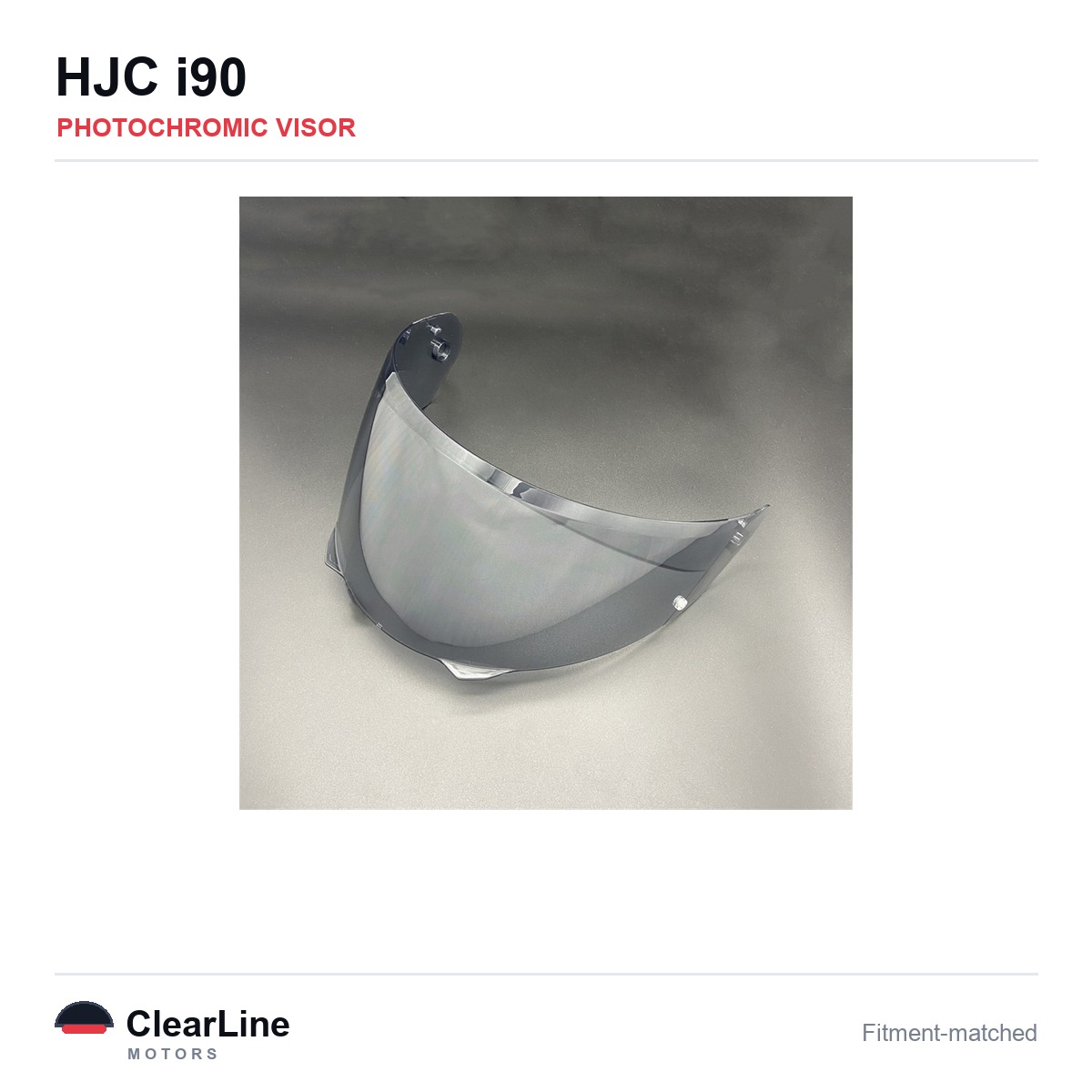
For an i90 rider that means the HJC i90 Photochromic Visor, which fits the same base plate as the standard outer visor and needs no modification to the shell. It is the most direct answer we stock to a sun shield that has given up.
Two caveats are worth stating plainly. Photochromic coatings respond to ultraviolet rather than to brightness, so they stay clearer behind a car windscreen than they do in open air, and they react more slowly in cold weather. Our guide to how photochromic visors work covers both behaviours, and the full photochromic visor range lists the models we cover.
If fogging is the other half of your problem, a Pinlock-compatible anti-fog insert for the i90 works alongside either visor. Not sure which model you have? The visor finder narrows it down from the helmet, not from a part number.
Visors and inserts mentioned in this guide
- HJC i90 Photochromic Visor
- See the i90 anti-fog insert
- Replacement visors for the HJC i90
- Visors for the HJC i70
- Which visors fit which HJC helmets
Frequently asked questions
Why is my HJC sun visor stuck halfway?
The usual cause is grit or dried road film collecting at one of the two points where the shield parks. The channel it runs in has very little clearance, so a small amount of debris is enough to stop it dead. Flushing the track with warm water and cycling the slider slowly clears most cases without any parts.
Can you replace an HJC drop-down sun shield?
On most models the shield itself is a serviceable part with its own code, fitted from inside the shell once the outer visor is removed. The slider and actuator arm are often bonded into the shell assembly and are not sold separately. Check the maker’s parts listing for your exact model before ordering anything.
Is it safe to ride with the sun shield jammed down?
No. A shield you cannot retract leaves a darkened screen in front of your eyes in tunnels, under tree cover and after sunset, which is the opposite of what the Highway Code expects of eye protection. Treat it as a fault to fix rather than a tint you have selected.
Will a photochromic visor replace a broken sun shield?
It does the same job without a mechanism to jam, darkening in ultraviolet light and clearing as the light drops. It fits the standard base plate, so no modification to the helmet is needed. Bear in mind that it reacts more slowly in cold conditions and stays clearer behind glass.
Does visor cleaner damage the sun shield?
Many of them do. Ammonia-based glass cleaners, alcohol wipes and silicone polishes attack the soft coating on an internal shield and leave a tacky residue in the channel. Warm water with a drop of mild soap and a microfibre cloth is all the assembly needs.
Why does the shield bind only when the liner is fitted?
A comfort liner refitted slightly proud of its clips can press against the sun shield housing. The giveaway is a shield that moves freely with the liner removed and drags with it in place. Unclip the liner, reseat it fully and test again before suspecting the mechanism.
Written by the ClearLine team. ClearLine sells compatible aftermarket visors and inserts and is not affiliated with HJC.