
Grit lorries start running as soon as the first frost is forecast, and from that night onward every wet road throws a fine brine mist straight at your face. Motorcycle visor winter salt damage is not dramatic — it is a slow, cumulative haze that you only notice when a low sun turns the whole screen milky. The damage is rarely done by the salt sitting on the visor. It is done by the cloth you drag across it.
The short answer: road salt itself does not chemically attack polycarbonate, but dried salt crystals are hard, angular and abrasive. Flood them off with plenty of lukewarm water first, never wipe a dry or gritty visor, and never use screen wash, de-icer or household cleaners on a coated screen. If the haze survives a proper wash, the coating is already scratched and the visor is on borrowed time.
What road salt actually does to a motorcycle visor
Rock salt spread on UK roads is sodium chloride, usually mixed with grit and sometimes pre-wetted with brine. Motorcycle visors are injection-moulded polycarbonate with a thin hard-coat and, on many screens, an anti-scratch or anti-fog layer on top. Sodium chloride does not dissolve or craze polycarbonate the way a solvent does.
The problem is mechanical. As spray dries, the water leaves and the dissolved salt recrystallises into hard, sharp-edged crystals that key into every surface texture on the screen. Those crystals sit between your cloth and the coating, and a single wipe drags them across it like a lapping compound.
That is why a visor can look fine at a fuel stop and terrible a week later. Nothing corroded it. It was polished with its own contamination, one wipe at a time, and the same logic runs through our wider motorcycle visor care guide.
What motorcycle visor winter salt damage looks like
Salt damage has a recognisable signature, and it is worth learning because it tells you whether a visor can be recovered or only replaced. The tell-tale is that it is directional and worst where you wipe.
| What you see | What caused it | What to do |
|---|---|---|
| White chalky film that washes off | Dried salt residue only | Flood with lukewarm water, dry with a clean microfibre |
| Milky haze that returns when dry | Fine scratch network in the hard-coat | Not recoverable; plan a replacement screen |
| Arc-shaped scuffs across your sight line | Gritty cloth dragged in a curve | Change your cleaning method immediately |
| Cloudy patches near the edges | Salt trapped under the seal or beading | Remove the visor and rinse the channel |
| Rainbow smearing in low sun | Degraded or partially stripped coating | Replace; polishing removes more coating |
If the haze disappears when the visor is wet and reappears as it dries, that is scratching, not residue. Water is temporarily filling the scratches and levelling the surface. There is no cleaner that reverses it, and the options are covered in our guide to removing scratches from a motorcycle visor.
The one mistake that turns salt into scratches
The single most damaging thing a rider does in winter is take a dry glove, a sleeve or a garage rag to a salt-dusted screen at a petrol station. It feels harmless because the visor looks merely dusty. Every one of those wipes is abrasive.
The second most damaging habit is reaching for whatever is on the shelf. Screen wash, de-icer, glass cleaner and kitchen sprays commonly contain alcohols, ammonia or solvents. Those attack the coating and can craze polycarbonate over repeated use, which is a permanent, cloudy failure with no remedy.
We have written up the full list of habits that shorten a screen’s life in common visor cleaning mistakes. Winter simply makes each one bite faster, because there is abrasive on the surface almost every ride.
How to clean winter salt off a visor, step by step
The whole method is built around one idea: lift the salt off in water before anything touches the surface. Work indoors or in a sheltered spot so the visor does not dry out mid-clean.
- Remove the visor from the helmet. Salt collects in the mechanism and along the seal, and you cannot reach either with the screen fitted.
- Rinse under a slow flow of lukewarm water. Not hot. Let the water carry the crystals away rather than pushing them around.
- Soak a folded microfibre or paper towel in warm water and lay it flat on the visor. Leave it for ten to fifteen minutes so stubborn deposits redissolve.
- Add a drop of plain non-scented washing-up liquid to warm water and float the residue off with an open hand, no pressure, no circular scrubbing.
- Rinse thoroughly. Any soap left behind will smear and attract more contamination on the next ride.
- Pat dry with a clean, dedicated microfibre — straight lines, light pressure, and never the cloth you used on the bike.
If you are away from a tap, a bottle of plain water and patience beats any wipe. For the cold-water and no-tap situations riders actually face in winter, see cleaning a visor without water.
Never use hot water or de-icer to shift frozen salt
When salt spray freezes onto a screen, the instinct is heat. Hot water on cold polycarbonate causes uneven expansion and can distort a thin screen or lift a coating at the edges. It also does nothing the soak method does not do more safely.
De-icer is worse. It is formulated for laminated car glass, not coated plastic, and the alcohols in it strip anti-fog and hydrophobic layers quickly. The same applies to the scraper in the garage. Our guidance for frozen screens is set out in dealing with ice on a motorcycle visor.
Bring the helmet indoors and let the ice release on its own, then treat what is underneath as ordinary salt residue. Time is the only tool that costs nothing and damages nothing.
Cleaning the seal, channel and mechanism
Salt concentrates where water pools, and on a helmet that means the rubber beading, the visor channel and the ratchet. Left there it dries into a gritty paste that grinds the mechanism and holds moisture against the shell.
Wipe the beading with a damp cloth and run a cotton bud along the channel. Do not lubricate the mechanism with oil or silicone spray unless the manufacturer specifies it, because most attract grit and make the problem worse. The detail work is covered in motorcycle visor seal cleaning.
A clean seal also matters for fogging. Salt residue on the rubber breaks the seal’s contact with the aperture, and cold air leaking past it puts moisture exactly where you do not want it, which is why helmet vents in winter riding deserve attention at the same time.
Salt and anti-fog inserts
An anti-fog insert makes winter riding tolerable and complicates cleaning. The insert sits on the inside of the screen, so it never meets road salt directly, but it is far softer than the visor’s hard-coat and marks with almost no pressure.
Remove the insert before washing the outside of the visor. Clean it separately in plain lukewarm water with no detergent and no rubbing, then let it air-dry rather than patting it. Detergent residue on an insert ruins its ability to hold a water film, which is the entire mechanism it works by.
If yours is scuffed or the seal has gone hard, the range of Pinlock-compatible anti-fog inserts covers most current screens, and the step-by-step routine is in how to clean a Pinlock-compatible insert.
When a salt-damaged visor should be replaced
There is a point where cleaning stops being the answer, and in winter it arrives sooner than riders expect. The test is not how the visor looks in the garage. It is how it behaves against a low winter sun or oncoming headlights, when a fine scratch network turns every light source into a starburst.
The Highway Code is direct about the standing expectation. Highway Code rules 83 to 88 for motorcyclists state: “Before each journey check that your helmet visor is clean and in good condition.” Rule 84 adds that “Scratched or poorly fitting eye protectors can limit your view when riding, particularly in bright sunshine and the hours of darkness” — which is precisely the winter commute.
Legality is a separate question from condition, and it rests on the marking, not on how a screen looks or what a tint is called. The Motor Cycles (Eye Protectors) Regulations 1999 require an eye protector to be “marked with an approved certification mark of an approved body”, and they prescribe “Grade X in British Standard BS 4110:1979” and its later graded amendments. BS 4110 is the visor standard; BS 6658 is a helmet standard and is not the same test.
We do not verify the markings on individual items, so we make no claim about the road-legal status of anything we sell. When a screen has reached the end of its winter, the clear replacement visors range is the direct swap, and the ClearLine visor finder narrows it to your helmet.
A winter routine that prevents most of it
Prevention is almost entirely about not letting salt dry on the screen. A rinse after a salted ride takes a minute and removes the abrasive before it ever meets a cloth.
Keep a dedicated visor microfibre somewhere it cannot pick up grit — a sealed bag in the top box works well. Carry a small bottle of plain water for fuel stops rather than relying on the forecourt squeegee, which lives in a bucket of road grime.
Finally, accept that a winter screen is consumable. Riders who keep a spare clear visor for the salted months and refit the good one in spring spend less over a season than riders who polish one screen into haze. Browsing the MT Stinger 2 visor range or your own model’s category is the quickest way to see what a spare costs.
Visors and inserts mentioned in this guide
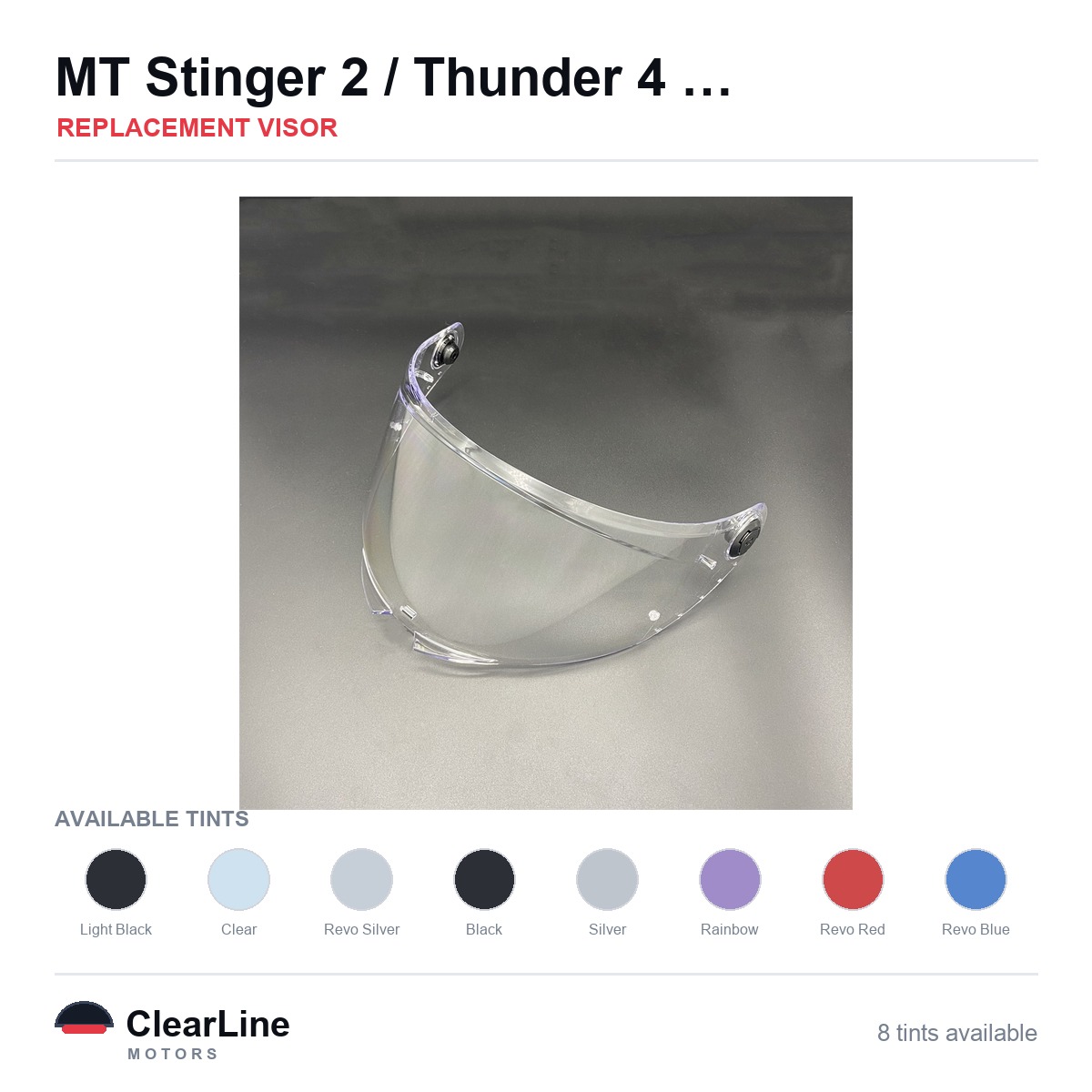
- MT Stinger 2 / Thunder 4 SV Replacement Visor — Smoke, Clear Tints
- See the MT Stinger 2 visor range
- Clear replacement visors for winter riding
- Pinlock-compatible anti-fog inserts
- Iridium and mirrored visors
Frequently asked questions
Does road salt permanently damage a motorcycle visor?
Salt on its own does not attack polycarbonate chemically, so residue alone is recoverable with a proper wash. The permanent damage comes from wiping dried salt crystals across the coating, which leaves a fine scratch network. Once that haze returns as the visor dries, it cannot be cleaned out.
Can I use hot water to melt salt and ice off my visor?
No. Hot water on a cold screen creates uneven expansion that can distort thin polycarbonate or lift a coating at the edges. Lukewarm water and a longer soak achieve the same result without the risk.
Is car screen wash or de-icer safe on a motorcycle visor?
Neither is safe. Both commonly contain alcohols or ammonia that strip anti-fog and hydrophobic coatings and can craze polycarbonate over repeated use. Plain lukewarm water with a drop of non-scented washing-up liquid is the correct choice.
Are iridium visors a sensible choice for winter riding in the UK?
No. Iridium and mirrored visors are never road legal in Great Britain, day or night, so they are a track and sunny-day item rather than a winter one. They also transmit too little light to be legal for road use on dark, wet commutes when visibility matters most. If you own one, the care routine is in our guide to cleaning an iridium visor.
How often should I clean winter salt off my visor?
After every ride on a salted road, ideally before the spray dries. A thirty-second rinse with plain water removes the abrasive while it is still soluble, which is far more effective than a thorough clean once a week.
Should I keep a separate visor just for winter?
It is the cheapest approach for most riders. A clear screen used through the salted months takes the wear, and the visor you care about goes back on in spring with its coating intact.
Written by the ClearLine team — see about ClearLine.