
If you have searched for a Pinlock alternative, you are usually asking one of two quite different questions. Either your helmet will not take the insert everyone recommends, or you have one fitted and the visor still mists over. Those two problems have different answers, and most of the advice online mixes them together.
This guide separates them. It covers what actually replaces an insert, what only looks like it does, and how to work out which group your helmet falls into before you spend anything.
The short answer:
- The closest like-for-like swap is an aftermarket anti-fog insert that fits the same pins your visor already has.
- If your visor has no pins, an insert of any brand is not an option until the visor is replaced with a ready-drilled one.
- Coatings and sprays are a genuine alternative, but they are consumable and need reapplying.
- Airflow changes cost nothing and fix a surprising share of misting complaints.
- A fogging insert is usually a sealing or fitting fault, not a worn-out one.
What a Pinlock alternative actually means
Pinlock is a third-party registered trademark and a widely used design of double-glazed visor insert. ClearLine is not affiliated with it. The inserts we sell are aftermarket parts made to fit Pinlock-ready visors, which is the distinction that matters when you go shopping.
So “alternative” splits into two searches. One is a different supplier of the same style of insert, which is a straight swap. The other is a different method of keeping a visor clear, which is not a swap at all and behaves differently on the road.
Riders arrive at the question from opposite directions. Some have an older or budget helmet that was never drilled for an insert. Others have a premium lid, a correctly fitted insert, and a visor that still greys over at every set of traffic lights. Sorting out which description fits you saves buying the wrong thing twice.
Why your visor may not take an insert at all
An insert is not glued on. It is held in tension between two small pins set into the inside face of the visor, and it seals against the visor with a silicone bead around its edge. No pins means nothing to tension against.
Manufacturers call a drilled visor “Pinlock-ready” or “Pinlock-prepared”. You can check yours in a few seconds: take the visor off the helmet, turn it so you are looking at the inside curve, and look for two small studs roughly level with your eyes, one near each end. Our guide to fitting an anti-fog insert correctly walks through the tensioning step, which is where most first attempts go wrong.
If the studs are absent, you have two honest routes. Replace the visor with a ready-drilled one for the same helmet, or drop the insert idea and use one of the non-insert methods below. Drilling a visor yourself is not a route we recommend: it removes material from a safety component and voids any marking it carries.
Aftermarket anti-fog inserts
This is the like-for-like answer. An aftermarket insert uses the same two-pin mounting and the same double-glazing principle, so it sits in the visor the same way and works on the same physics. The trapped air gap keeps the inner surface above the temperature at which your breath condenses.
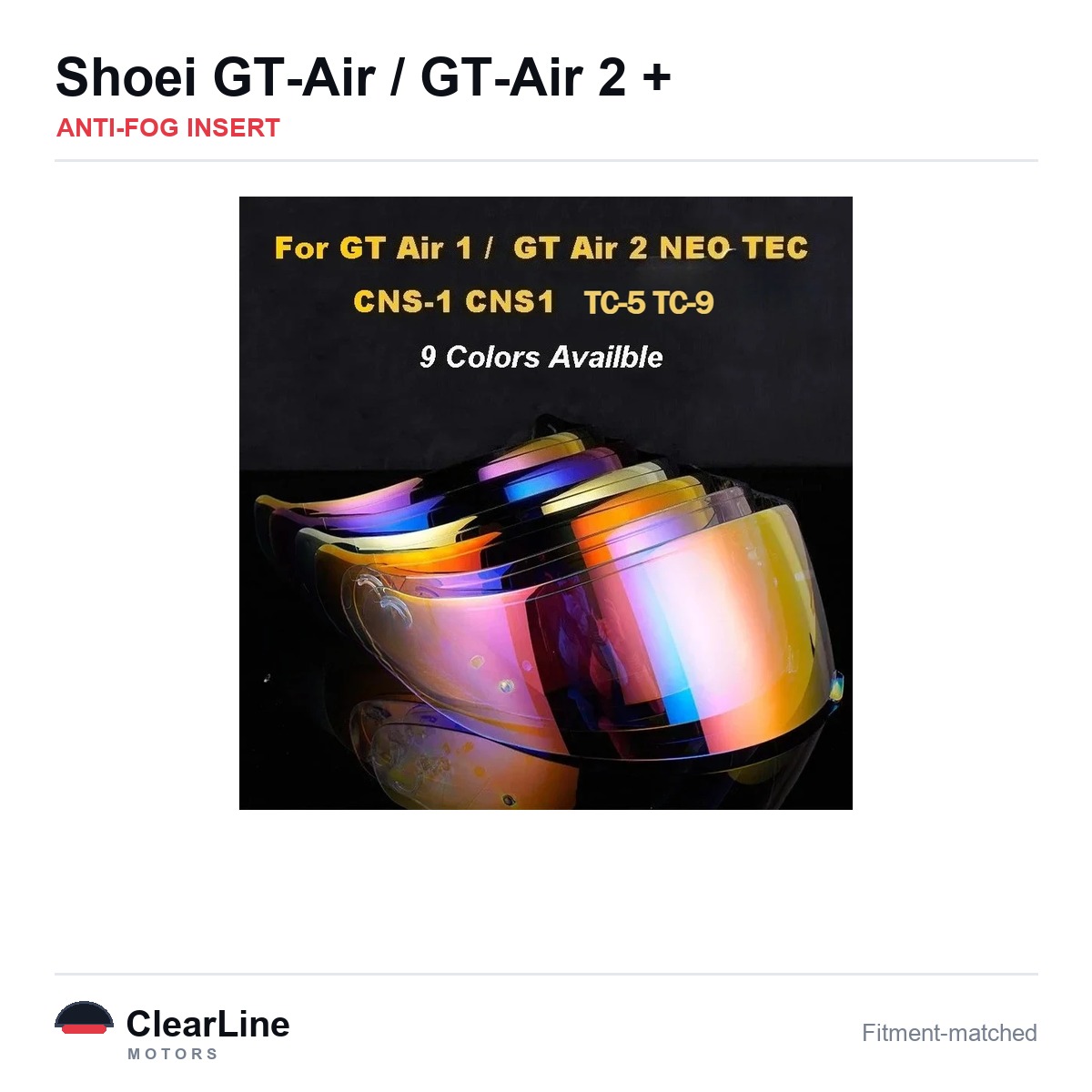
Fitment is by visor, not by helmet brand, which is the part that catches people out. The insert above covers the Shoei GT-Air II, GT-Air and Neotec visors because those share a shell profile, and the rest of the range is grouped the same way across visors and inserts that fit Shoei helmets and every other marque we carry.
Sizing is worth a moment too. Inserts come in different coverage areas, and a larger one clears more of your field of view while sitting closer to the visor edge. Our comparison of insert sizes 70 and 120 explains which shape suits which riding position. You can browse the full range of Pinlock-compatible anti-fog inserts by helmet model.
Anti-fog coatings and sprays
A coating works on a different principle. Instead of holding a warm air gap in front of the cold surface, it changes how condensation behaves when it lands, persuading the moisture to spread into a thin continuous film rather than forming the tiny droplets that scatter light and grey out your view.
That makes a coating a real alternative rather than a poor relation, with one honest caveat: it is consumable. Every wipe, every rain shower and every cleaning session takes some of it away, so it needs reapplying on a schedule that a fitted insert does not.
Coatings also have the run of any visor. No pins are needed, so this is the route that opens up for a helmet that was never drilled. We compare the two approaches directly in anti-fog insert versus coating, and if you have already tried a spray without success, why anti-fog spray stops working covers the usual causes.
Airflow fixes that cost nothing
Before buying anything, work through the changes that are free and reversible. A large share of misting complaints come down to warm, damp air from your own breathing being routed straight up the inside of the visor.
Cracking the visor to its first detent is the fastest test. If the fog clears within a few seconds of opening it, you have an airflow problem rather than a surface problem, and that changes what is worth buying. Opening the chin vent and closing the neck of your jacket do the same job more subtly.
A breath deflector or a chin curtain redirects exhaled air down and away instead of up. Neither is something we stock, so treat this as a pointer rather than a recommendation, but both are cheap and both attack the cause rather than the symptom. The wider set of remedies lives in our pillar guide on how to stop a helmet visor fogging.
Pinlock alternative options compared
| Option | How it works | Fits any visor? | Main limitation |
|---|---|---|---|
| Aftermarket anti-fog insert | Sealed air gap in front of the cold surface | No, needs visor pins | Model-specific, and adds an inner surface to keep clean |
| Anti-fog coating or spray | Spreads condensation into a thin film | Yes | Consumable, needs reapplying |
| Breath deflector or chin curtain | Redirects exhaled air away from the visor | Yes | Depends on helmet shape and how well it seals |
| Cracking the visor or opening vents | Replaces humid air with outside air | Yes | Noisy, cold, and limited in heavy rain |
| Replacing a hazed visor | Restores a clean optical surface | Yes | Does not prevent fogging on its own |
No row in that table is a clear winner on its own. Most riders who solve the problem permanently end up combining an airflow change with one surface treatment.
When the insert itself is the problem
If you already have an insert and it still mists, replacing it with a different brand rarely helps, because the fault is usually in the seal rather than the part. Three things account for most cases.
The first is tension. An insert that has not been stretched properly across both pins leaves a gap at the silicone bead, and humid air walks straight into the space the insert was meant to protect. The second is a smeared inner face, often from cleaning it with the wrong thing.
The third is simply that the insert is sitting behind a visor that has hazed with age, so the view looks foggy even when nothing has condensed. A fresh clear replacement visor settles that question quickly. Our guide to an insert that fogs up anyway works through the diagnosis in order.
Where the law sits on visors and inserts
None of this changes the legal test, and the legal test is not about the insert. In Great Britain the Motor Cycles (Eye Protectors) Regulations 1999 work through what the eye protector is marked with, requiring it to be marked with an approved certification mark of an approved body and prescribing grades in British Standard BS 4110.
BS 4110 is the visor standard, and it is a different document from the helmet standard. Because the test is the marking carried by the individual item, we do not describe anything we sell as approved or certified: we have not inspected the marking on your specific part, and neither has anyone else selling online.
Clarity is separately a Highway Code expectation. Rule 83 asks riders to check “Before each journey check that your helmet visor is clean and in good condition“, and rule 84 warns that “Scratched or poorly fitting eye protectors can limit your view when riding, particularly in bright sunshine and the hours of darkness”. A misting visor is the same failure by a different route.
Choosing between them
Start with the pins, because that single check removes half the options or none of them. A ready-drilled visor makes an aftermarket insert the simplest and most durable answer, and the one you can fit once and forget.
Without pins, a coating plus an airflow change is the honest combination, and it is worth trying the free half first. If you are not certain which visor your helmet takes, the visor finder narrows it down by model before you commit to anything. Written by the ClearLine team, who you can read about on our about page.
Visors and inserts mentioned in this guide
- Shoei GT-Air II / GT-Air / Neotec Anti-Fog Insert — Stops Visor Fogging
- Pinlock-Compatible Anti-Fog Visor Inserts
- visors and inserts that fit Shoei helmets
- Clear replacement visors
Frequently asked questions
Can I fit an anti-fog insert to a visor that is not Pinlock-ready?
No. The insert is held in tension between two pins moulded into the visor, so a visor without them has nothing to grip. The practical routes are a ready-drilled replacement visor for the same helmet, or a coating that needs no fixings at all.
Does fitting an anti-fog insert change the legal position of a visor?
The legal test in Great Britain turns on the certification marking carried by the eye protector itself, under the Motor Cycles (Eye Protectors) Regulations 1999. We do not verify markings on individual items, so we make no approval claim either way. What an insert plainly does affect is how much you can see, which rule 84 of the Highway Code treats as a safety matter in its own right.
Do anti-fog coatings work as well as an insert?
They work on a different principle rather than a weaker one, spreading condensation into a film instead of holding an air gap. The practical difference is durability: a coating is consumable and needs reapplying, while a correctly tensioned insert keeps working until it is damaged or removed.
Why does my visor still fog with an insert fitted?
Most often the insert is under-tensioned, so its silicone bead is not sealing against the visor. A smeared inner face and an aged, hazed outer visor account for the majority of the rest. Replacing the insert with another brand fixes none of those three.